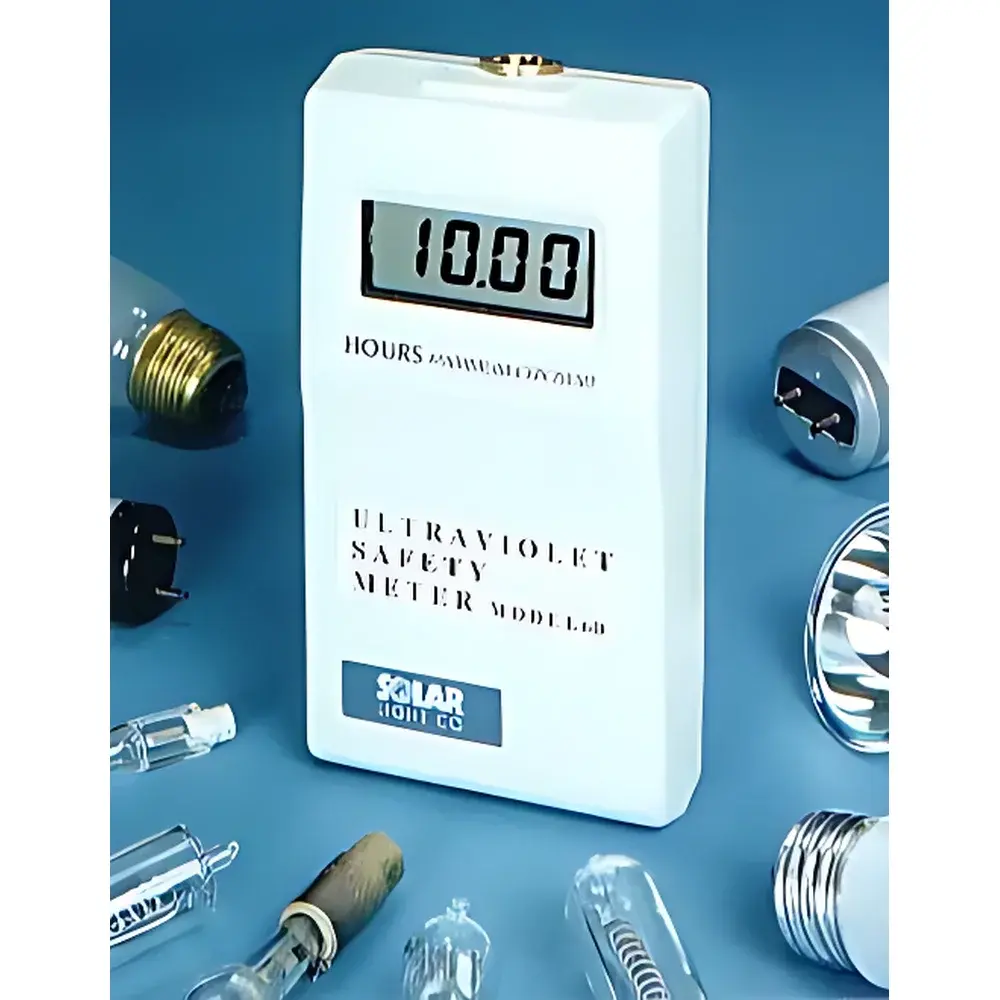
Solar Light 6D UV Radiation Safety Meter
| Brand | Solar Light |
|---|---|
| Origin | USA |
| Manufacturer Type | Authorized Distributor |
| Origin Category | Imported |
| Model | 6D |
| Price | Upon Request |
| Spectral Response | 250–400 nm (ACGIH SWF-weighted) |
| Field of View | 60° |
| Display Range | 0.03–10.00 hours |
| Operating Temperature | 0–40°C |
| Power Supply | 9V alkaline battery (200-hour typical life) |
| Dimensions | 15 × 8 × 3.8 cm |
| Weight | 200 g |
Overview
The Solar Light 6D UV Radiation Safety Meter is a handheld, field-deployable radiometric instrument engineered for real-time assessment of occupational ultraviolet (UV) radiation exposure risk to the human eye and skin. It operates on the principle of spectrally weighted irradiance measurement—specifically applying the ACGIH® (American Conference of Governmental Industrial Hygienists) Threshold Limit Value (TLV®) spectral weighting function for actinic UV (SWF), which integrates biologically effective radiant exposure across 250–400 nm. Unlike broadband UV meters that report unweighted irradiance, the 6D computes cumulative dose against the ACGIH-recommended limit of 3.0 mJ/cm² for 270 nm–weighted exposure over an 8-hour workday. Its photodetector—mounted at the top of the unit—is cosine-corrected and calibrated to replicate human ocular and epidermal spectral sensitivity, enabling direct readout of remaining safe exposure time in hours, updated continuously during measurement.
Key Features
- ACGIH SWF-compliant spectral response (250–400 nm) with NIST-traceable calibration certificate supplied
- Real-time LCD display showing instantaneous safe exposure time remaining (0.03–10.00 h), dynamically calculated from measured weighted irradiance
- 60° full-angle cosine-corrected optical input for accurate angular response under non-normal incidence conditions
- Robust, ergonomic handheld housing (15 × 8 × 3.8 cm; 200 g) with integrated detector head—no external probes or cables required
- Low-power design powered by a single 9V alkaline battery delivering >200 hours of continuous operation
- Operating temperature range of 0–40°C ensures reliability in laboratory, manufacturing floor, and field environments
- Simple two-position slide switch (ON/OFF) with immediate stabilization—no warm-up delay
Sample Compatibility & Compliance
The 6D is compatible with all common artificial UV sources encountered in industrial and clinical settings, including low- and medium-pressure mercury vapor lamps, UV-LED arrays (265–395 nm), excimer lamps, welding arcs, and germicidal UVC (254 nm) fixtures. It does not require sample preparation or spectral deconvolution—measurements are performed directly in situ. The instrument complies with ACGIH TLV® guidelines for occupational UV exposure and supports adherence to OSHA 1910.97 (non-ionizing radiation), ISO 15858:2016 (UV safety in workplaces), and IEC 62471 (Photobiological safety of lamps). While not a medical device, its dosimetric output is routinely referenced in GLP-compliant hazard assessments and workplace safety audits per ANSI Z136.1 and EU Directive 2006/25/EC.
Software & Data Management
The 6D is a standalone analog-digital hybrid instrument with no embedded memory, Bluetooth, or USB interface. All measurements are displayed in real time on the integrated LCD; no data logging or PC connectivity is provided. This design prioritizes operational simplicity, intrinsic safety in explosive or EMI-sensitive environments (e.g., semiconductor cleanrooms), and long-term calibration stability without firmware dependencies. For laboratories requiring traceable records, users may manually log timestamped readings alongside source identification and environmental notes. The absence of digital storage aligns with FDA 21 CFR Part 11 requirements for instruments used in non-GxP contexts where audit trails are not mandated—eliminating validation overhead while maintaining metrological integrity.
Applications
- UV curing line safety validation in printing, coating, and adhesive manufacturing
- Hazard mapping around UV disinfection systems in hospitals, pharmaceutical water loops, and biosafety cabinets
- Exposure assessment during arc welding, plasma etching, and photolithography processes
- Verification of UV lamp aging and output drift in clinical phototherapy and sterilization workflows
- Compliance checks for commercial UV lighting installations (e.g., retail display cases, insect traps)
- Field evaluation of solar UV reflectance from building materials and coatings
FAQ
Does the 6D measure UVA, UVB, and UVC separately?
No. It reports a single, biologically weighted UV dose rate and remaining safe exposure time based on the ACGIH SWF curve—integrating contributions across 250–400 nm. It does not provide spectral decomposition.
Can it be recalibrated in-house?
No. Calibration must be performed by Solar Light Co. or an A2LA-accredited laboratory using NIST-traceable UV reference standards. Annual recalibration is recommended for compliance-critical use.
Is the detector sensitive to visible light or IR?
No. Optical filtering ensures rejection of wavelengths outside 250–400 nm, minimizing interference from ambient lighting or thermal radiation.
What does “0.03 hour” minimum display resolution mean in practice?
It corresponds to ~1.8 minutes—sufficient to assess short-duration exposures near high-intensity sources such as pulsed UV lamps or handheld germicidal wands.
How is cosine correction verified?
Each unit undergoes angular responsivity testing at ±45° and ±60° incidence angles per ISO 15858 Annex B, with deviation <±5% from ideal cosine response across the specified 60° FOV.