
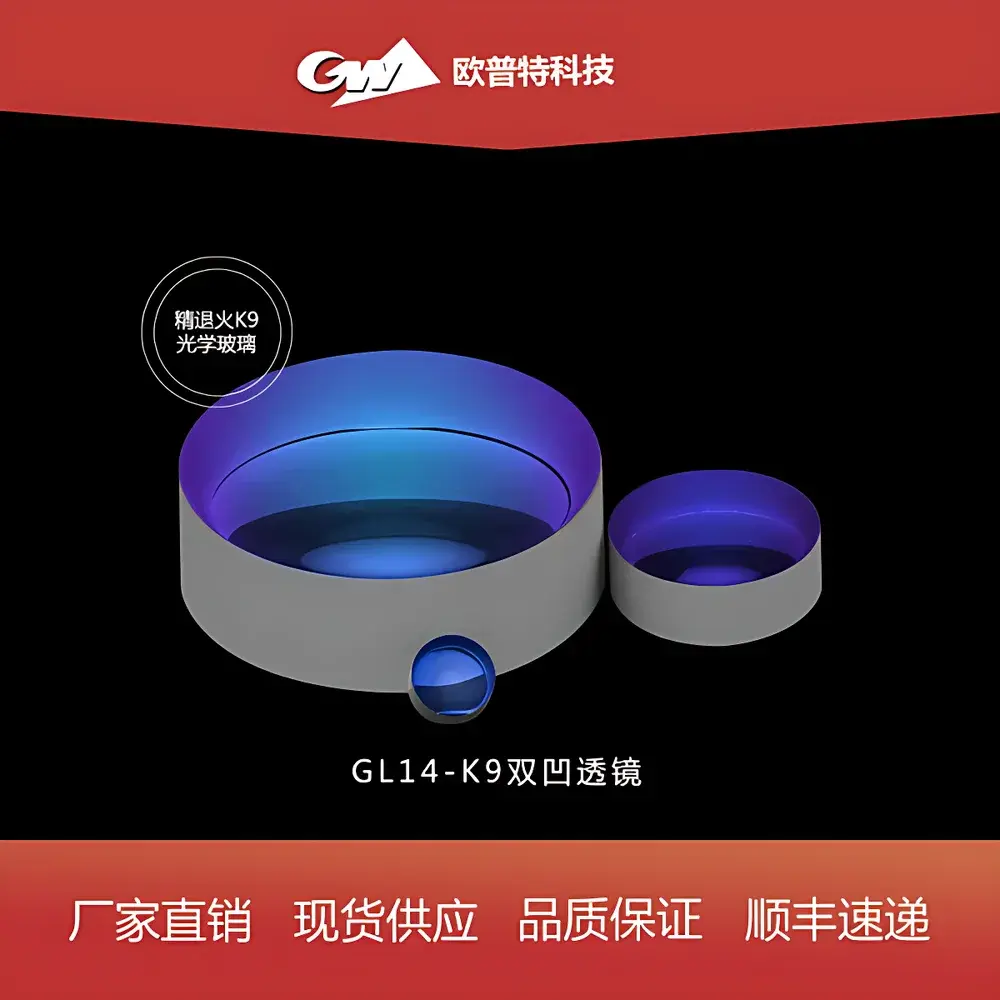
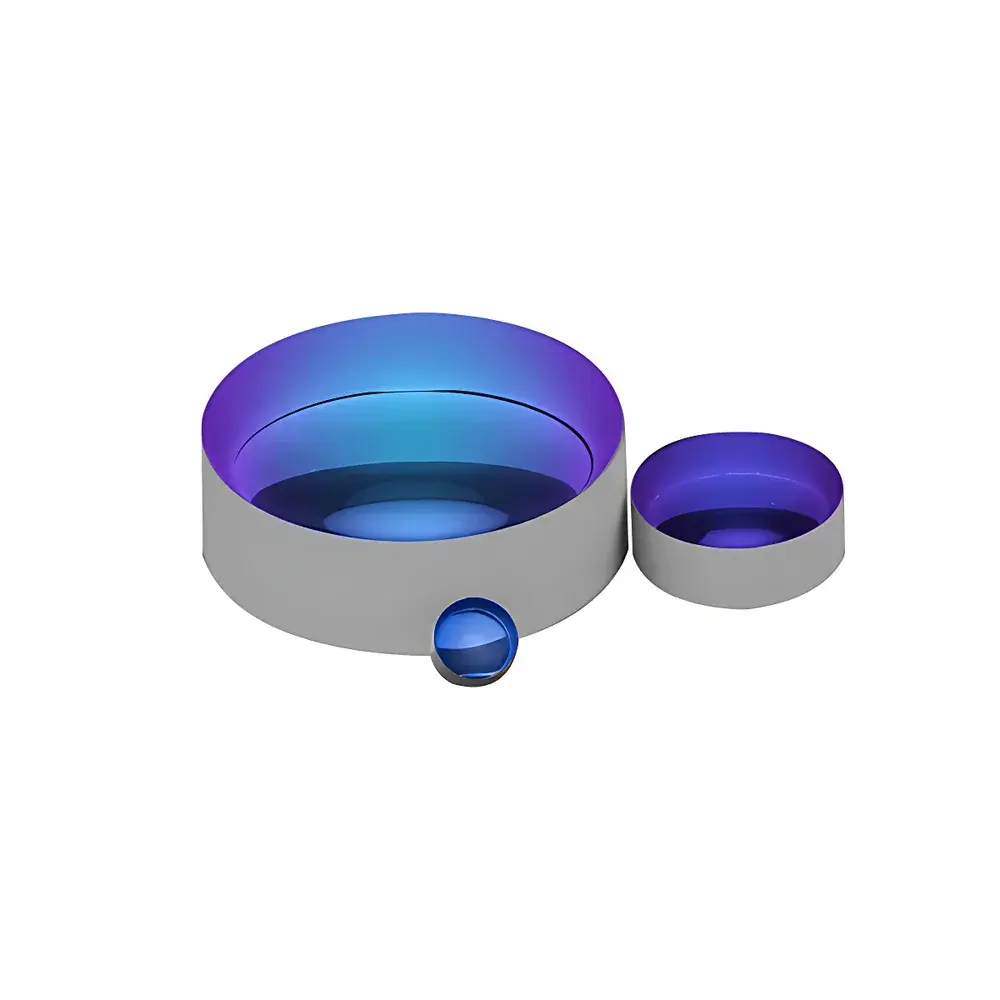
GL14-NIR Dual-Concave Lens with Broadband Anti-Reflective Coating for Near-Infrared (650–1050 nm)
| Origin | Beijing, China |
|---|---|
| Manufacturer Type | Authorized Distributor |
| Regional Origin | Domestic (PRC) |
| Model | GL14-NIR |
| Price Range | USD 0.15–75.00 (per unit, volume-dependent) |
| Component Category | Optical Element |
| Coating Specification | Broadband AR, Rₐᵥg < 0.5% @ 650–1050 nm |
Overview
The GL14-NIR Dual-Concave Lens is a precision optical component engineered for demanding near-infrared (NIR) applications requiring minimal surface reflection and high wavefront fidelity. Fabricated from high-homogeneity N-BK7 optical glass (Schott grade or equivalent), this lens features symmetric dual-concave geometry—both surfaces share identical radius of curvature—optimized to introduce controlled negative optical power while maintaining low spherical aberration in collimated beam paths. Its broadband anti-reflective (BBAR) coating is specifically designed for the 650–1050 nm spectral range, achieving average reflectance 99% per surface) in NIR spectroscopy, free-space optical interconnects, laser beam expansion, and interferometric alignment systems where stray light suppression and signal-to-noise ratio are critical.
Key Features
- Symmetric dual-concave design with matched radii (R₁ = R₂) ensures balanced optical power distribution and simplifies mechanical mounting alignment.
- Broadband anti-reflective coating deposited via ion-assisted e-beam evaporation, meeting MIL-C-48497A and ISO 9211-3 standards for environmental durability (humidity, abrasion, adhesion).
- Surface quality rated at 40–20 scratch-dig per MIL-PRF-13830B; λ/4 surface flatness tolerance on both faces (measured at 632.8 nm).
- Center thickness tolerance: ±0.05 mm; focal length tolerance: ±1% EFL (verified via interferometric null testing with Zygo Verifire™).
- Available in 13 standard diameters (2.0 mm to 50.0 mm) and corresponding EFLs from −2.0 mm to −50.0 mm, enabling scalable integration into micro-optics assemblies and macro-scale optical benches.
- Coating performance validated using PerkinElmer Lambda 1050+ spectrophotometry with integrating sphere, traceable to NIST SRM 2036.
Sample Compatibility & Compliance
The GL14-NIR lens is compatible with standard SM-threaded lens mounts (e.g., Thorlabs SM05, SM1, SM2) and kinematic optical posts (see mounting ring part numbers referenced in catalog page 100). It conforms to RoHS 2015/863/EU and REACH SVHC regulations. The N-BK7 substrate meets ASTM F2738-19 specifications for optical glass used in laboratory instrumentation. Coating spectral performance complies with ISO 10110-7:2017 (optical elements — surface imperfections — coating requirements) and supports GLP-compliant calibration workflows when integrated into metrology-grade optical trains.
Software & Data Management
While the lens itself is a passive component, its specification data—including measured transmission curves (650–1050 nm), interferometric surface maps, and batch-specific coating uniformity reports—are provided in standardized CSV and Zemax .ZBF formats upon request. These files support direct import into optical design software (Zemax OpticStudio, CODE V, FRED) for system-level tolerancing and stray-light analysis. All production batches undergo full spectral QA documentation archived for ≥10 years, satisfying FDA 21 CFR Part 11 requirements for electronic records in regulated R&D environments.
Applications
- NIR spectroscopic systems (e.g., FT-NIR, dispersive NIR) requiring low-loss beam folding and collimation correction.
- Free-space quantum optics setups involving entangled photon pairs in the 780–980 nm telecom O-band.
- Laser cavity mode-matching for Ti:sapphire and Cr:forsterite oscillators operating between 700–1000 nm.
- Thermal imaging pre-collimators in uncooled microbolometer arrays (e.g., FLIR Boson® integration).
- Calibration reference optics in ISO/IEC 17025-accredited photometric laboratories performing spectral irradiance validation.
FAQ
Is the GL14-NIR lens suitable for pulsed laser applications?
Yes—N-BK7 substrate exhibits high laser-induced damage threshold (LIDT) of ≥5 J/cm² at 1064 nm, 10 ns, 10 Hz (tested per ISO 21254-1); however, LIDT decreases at shorter wavelengths and must be verified for specific pulse parameters.
Can I request custom coating for extended NIR range (e.g., 900–1700 nm)?
Custom SWIR BBAR coatings (1000–1650 nm) are available under part suffix “-SWIR”; lead time extends by 4–6 weeks and requires minimum order quantity of 25 units.
Are mounting rings included with the lens?
No—mounting hardware is sold separately; compatible rings are listed in catalog section “Mechanical Accessories,” page 100 (part numbers PN350xx-LMxxx-S).
What is the maximum incident angle for optimal AR performance?
Coating design assumes ≤5° angle of incidence; transmission degrades gradually beyond 8°, with >1.2% average reflectance observed at 15° AOI.
Do you provide ISO 17025-accredited calibration certificates?
Yes—traceable spectral transmission certification (NIST-traceable spectrophotometer) is available as an add-on service (certification code: CAL-GL14-NIR-TR).






