
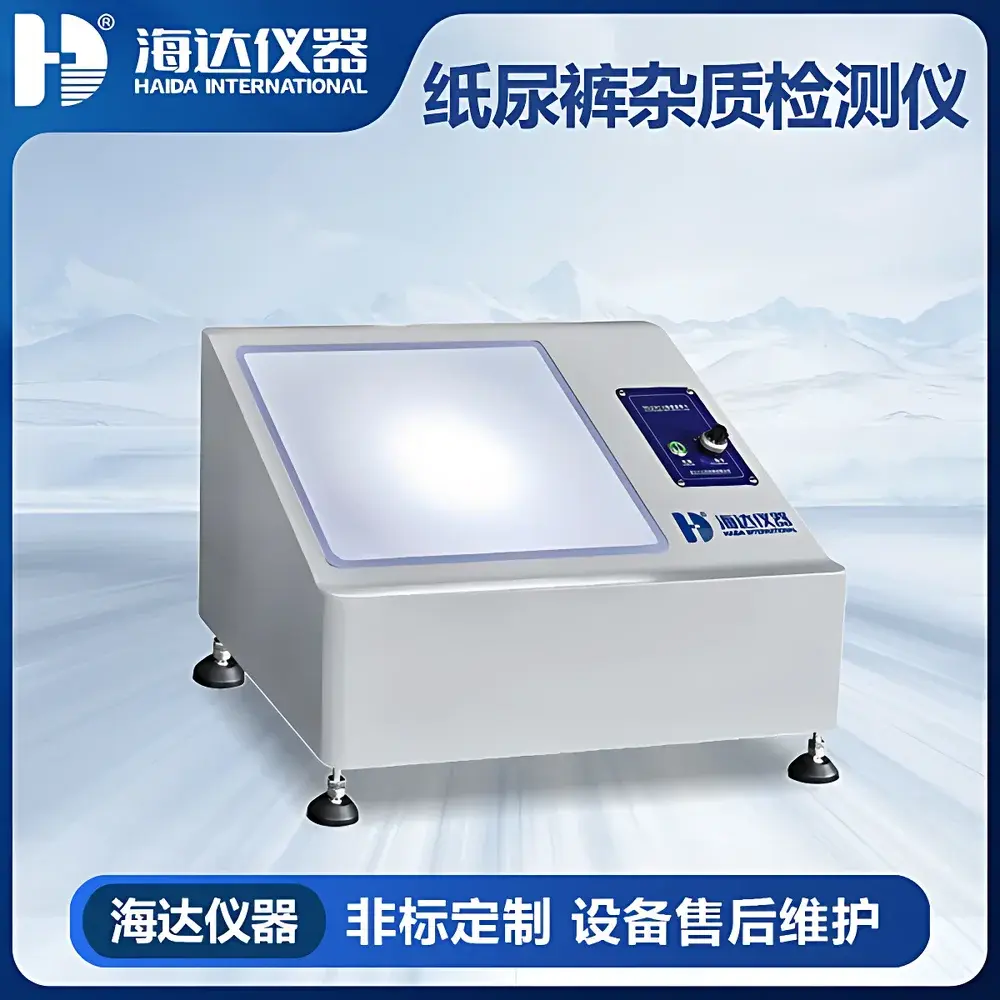
HAIDA HD-D007 Diaper Foreign Contaminant Inspection System
| Brand | HAIDA INTERNATIONAL |
|---|---|
| Origin | Guangdong, China |
| Manufacturer Type | Direct Manufacturer |
| Country of Origin | China |
| Model | HAIDA HD-D007 Diaper Foreign Contaminant Inspection System |
| Pricing | Available Upon Request |
Overview
The HAIDA HD-D007 Diaper Foreign Contaminant Inspection System is a dedicated optical inspection instrument engineered for the qualitative and semi-quantitative detection of foreign particulate contaminants—including metal fragments, plastic shavings, glass shards, hair, and fiber residues—embedded within absorbent hygiene products such as disposable diapers, training pants, and incontinence pads. It operates on the principle of transmitted visible-light illumination: a calibrated, high-uniformity LED light source backlights the sample, enabling visual differentiation between translucent substrate materials (e.g., nonwoven topsheets, SAP layers, and acquisition distribution layers) and opaque or refractive foreign bodies based on contrast, shadow morphology, and light-scattering behavior. Designed specifically for QC laboratories in hygiene product manufacturing and third-party testing facilities, the HD-D007 supports objective, operator-independent visual assessment under standardized lighting conditions, forming a critical first-line screening step prior to more advanced analytical methods (e.g., X-ray imaging or FTIR identification).
Key Features
- Adjustable high-CRI (≥90) white LED backlight source with continuous intensity control (10–100% output), ensuring optimal contrast across varying diaper thicknesses and material compositions.
- Uniform illumination field (≥95% homogeneity over 300 × 400 mm active area) achieved via precision light-guide plate and diffuser optics, minimizing glare and edge falloff.
- Robust industrial enclosure constructed from electrostatically powder-coated steel housing, resistant to cleaning agents and mechanical abrasion in regulated production environments.
- Front panel featuring brushed aluminum alloy fascia with sealed stainless-steel tactile push-button controls—designed for durability, chemical resistance, and compliance with IP54-rated ingress protection.
- Ergonomic viewing angle (30° tilt) and anti-glare tempered glass observation window reduce operator fatigue during extended shift-based inspections.
- No moving parts or consumables; maintenance-free operation with LED lifetime exceeding 50,000 hours at rated output.
Sample Compatibility & Compliance
The HD-D007 accommodates flat, unrolled diaper samples up to 450 mm wide × 600 mm long, including taped, tabbed, and pant-style configurations. Samples are placed directly onto the illuminated stage without fixation or vacuum hold-down, enabling rapid manual positioning and re-inspection. The system conforms to the optical inspection methodology specified in Annex C of GB/T 28004.1–2021 (“Disposable Baby Diapers and Pants”) and GB/T 28004.2–2021 (“Adult Incontinence Products”), which define illumination geometry, minimum luminance (≥2,500 lux at sample plane), spectral distribution (CIE Standard Illuminant D65 equivalent), and observer viewing distance (300–500 mm). While not an automated vision system, the HD-D007 provides the foundational illumination platform required to meet these national standard requirements for manual contaminant screening in GLP-compliant quality control workflows.
Software & Data Management
The HAIDA HD-D007 is a hardware-only inspection station with no embedded microprocessor, touchscreen, or digital data output. It functions as a deterministic optical workstation—intentionally designed to eliminate software validation complexity in regulated environments. All inspection records (e.g., sample ID, inspector name, date/time, pass/fail determination, annotated physical log sheets) are maintained externally per facility’s documented quality management system (QMS). This architecture aligns with FDA 21 CFR Part 11 expectations for instruments where electronic records are not generated, and supports audit readiness under ISO 13485 and GB/T 19001 frameworks. Optional integration with external documentation systems (e.g., LIMS or paperless QC tablets) is supported via standardized sample labeling and procedural SOP linkage.
Applications
- Routine incoming inspection of nonwoven roll stock and SAP granules for extraneous particles prior to converting.
- Final product release testing of finished diapers across production batches per AQL sampling plans (e.g., ISO 2859-1 Level II).
- Root cause analysis of customer complaints involving visible contaminants—used in conjunction with stereomicroscopy and SEM-EDS for forensic traceability.
- Process capability verification for converting line cleanliness (e.g., post-die-cutting, post-packaging seal integrity checks).
- Training tool for QA inspectors to develop consistent visual recognition thresholds for Class I–III foreign material per IATF 16949-aligned defect classification matrices.
FAQ
Does the HD-D007 provide automatic defect classification or image capture?
No. It is a manual visual inspection station only. No camera, image storage, or AI-based classification functionality is included.
Can it be used for inspecting other hygiene products beyond diapers?
Yes—validated use cases include feminine hygiene pads, wound dressings, and surgical drapes, provided sample dimensions fit within the illuminated area and optical contrast remains sufficient.
Is calibration required, and does it support traceable certification?
The LED light source is factory-calibrated for luminance uniformity and CCT. Annual verification using a NIST-traceable photometer (e.g., Konica Minolta CL-200A) is recommended; calibration certificates are available upon request.
What safety standards does the unit comply with?
It meets GB 4706.1–2005 (IEC 60335-1) for household and similar electrical appliances, including dielectric strength, grounding continuity, and temperature rise limits under continuous operation.
Is technical support available outside mainland China?
Yes—HAIDA INTERNATIONAL provides remote application engineering support, English-language documentation, and OEM-compatible spare parts logistics through authorized regional distributors.



