
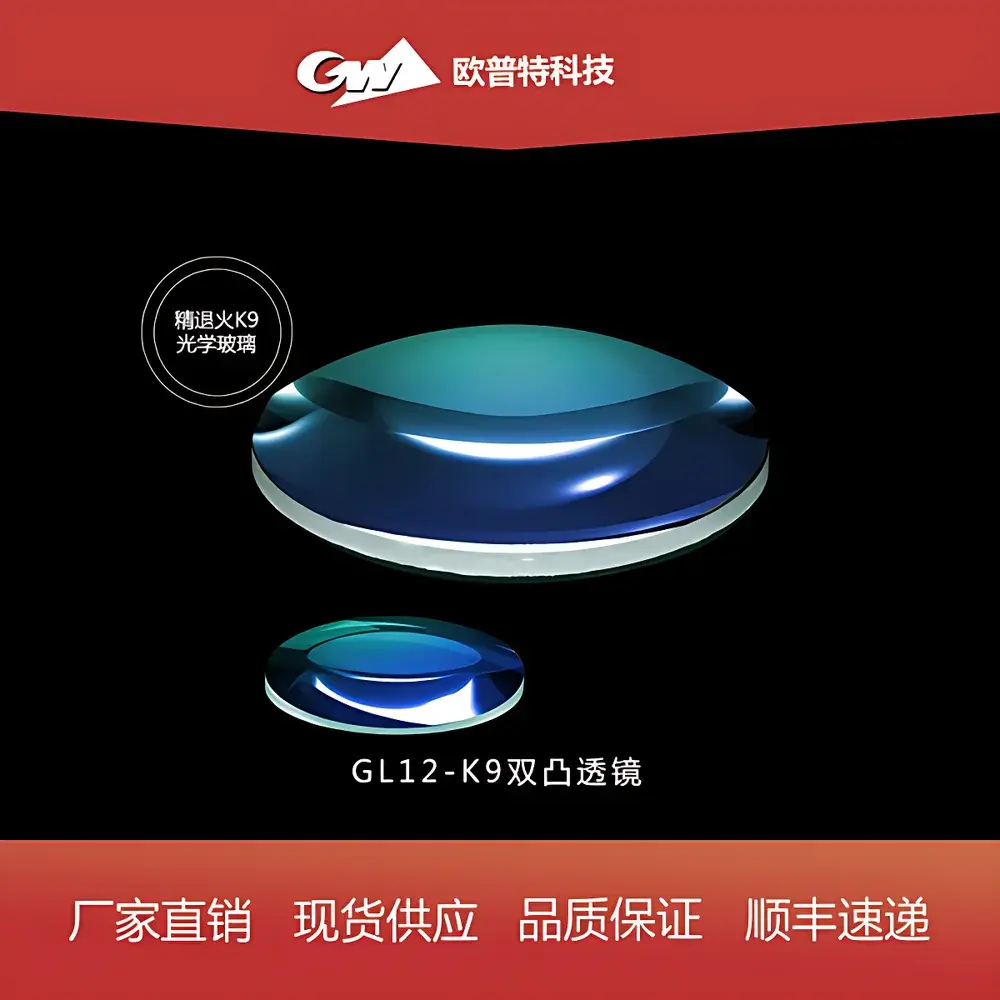
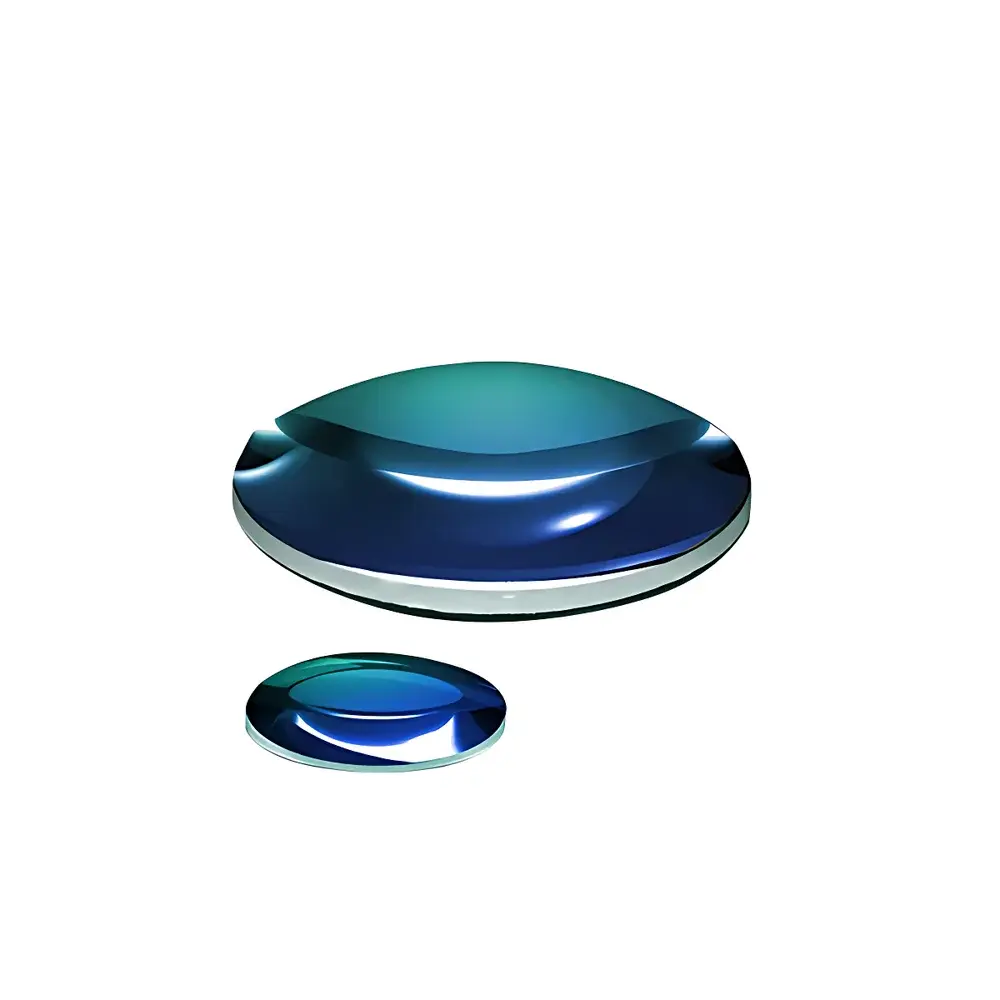
GL12-VIS K9 Double-Convex Lens with Broadband Anti-Reflective Coating (400–700 nm)
| Origin | Beijing, China |
|---|---|
| Manufacturer Type | Distributor |
| Origin Category | Domestic |
| Model | GL12-VIS |
| Price Range | USD 0.15–75.00 (per piece, volume-dependent) |
| Component Category | Optical Element |
| Material | Precision-Annealed K9 Optical Glass |
| Design Wavelength | 587.6 nm |
| Diameter Tolerance | +0.0 / −0.1 mm |
| Center Thickness Tolerance | ±0.2 mm |
| Surface Irregularity | λ/4 @ 632.8 nm |
| EFL Tolerance | ±2% |
| Centration Error | 3 arcmin |
| Surface Quality | 3–4 scratch-dig |
| Edge Treatment | 0.2 mm × 45° chamfer |
| Coating | Broadband AR, Rₐᵥg < 0.5% over 400–700 nm |
Overview
The GL12-VIS is a precision-engineered double-convex (DCX) lens fabricated from homogenously annealed K9 borosilicate crown glass—a material widely specified in optical design for its excellent transmission (≥91.5% per surface uncoated), low bubble/inclusion content, and predictable thermal and mechanical stability. Designed for use in visible-light applications spanning 400–700 nm, the lens features a broadband anti-reflective (BBAR) coating optimized to minimize Fresnel losses across the entire VIS spectrum. Its symmetric biconvex geometry yields a positive effective focal length (EFL), making it suitable for collimation of point sources, focusing of collimated beams, and basic imaging configurations where moderate aberration control and cost-effective performance are prioritized. The lens adheres to ISO 10110-3 standards for surface form and irregularity (λ/4 PV @ 632.8 nm HeNe wavelength), and is manufactured under controlled cleanroom conditions to ensure consistent wavefront fidelity.
Key Features
- Precision-annealed K9 optical glass substrate with certified refractive index (nd = 1.5163) and Abbe number (νd = 64.2), enabling predictable paraxial and third-order aberration behavior.
- Broadband anti-reflective coating deposited via ion-assisted e-beam evaporation; average reflectance <0.5% across 400–700 nm, with <1.0% peak reflectance at band edges—measured per ISO 9211-3.
- Tight mechanical tolerances: diameter tolerance +0.0/−0.1 mm ensures compatibility with standard SM-threaded lens mounts (e.g., Thorlabs SM05, SM1); center thickness tolerance ±0.2 mm supports accurate axial positioning in multi-element assemblies.
- Surface quality rated 3–4 scratch-dig per MIL-PRF-13830B, verified by automated dark-field inspection; surface irregularity λ/4 PV @ 632.8 nm confirmed via interferometric testing using a Zygo Verifire™ or equivalent.
- Centration error ≤3 arcminutes—critical for minimizing beam deviation in alignment-sensitive setups such as laser cavity optics or fiber coupling stages.
- Chamfered edge (0.2 mm × 45°) prevents chipping during handling and mounting, and complies with ISO 10110-7 edge finish requirements.
Sample Compatibility & Compliance
The GL12-VIS lens is compatible with industry-standard optomechanical components including SM05 (0.535″-40), SM1 (1.035″-40), and RMS-threaded lens tubes and retaining rings. Its dimensional and surface specifications conform to ISO 10110 parts 1 (drawing notation), 2 (material properties), 3 (surface form), and 7 (edge treatment). While not certified to ISO 9001 or ISO 13485, manufacturing documentation—including batch-specific interferometric test reports, coating spectral transmittance curves (200–1100 nm), and raw material certification—is available upon request for traceability in regulated environments (e.g., academic instrumentation validation, industrial metrology subsystems). The lens is not intended for high-power laser applications (>500 mW CW at 532 nm) without prior damage threshold verification.
Software & Data Management
No embedded firmware or proprietary software is associated with this passive optical component. However, full optical prescription data—including radius of curvature (R₁ = R₂), center thickness, EFL, BFL, and dispersion coefficients (Sellmeier parameters for K9)—is provided in Zemax-compatible .ZMX and CODE V .SEQ formats upon order confirmation. Spectral transmittance datasets (CSV format) covering 200–1100 nm at 1 nm resolution are supplied with each shipment. All documentation complies with ISO/IEC 17025 clause 7.5.2 for record retention and is archived for ≥10 years.
Applications
- Visible-light collimation and focusing in educational optics kits, OEM illumination modules, and machine vision lighting systems.
- Primary or relay elements in low-magnification microscope objectives, endoscopic probe optics, and barcode scanner assemblies.
- Beam shaping in diode-pumped solid-state (DPSS) laser systems operating at 473 nm, 532 nm, or 635 nm—provided irradiance remains below coating LIDT thresholds.
- Reference optics in spectrophotometer calibration paths, integrating sphere input couplers, and photometric detector alignment fixtures.
- Prototyping platforms for Shack-Hartmann wavefront sensors and Hartmann-Shack arrays requiring stable, repeatable spherical reference surfaces.
FAQ
Is the GL12-VIS suitable for near-infrared (NIR) applications beyond 700 nm?
Yes—K9 glass transmits effectively up to ~2.0 µm, but the BBAR coating is optimized only for 400–700 nm. For NIR use (e.g., 780–1050 nm), reflectance increases significantly (~2–4% per surface); custom NIR-optimized coatings are available on request.
Can I specify custom diameters or focal lengths outside the standard catalog range?
Yes—custom diameters from 2 mm to 100 mm and EFLs from 2 mm to 500 mm are manufacturable under NRE agreement, subject to minimum order quantities and extended lead times.
Do you provide mounting solutions for these lenses?
Standard SM-threaded lens mounts (SM05, SM1, RMS), kinematic lens holders, and adjustable translation stages compatible with GL12-VIS dimensions are available separately—no integrated mount is supplied with the bare lens.
What is the maximum permissible surface contamination level for cleanroom integration?
Lenses are cleaned to Class 100 (ISO Class 5) cleanroom standards pre-shipment; particulate count ≤100 particles ≥0.5 µm per cubic foot. Certificate of Cleanliness is included with orders >10 pcs.
Are test reports traceable to national metrology institutes?
Interferometric surface form data is traceable to NIM (National Institute of Metrology, China) via calibrated reference flats; spectral measurements are traceable to NIST-traceable spectroradiometers.




