
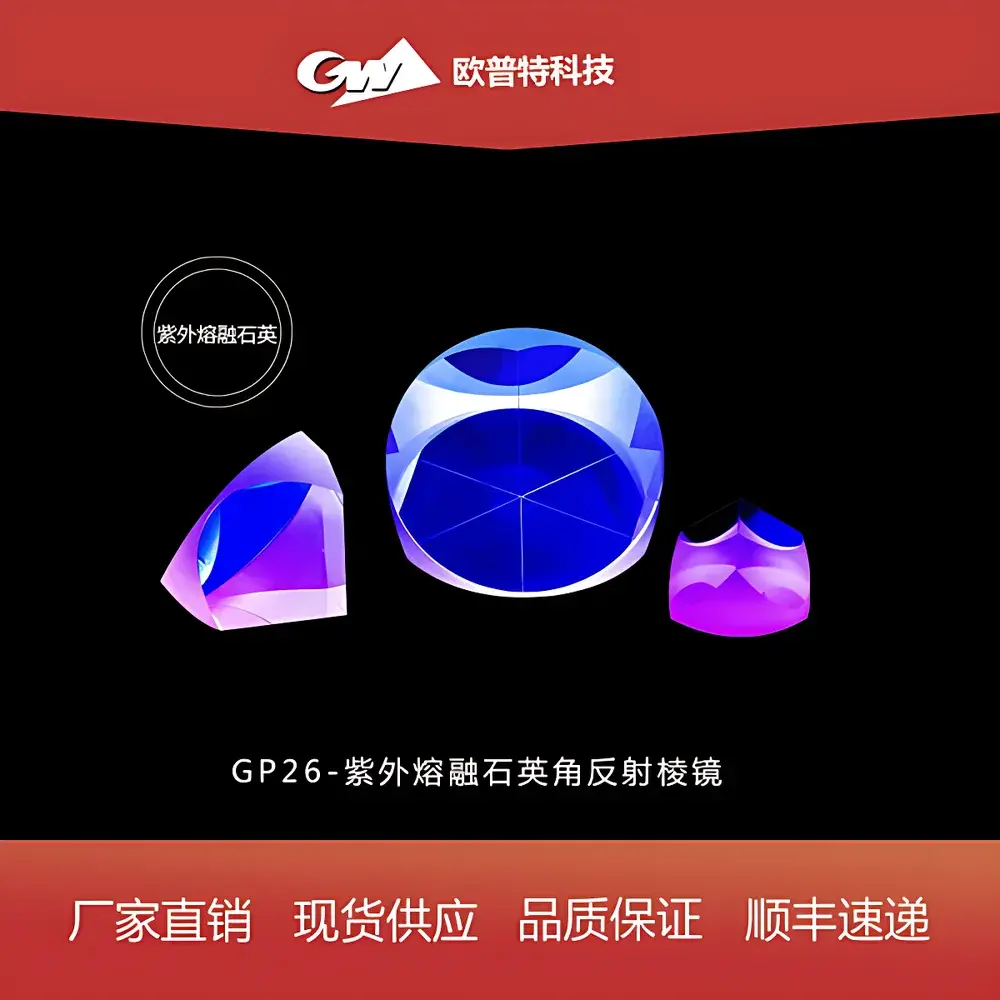
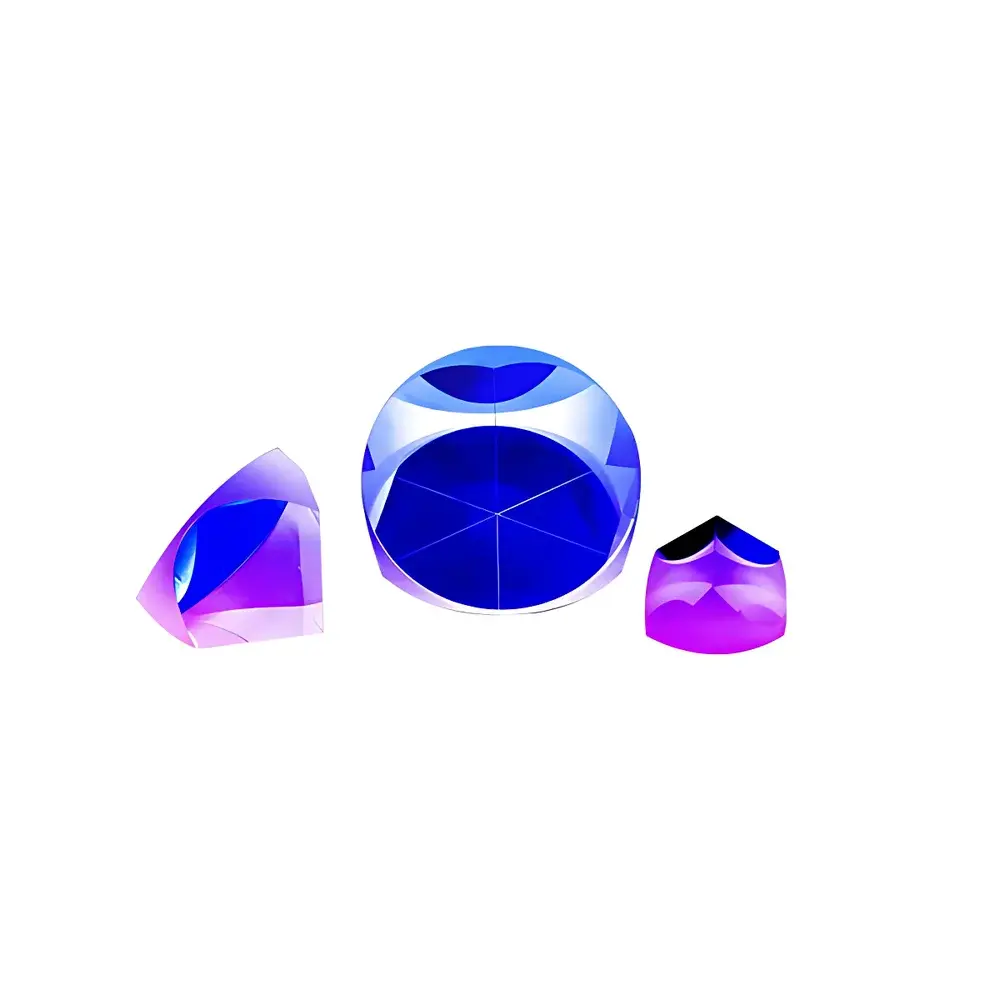
GP26 UV-Grade Fused Silica Corner Cube Retroreflector
| Material | UV-grade fused silica |
|---|---|
| Diameter tolerance | +0.0 / −0.1 mm |
| Height tolerance | ±0.2 mm |
| Surface flatness | λ/10 @ 632.8 nm |
| Surface quality | 1–2 scratch-dig |
| Edge break | <0.25 mm × 45° |
| Coating | Uncoated |
| Beam deviation | <3″ (models GP26-012, GP26-025-1, GP26-038, GP26-050) or <10″ (models GP26-008, GP26-025-2) |
| Available diameters | 8.0, 12.7, 25.4, 38.1, 50.8 mm |
| Corresponding heights | 6.0, 10.16, 19.0, 28.5, 37.5 mm |
Overview
The GP26 UV-grade fused silica corner cube retroreflector is a precision optical component engineered for high-fidelity beam return in alignment-critical and metrology-grade applications. Based on the principle of total internal reflection within a trihedral prism geometry, it ensures that an incident collimated beam is reflected back parallel to its original path—regardless of small angular misalignments—within the specified beam deviation tolerance (<3″ or 10 J/cm² at 266 nm, 10 ns), and minimal birefringence. Its monolithic, uncoated design eliminates thin-film stress, phase distortion, and wavelength-dependent reflectivity loss—making it ideal for ultrafast laser diagnostics, interferometric length measurement, gravitational wave detector calibration, and space-qualified optical benches.
Key Features
- Monolithic UV-grade fused silica substrate with certified homogeneity and bubble-free volume
- Precision-ground and polished trihedral geometry ensuring angular stability and minimal wavefront distortion
- Surface flatness of λ/10 @ 632.8 nm (measured via ZYGO interferometry), traceable to NIST standards
- Surface quality rated to MIL-PRF-13830B 1–2 scratch-dig specification
- Tight mechanical tolerances: diameter tolerance +0.0 / −0.1 mm; height tolerance ±0.2 mm
- Controlled edge break (<0.25 mm × 45°) to prevent chipping and reduce scatter at aperture edges
- No dielectric coating applied—preserves broadband UV-VIS-NIR performance and avoids coating delamination under thermal cycling
Sample Compatibility & Compliance
The GP26 series is compatible with standard kinematic mounts (e.g., Thorlabs KM100, Newport UMB1) and vacuum-compatible optical tables (UHV-rated up to 10⁻⁹ Torr when properly baked). All units undergo 100% inspection per ISO 10110-7 for surface imperfections and ISO 10110-5 for transmitted wavefront error. Documentation includes individual test reports listing measured beam deviation (verified using autocollimation with a 0.1″ resolution theodolite), surface flatness map, and spectral transmittance curve (200–2000 nm). The component conforms to ISO 9001:2015 manufacturing controls and supports GLP-compliant optical system validation protocols.
Software & Data Management
While the GP26 is a passive optical element requiring no firmware or driver software, its geometric and metrological specifications are fully integrated into common optical design platforms—including Zemax OpticStudio (as a non-sequential object with user-defined material dispersion), CODE V (via custom DLL interface), and FRED (with built-in trihedral retroreflector library). Each unit ships with a unique serial-numbered calibration certificate containing interferometric surface data (in .ZBF or .DAT format), enabling traceable integration into ISO/IEC 17025-accredited measurement chains. Audit trails for calibration history and environmental exposure (temperature/humidity logs during final inspection) are retained for ≥10 years per internal QA policy.
Applications
- Laser ranging and time-of-flight distance measurement in geodetic and satellite laser ranging (SLR) stations
- Alignment reference in synchrotron beamlines and free-electron laser (FEL) diagnostic hutches
- Reference standard in Michelson and Twyman-Green interferometers for cavity length stabilization
- Beam recombination optics in heterodyne interferometry and optical coherence tomography (OCT) systems
- Primary retroreflection target in ISO 13675-1:2021-compliant retroreflector performance testing
- Vacuum- and cryogenic-compatible fiducial marker in quantum optics experiments (e.g., atom interferometry, cavity QED setups)
FAQ
Is the GP26 suitable for 193 nm ArF excimer laser applications?
Yes—UV-grade fused silica provides >85% bulk transmission at 193 nm, and the uncoated surface minimizes multiphoton absorption risk. LIDT validation is available upon request.
Can I specify custom beam deviation tighter than <3″?
Yes—tighter angular tolerances (e.g., <1″) are achievable via extended polishing and interferometric feedback; lead time increases by 3–4 weeks.
Do you provide mounting adapters or kinematic bases?
Standard SM1-threaded or M25×0.75 kinematic base plates are available as optional accessories (part numbers GP26-MNT-SM1 and GP26-MNT-M25).
Is there a version with anti-reflection coating for 1064 nm?
Coated variants (e.g., GP26-AR1064) are offered separately—however, AR coating reduces UV transmission and introduces group delay dispersion; consult application engineering before specifying.
Are calibration certificates NIST-traceable?
Surface flatness and beam deviation measurements are performed using NIST-traceable interferometers and autocollimators; certificates include uncertainty budgets per GUM (JCGM 100:2018).



