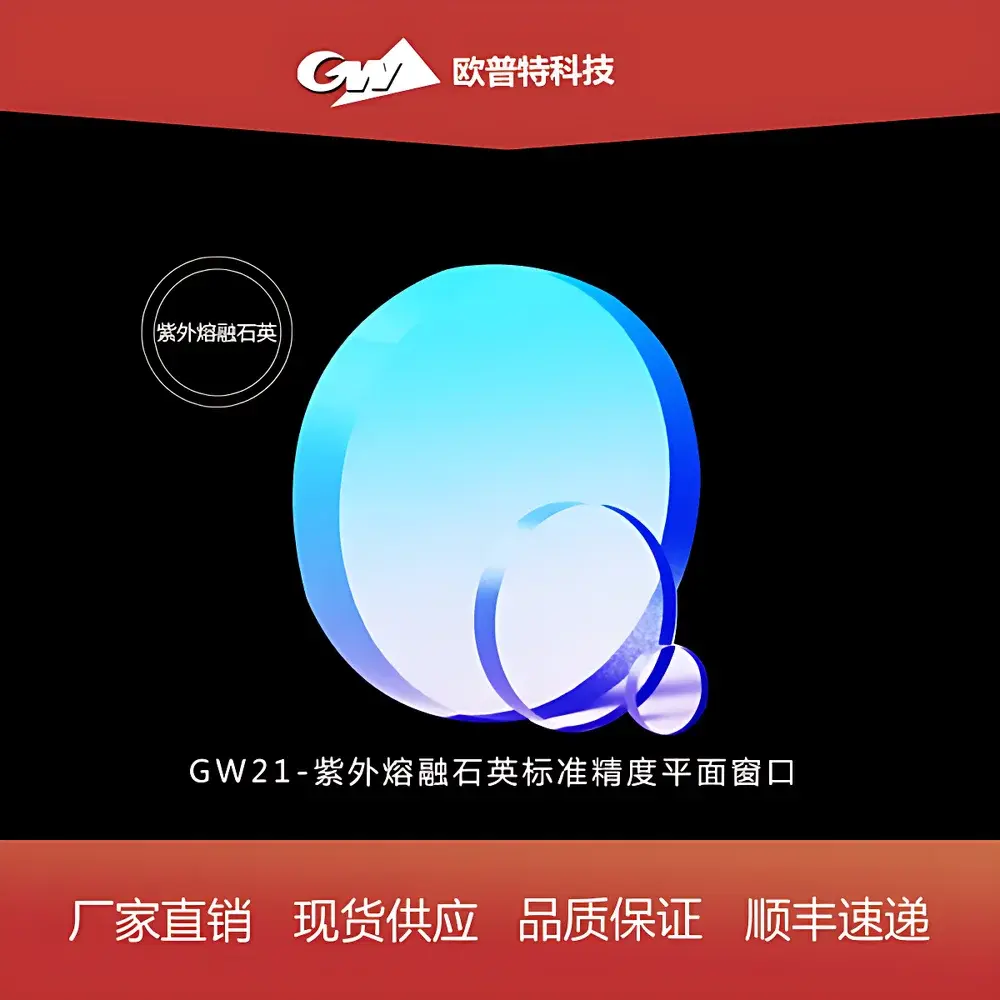

GW21 UV-Fused Silica Precision Flat Window
| Origin | Beijing, China |
|---|---|
| Manufacturer Type | Distributor |
| Origin Category | Domestic |
| Model | GW21 |
| Price Range | USD 0.15–75.00 (per unit) |
| Component Type | Optical Element |
| Material | UV-Grade Fused Silica |
| Transmission Range | 250–425 nm (AR-coated), 908–1700 nm (SWIR-compatible) |
| Standard Coating | Broadband AR @ 250–425 nm |
| Thickness Tolerance | ±0.05 mm |
| Surface Flatness | λ/10 @ 633 nm |
| Surface Quality | 10–5 Scratch-Dig |
| Parallelism | <3 arcsec |
| Clear Aperture | ≥90% of diameter |
| Diameter/Dimensions | Customizable |
Overview
The GW21 UV-Fused Silica Precision Flat Window is a high-stability optical component engineered for demanding ultraviolet (UV) through short-wave infrared (SWIR) applications. Constructed from synthetic UV-grade fused silica (SiO₂), this window exhibits exceptional transmission from 250 nm to >2.2 µm, with minimal hydroxyl (OH⁻) content ( 5 J/cm² at 355 nm, 10 ns pulse, 20 Hz), making it suitable for excimer laser systems, UV spectroscopy cells, and vacuum-compatible optical housings where outgassing and radiation stability are critical.
Key Features
- UV-grade fused silica substrate with certified OH⁻ content ≤1 ppm and refractive index homogeneity Δn ≤ 5 × 10⁻⁶
- Broadband anti-reflection (AR) coating optimized for 250–425 nm (Rₐᵥg < 0.5% per surface); uncoated variant available for custom coating integration
- Surface flatness specified to λ/10 @ 633 nm (peak-to-valley), verified via interferometric measurement traceable to NIST standards
- Surface quality rated 10–5 per MIL-PRF-13830B, with scratch-dig inspection performed under controlled cleanroom conditions (ISO Class 5)
- Tight thickness tolerance of ±0.05 mm and parallelism <3 arcseconds support precision alignment in multi-element optical trains
- Compatible with UHV environments (outgassing rate <1 × 10⁻¹⁰ Torr·L/s·cm² per ASTM E595), validated via thermal desorption GC-MS analysis
Sample Compatibility & Compliance
The GW21 window is compatible with optical systems operating across UV-VIS-NIR-SWIR spectral regions, including but not limited to fluorescence microscopy illumination paths, Raman spectrometer entrance optics, UV photolithography alignment subassemblies, and FTIR beam splitters. It meets material requirements for ISO 9022-5 (optical environmental testing), RoHS Directive 2011/65/EU (lead-free composition), and REACH Annex XVII compliance. While not an active measuring instrument, its dimensional and optical specifications are documented in accordance with ISO/IEC 17025:2017 calibration reporting guidelines when supplied with certified test reports. No FDA or CE marking applies, as it is classified as a passive optical component under EU Regulation (EU) 2016/425 and IEC 61000-6-3.
Software & Data Management
As a passive optical component, the GW21 requires no embedded firmware, drivers, or software interface. However, its metrological data—including interferometric surface maps, spectral transmittance curves (200–2500 nm), and coating reflectance spectra—are delivered in standardized formats: CSV for spectral data, ZYGO .ZPD for interferograms, and PDF-certified test reports compliant with ISO/IEC 17025 documentation structure. Customers may integrate these datasets into optical design platforms such as Zemax OpticStudio (via .DAT surface files) or CODE V (using ASCII surface deviation tables). Traceability to national metrology institutes (e.g., NIM China, PTB Germany) is provided upon request for GMP/GLP-regulated installations.
Applications
- UV lithography mask inspection systems requiring high-transmission, low-birefringence windows
- Excimer laser delivery optics (193 nm ArF, 248 nm KrF) where solarization resistance is mandatory
- High-resolution UV-Vis spectrophotometer sample compartments and detector windows
- Vacuum ultraviolet (VUV) monochromator exit ports (down to 115 nm, with optional MgF₂ overcoat)
- SWIR imaging systems (900–1700 nm) where broadband transmission and thermal stability supersede coating optimization
- Calibration reference elements in NIST-traceable radiometric setups (e.g., integrating sphere input windows)
FAQ
Is the GW21 window suitable for 193 nm ArF excimer laser applications?
Yes — its low-OH fused silica matrix and absence of metallic impurities ensure minimal solarization-induced absorption growth after prolonged 193 nm exposure. LIDT validation is performed per ISO 21254-2.
Can custom diameters or thicknesses be manufactured?
Yes — standard stock sizes include Ø25.4 mm (1″), Ø50.8 mm (2″), and 25 × 25 mm square. Custom geometries up to Ø150 mm and thicknesses from 1.0 mm to 25.0 mm are available with 4–6 week lead time.
What is the maximum operating temperature?
Continuous use up to 1050 °C in inert or oxidizing atmospheres; thermal shock resistance supports rapid cycling between −60 °C and +300 °C without fracture.
Do you provide ISO/IEC 17025-accredited calibration reports?
Yes — surface flatness, transmitted wavefront error (TWE), and spectral transmittance reports are issued by an ILAC-MRA signatory laboratory upon request (additional fee applies).
Is the AR coating durable enough for cleaning with IPA and lens tissue?
Yes — the ion-assisted e-beam deposited MgF₂/TiO₂/SiO₂ stack meets MIL-C-48497A abrasion resistance requirements and withstands repeated solvent-based cleaning per ISO 10110-7 protocols.