
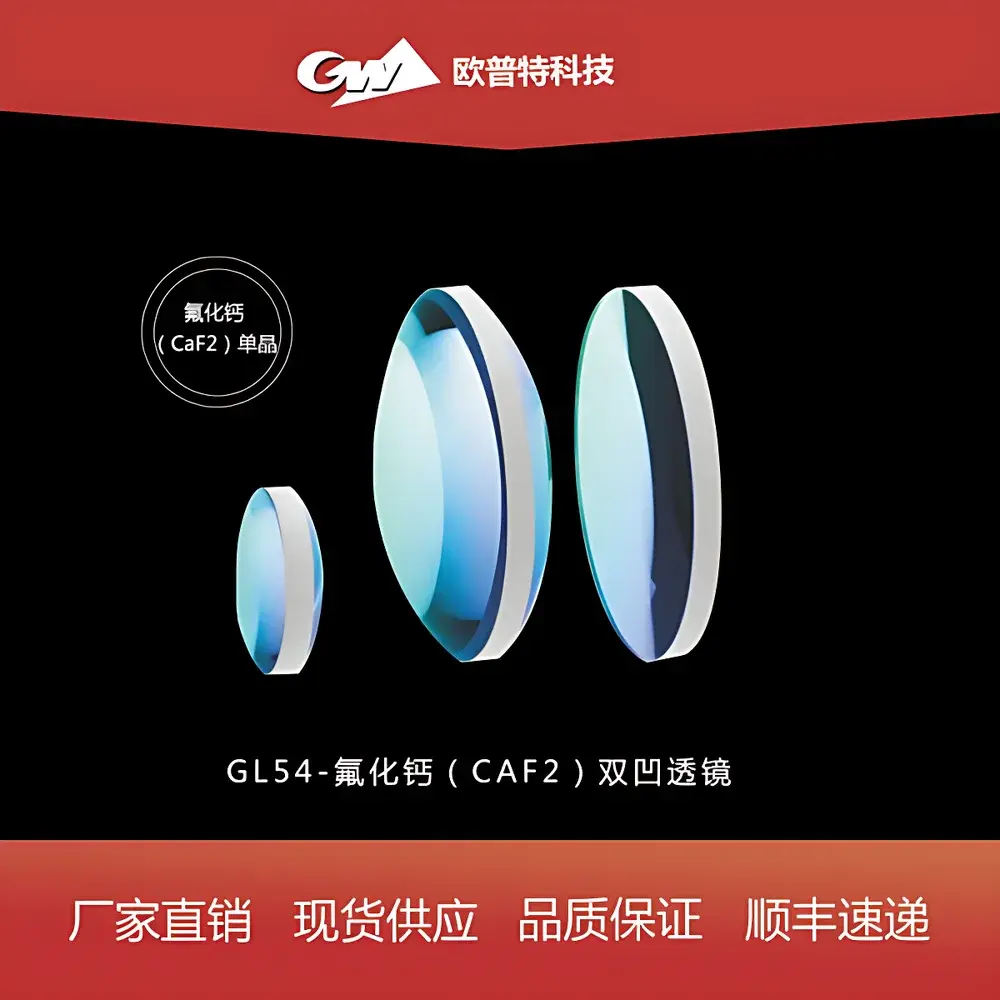
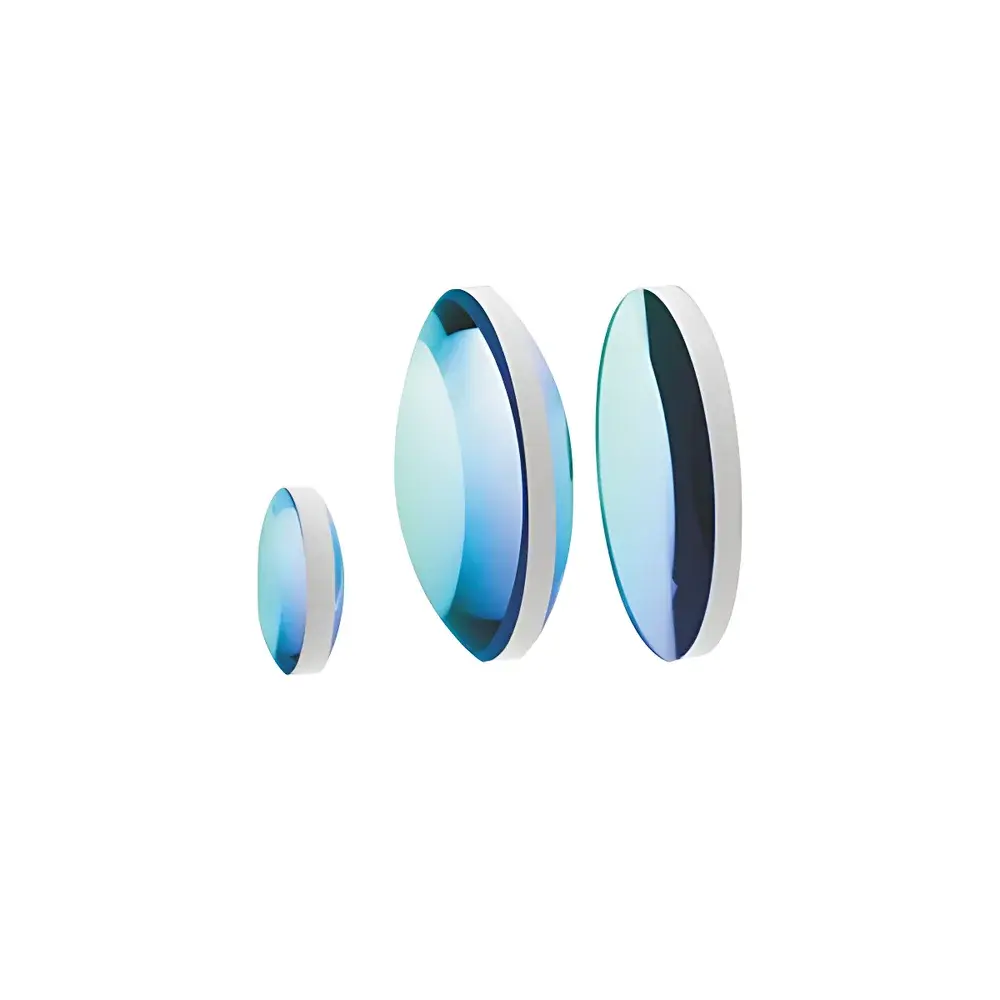
GL54 Calcium Fluoride (CaF₂) Biconcave Lens, Uncoated & IR Broadband AR-Coated (3–5 µm)
| Diameter | +0.0 / −0.1 mm |
|---|---|
| Center Thickness Tolerance | ±0.1 mm |
| EFL Tolerance | ±1% |
| Surface Quality | < 3/2 (Scratch/Dig) |
| Edge Chamfer | 0.2 mm × 45° |
| Material | Single-Crystal CaF₂ |
| Design Wavelength | 587.6 nm |
| Coating Options | Uncoated or Broadband AR (Rₐᵥg < 1.5% @ 3–5 µm) |
Overview
The GL54 Calcium Fluoride (CaF₂) Biconcave Lens is a precision optical component engineered for demanding infrared (IR) applications requiring high transmission in the 3–5 µm spectral range. Fabricated from single-crystal calcium fluoride—a low-refractive-index (n ≈ 1.39 @ 5 µm), low-dispersion, and radiation-resistant material—the lens exhibits exceptional transmittance (>93% per surface uncoated, >97% with AR coating) and minimal thermal expansion (α ≈ 18.9 × 10⁻⁶ K⁻¹). Its biconcave geometry produces negative focal power, enabling controlled beam divergence, optical path length extension, and correction of spherical aberration in multi-element systems. Designed to ISO 10110-1 and ISO 10110-7 standards for surface form and quality, the GL54 lens serves as a foundational element in FTIR spectrometers, CO₂ laser beam conditioning, thermal imaging relay optics, and mid-wave infrared (MWIR) collimation assemblies.
Key Features
- Precision-ground biconcave geometry with matched radii of curvature for symmetric wavefront divergence and minimized coma.
- Single-crystal CaF₂ substrate with ≤ 0.1 arcmin wedge and ≤ 0.2 µm RMS surface irregularity (λ/2 @ 633 nm).
- Tight dimensional tolerances: diameter tolerance +0.0 / −0.1 mm; center thickness ±0.1 mm; effective focal length (EFL) ±1%.
- Surface quality rated < 3/2 per MIL-PRF-13830B (scratch/dig), verified via interferometric inspection.
- Standard edge treatment: 0.2 mm × 45° chamfer to mitigate chipping and improve mechanical robustness during mounting.
- Two coating configurations available: uncoated (for UV-VIS-NIR compatibility and custom coating flexibility) or broadband anti-reflection (BBAR) coating optimized for Rₐᵥg < 1.5% across 3–5 µm—conforming to ISO 9211-3 for spectral performance and environmental durability.
Sample Compatibility & Compliance
The GL54 lens is compatible with standard SM-series lens mounts (e.g., SM05, SM1), kinematic optical cages, and vacuum-compatible lens cells. Its CaF₂ substrate meets ASTM F273-21 specifications for optical-grade calcium fluoride and complies with RoHS Directive 2011/65/EU. The BBAR coating adheres to ISO 9211-4 for adhesion (tape test per ISO 2409), humidity resistance (95% RH, 40°C, 240 h), and abrasion resistance (CS-10 wheel, 1000 cycles). No outgassing data is provided; users requiring ultra-high-vacuum environments should perform pre-bake qualification per ASTM E595.
Software & Data Management
No embedded firmware or software control is associated with this passive optical component. However, lens parameters—including nominal EFL, radius values, center thickness, and coating spectral curves—are supplied in standardized Zemax (.ZMX) and CODE V (.SEQ) format files upon request. All metrology reports (interferograms, surface roughness scans, spectral reflectance traces) are archived digitally and available under NDA for GLP-compliant validation workflows. Traceable calibration certificates (NIST-traceable interferometry and spectrophotometry) may be issued per ISO/IEC 17025 requirements.
Applications
- Beam expansion in MWIR laser systems (e.g., quantum cascade lasers at 4.6 µm).
- Field flattening and pupil relay in cooled InSb or HgCdTe detector-based imaging optics.
- Dispersion compensation in dual-band (3–5 µm / 8–12 µm) thermal imaging objectives.
- Reference optics in cryogenic Fourier-transform infrared (FTIR) spectrometers operating below 150 K.
- Collimator elements in gas sensing modules utilizing tunable diode laser absorption spectroscopy (TDLAS) in the ν₃ band of methane (3.3 µm) or CO (4.7 µm).
FAQ
Is the GL54 lens suitable for ultraviolet (UV) applications below 180 nm?
No. While CaF₂ transmits down to ~120 nm, the GL54 variant is optimized for IR performance; UV-grade CaF₂ requires tighter impurity control (e.g., reduced metallic contamination) and specialized polishing protocols not applied here.
Can the lens be cleaned using acetone or isopropanol?
Yes—CaF₂ is chemically inert to both solvents. Use lint-free wipes and vapor-phase cleaning per ISO 10110-7 Annex A to avoid surface residue or micro-scratching.
What is the maximum permissible power density for continuous-wave (CW) 4.5 µm laser exposure?
At room temperature and with AR coating, the damage threshold is ≥ 1.5 GW/cm² for 10-ns pulses (1064 nm reference); for CW operation at 4.5 µm, conservative design limits recommend ≤ 5 kW/cm² with active cooling and beam homogenization.
Does the ±1% EFL tolerance include thermal drift over operating temperature range?
No—the ±1% specification applies at 22 ± 2°C. Thermal focal shift (dn/dT and thermoelastic effects) must be modeled separately using CaF₂’s published thermo-optic coefficient (dn/dT = −1.1 × 10⁻⁶ K⁻¹) and CTE.
Are custom diameters or focal lengths available under OEM agreement?
Yes—standard production supports diameters from 2 mm to 25 mm and EFLs from −2 mm to −200 mm, subject to minimum order quantity and extended lead time. Custom coatings (e.g., dual-band AR for 3–5 µm + 8–12 µm) are also supported.




