
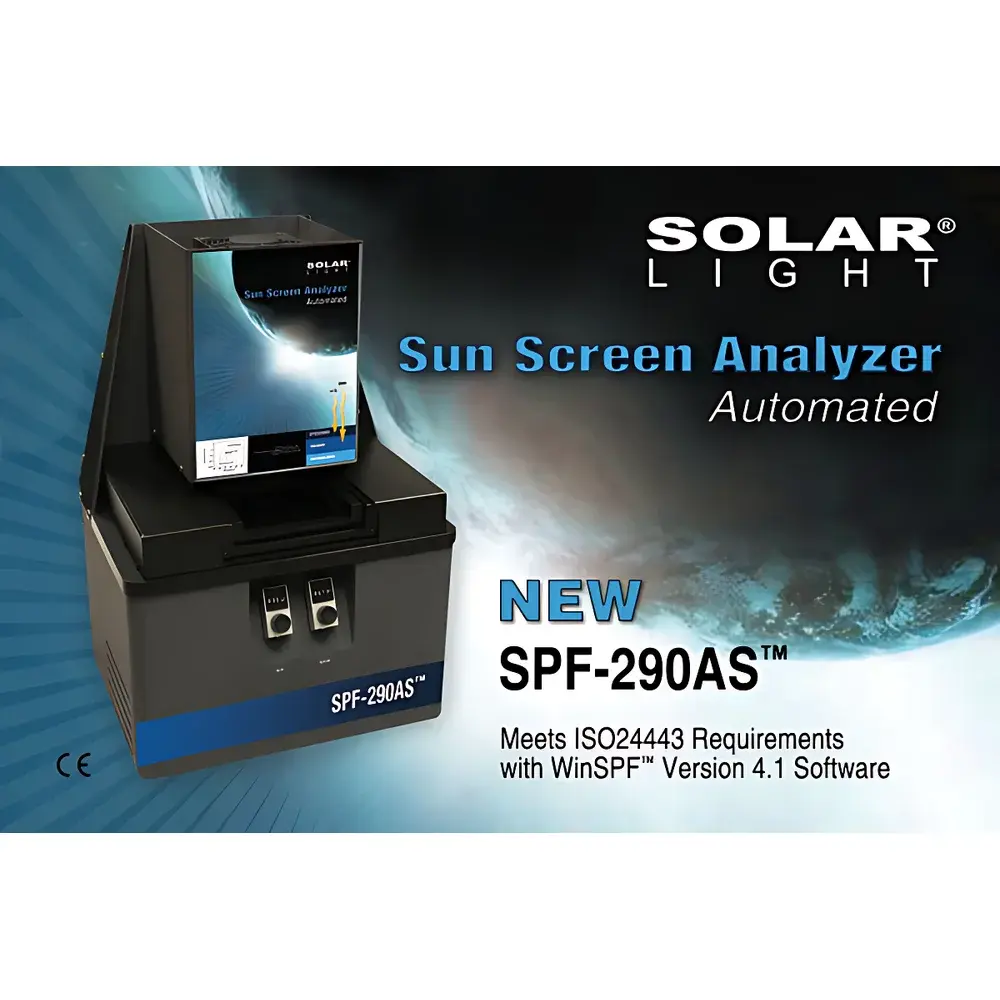
Solar Light SPF-290AS In Vitro Sun Protection Factor Analyzer
| Brand | Solar Light |
|---|---|
| Origin | USA |
| Model | SPF-290AS |
| Wavelength Range | 290–400 nm |
| Spectral Bandwidth (FWHM) | 1.66 nm |
| Wavelength Accuracy | ±0.2% (±0.58–0.80 nm) |
| Wavelength Repeatability | ±0.25 nm |
| Absorbance Range | 0–3.2 A (Dual-Doped PMMA Method) |
| SPF Measurement Range | 1–50+ |
| Scan Time | <25 s |
| Wavelength Step Intervals | 1, 2, or 5 nm (user-selectable) |
| Light Source | 125 W Continuous Xenon Lamp |
| Detector | High-Sensitivity Photomultiplier Tube (PMT) |
| Sample Positioning | Motorized X-Y Stage (Auto-sequencing for up to 12 measurement points) |
| Software | WinSPF v4.1 with FDA 21 CFR Part 11–compliant audit trail, GLP/GMP-ready reporting, and ISO 24443 support |
| Compliance | ASTM E2674, ISO 24443 (pending final publication), COLIPA 2011, EU Cosmetics Regulation (EC No. 1223/2009), AATCC-183, AS/NZS 4399, FDA Monograph 21 CFR §352, Boots Star Rating, Critical Wavelength (λc), UVA-PF/SPF Ratio, TNUV Calculation |
| Calibration Traceability | NIST-traceable reference filters included in Test Kit |
Overview
The Solar Light SPF-290AS In Vitro Sun Protection Factor Analyzer is a purpose-built UV spectrophotometer engineered for quantitative, reproducible determination of sun protection factor (SPF) and UVA protection parameters using standardized in vitro methodologies. Based on the principle of UV absorbance spectroscopy across the biologically relevant erythemal spectrum (290–400 nm), the system measures monochromatic protection factors (MPF) at discrete wavelengths and integrates them against the CIE-defined solar irradiance spectrum and the human erythema action spectrum to compute SPF, UVA-PF, critical wavelength (λc), Boots Star Rating, and TNUV. Designed to replace or significantly reduce reliance on in vivo human testing—particularly for early-stage formulation screening—the SPF-290AS delivers high inter-laboratory correlation with clinical SPF data when operated under COLIPA 2011, ISO 24443, or FDA-recommended protocols. Its architecture conforms to regulatory expectations for analytical instrument qualification (AIQ), including documented performance verification, traceable calibration, and software validation readiness.
Key Features
- Automated X-Y sample stage enabling unattended, sequential measurement across up to 12 predefined positions per PMMA substrate—fully compliant with COLIPA 2011 multi-point sampling requirements
- 125 W continuous-output xenon lamp with precision integrating sphere optics and color-correcting filters to emulate solar spectral distribution with high photometric stability
- High-resolution scanning monochromator with 1.66 nm FWHM bandwidth and ±0.25 nm wavelength repeatability, ensuring spectral fidelity required by ISO 24443 draft specifications
- Photomultiplier tube (PMT) detector optimized for low-light UV signal capture across 290–400 nm, supporting absorbance measurements from 0 to 3.2 A with dual-doped PMMA substrate compatibility
- “Hit-and-Forget” automated sequencing mode: initiates full scan sequence with one button press; eliminates operator-dependent positioning variability and improves intra- and inter-assay reproducibility
- Integrated time-resolved photostability module: enables longitudinal MPF monitoring at user-specified intervals to assess UV-induced degradation kinetics under controlled environmental conditions
Sample Compatibility & Compliance
The SPF-290AS is validated for use with standardized substrates including Schonberg-grade PMMA plates (50 × 50 mm, 5 µm surface roughness) and 3M™ Transpore™ tape, though Solar Light recommends PMMA for highest correlation with in vivo results. Sample application follows weight-based dosing (1.3 mg/cm² per COLIPA 2011 and ISO 24443), delivered via calibrated volumetric pipettes—not syringes—to ensure uniform film thickness and minimize edge effects. The system supports liquid, emulsion, gel, and spray formulations. Regulatory alignment includes full implementation of COLIPA 2011 test criteria, EU Annex VI labeling requirements (critical wavelength ≥370 nm, UVA-PF/SPF ≥1/3), FDA’s proposed UVA in vitro protocol (21 CFR §352), AATCC-183 for textile UV protection, and AS/NZS 4399 for sun-protective clothing. All software calculations—including erythemal-weighted integrals, UVA/UVB ratios, and area-under-curve (AUC) metrics—are programmatically verifiable and exportable in CSV/PDF formats for audit purposes.
Software & Data Management
WinSPF v4.1 is a Windows-based analytical platform designed for regulated laboratory environments. It provides role-based access control, electronic signatures, and a fully configurable audit trail compliant with FDA 21 CFR Part 11 and EU Annex 11. Every measurement event—including instrument parameter settings, raw spectral scans, MPF curves, final SPF/UVA-PF values, and manual annotations—is timestamped, user-logged, and stored in an encrypted database. Reporting modules generate GLP-compliant certificates containing date/time, analyst ID, sample identifier, substrate lot number, calibration status, and full spectral metadata. Additional features include real-time critical wavelength calculation, dynamic TNUV (Total Non-UVA) analysis, comparative overlay of multiple spectra, statistical evaluation of replicate measurements (mean, SD, CV%), and batch-level trending. Software updates for emerging standards—including official ISO 24443 release—are provided free of charge to registered users.
Applications
The SPF-290AS serves as a core analytical tool in cosmetic R&D laboratories, contract testing facilities, and regulatory quality units. Primary applications include: accelerated sunscreen formulation development and optimization; preclinical screening of novel UV filters and photostabilizers; batch release testing for SPF label claims; photostability assessment under simulated solar exposure; comparative benchmarking against reference standards (e.g., COLIPA Standard, 8% homosalate); and generation of technical dossiers for EU CPNP notifications or FDA OTC monograph submissions. Its ability to quantify both UVB and UVA protection parameters makes it equally suitable for broad-spectrum claim substantiation, pediatric sunscreen evaluation, and non-cosmetic applications such as UV-curable coating characterization and polymer photodegradation studies.
FAQ
What substrate is recommended for highest correlation with in vivo SPF?
Solar Light recommends Schonberg-grade PMMA plates with ≤5 µm surface roughness, prepared using volumetric pipette delivery and fingertip-spreading per COLIPA 2011 Section 5.2.
Does the system support FDA 21 CFR Part 11 compliance?
Yes—WinSPF v4.1 includes electronic signature workflows, audit trail logging, and user permission tiers validated for GxP environments.
Can the SPF-290AS measure photostability over time?
Yes—its time-resolved scanning mode allows scheduled MPF acquisition at user-defined intervals (e.g., every 5 min for 60 min) under constant irradiation to model filter degradation kinetics.
Is ISO 24443 support available now?
The current firmware implements all defined calculation algorithms; official ISO 24443 certification is pending final standard publication—free software upgrade will be provided upon release.
How is wavelength accuracy verified?
NIST-traceable bandpass filters included in the Test Kit enable routine wavelength and photometric verification; certificate of conformance is supplied with each analyzer.






