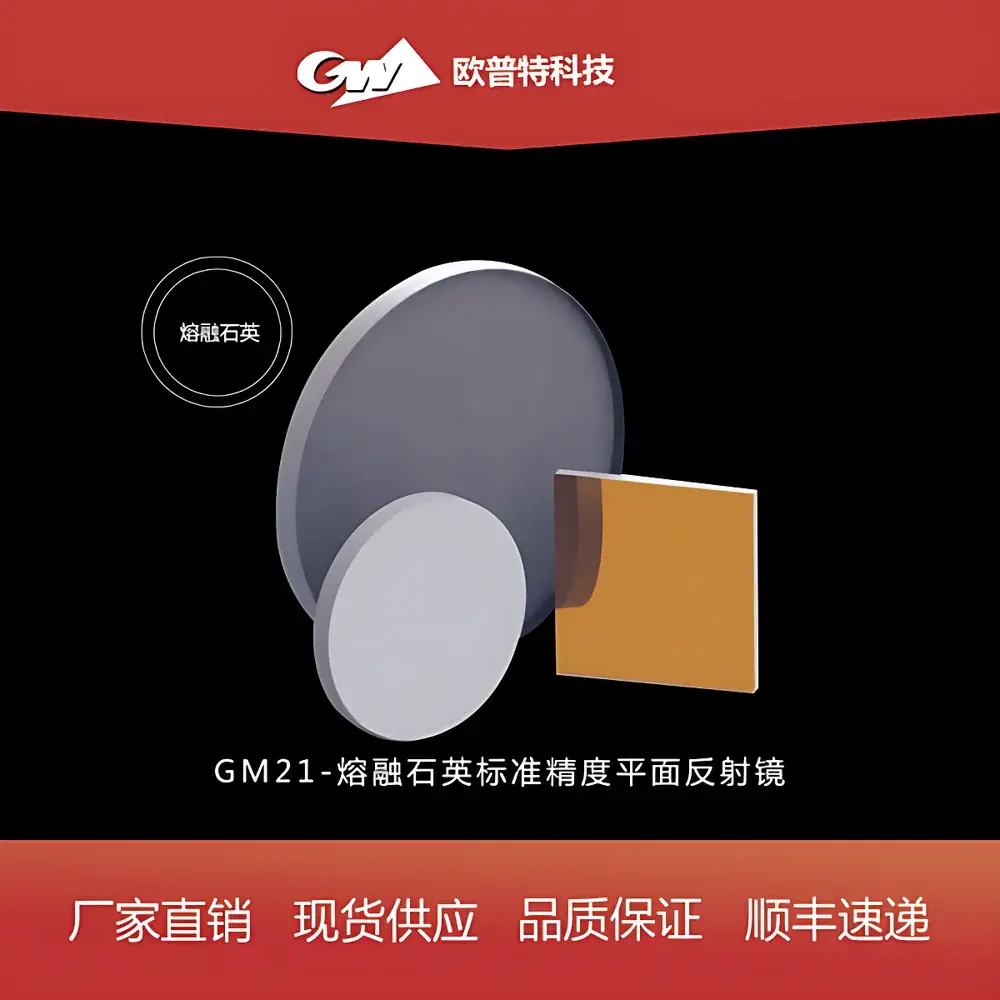
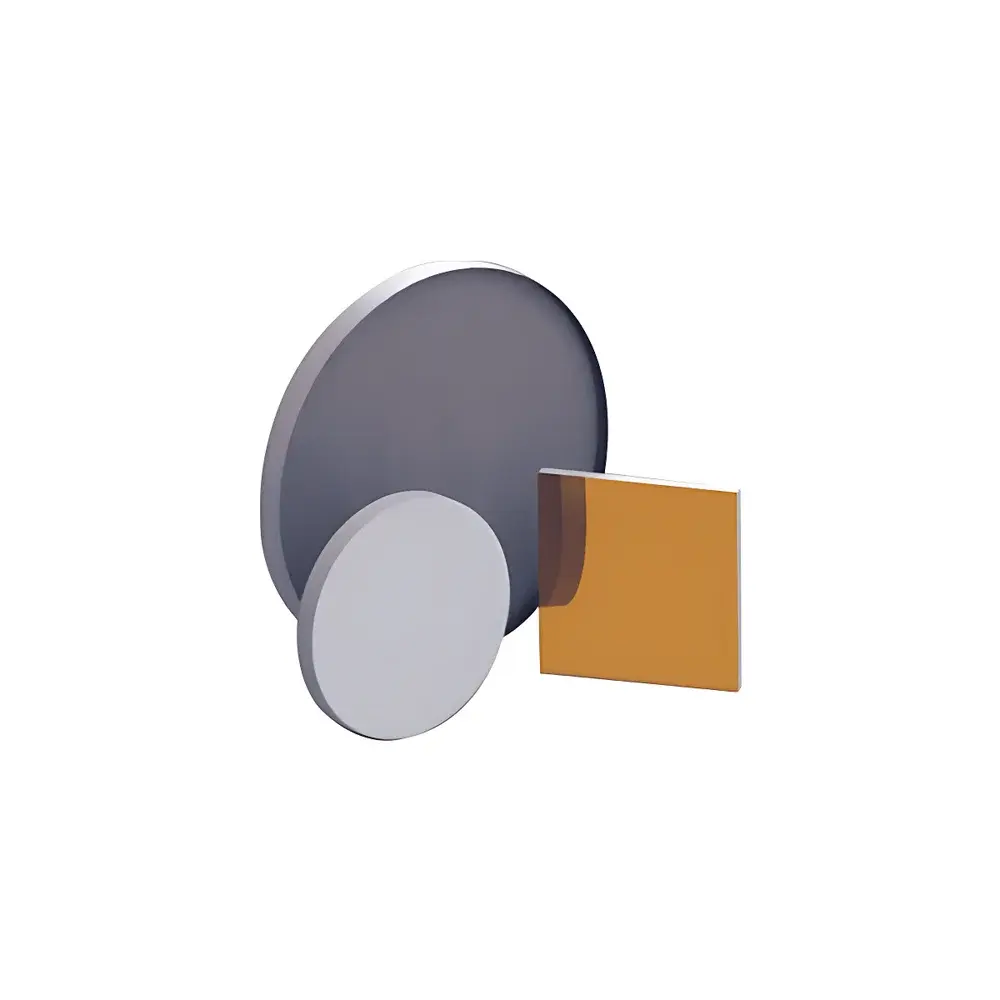
GM21 Fused Silica Precision Flat Mirror

| Material | Fused Silica |
|---|---|
| Surface Figure | λ/4 @ 633 nm |
| Parallelism | < 3 arcmin |
| Surface Quality | 10-5 (MIL-PRF-13830B) |
| Back Surface | Fine Ground |
| Dimensional Tolerance | +0.0 / –0.1 mm |
| Thickness Tolerance | ±0.2 mm |
| Edge | Protective 45° chamfer, 0.2–0.5 mm |
| Coating Options | Uncoated, Protected Aluminum, UV-Enhanced Aluminum, Protected Silver, Protected Gold |
Ask about pricing, availability and specifications.
Overview
The GM21 Fused Silica Precision Flat Mirror is an optically engineered component designed for high-stability beam steering, interferometric alignment, cavity folding, and imaging system integration in demanding laboratory and industrial optical setups. Fabricated from synthetic fused silica (SiO₂), this mirror leverages the material’s exceptional thermal stability (CTE ≈ 0.55 × 10⁻⁶ /°C), low intrinsic birefringence, and broad spectral transmission—from deep ultraviolet (185 nm) to near-infrared (2.1 µm). Its surface figure of λ/4 at 633 nm (RMS wavefront error ≤ 79 nm) ensures minimal phase distortion across the clear aperture, critical for applications requiring high fringe contrast in Michelson or Mach–Zehnder interferometers, laser cavity mirrors, or precision metrology platforms. The mirror’s mechanical design—featuring a protective 45° edge chamfer and fine-ground back surface—enhances mounting rigidity while mitigating edge chipping and thermal stress-induced deformation during kinematic or adhesive bonding.
Key Features
- Fused silica substrate with ultra-low thermal expansion and high UV transmission
- Optical surface polished to λ/4 peak-to-valley flatness at HeNe wavelength (633 nm)
- Surface quality rated to 10-5 scratch-dig per MIL-PRF-13830B, ensuring diffraction-limited performance in coherent systems
- Tight dimensional control: diameter/side length tolerance of +0.0 / –0.1 mm; thickness tolerance ±0.2 mm
- Standard 45° protective edge chamfer (0.2–0.5 mm) to prevent coating delamination and mechanical damage
- Five dielectric coating variants available: uncoated, protected aluminum (350–2000 nm), UV-enhanced aluminum (185–2000 nm), protected silver (450–2000 nm), and protected gold (700–12000 nm)
- Back surface fine-ground to minimize stray light and facilitate stable optical contact mounting
Sample Compatibility & Compliance
The GM21 series is compatible with standard kinematic mounts (e.g., KM100, PRM1Z8), lens tubes (SM1, SM2 threading), and vacuum-compatible optical tables. All substrates undergo full traceable metrology—including Zygo GPI interferometric verification—and comply with ISO 10110-5 (surface form tolerances) and ISO 10110-7 (surface imperfections). Coated variants meet ISO 9211-4 requirements for durability (adhesion, abrasion, humidity resistance) and are suitable for use in Class 100 cleanroom environments. While not certified to specific regulatory standards (e.g., FDA, CE), the components are routinely deployed in systems conforming to ISO/IEC 17025-accredited calibration labs and support GLP-compliant optical validation protocols.
Software & Data Management
As a passive optical component, the GM21 requires no embedded firmware or software interface. However, its metrological specifications are fully integrated into common optical design and tolerancing workflows—including Zemax OpticStudio (via user-defined surface files), CODE V, and FRED—enabling accurate sensitivity analysis of wavefront error propagation in multi-mirror systems. Interferometric test reports (Zygo .dat files) and coating spectral reflectance curves (measured on Agilent Cary 5000 or PerkinElmer Lambda 1050+) are supplied upon request for traceable system-level modeling and qualification documentation.
Applications
- Laser resonator end mirrors and intra-cavity fold mirrors for Ti:sapphire, Nd:YAG, and fiber lasers
- Reference arms in heterodyne/homodyne interferometers for displacement metrology (e.g., nanometer-scale stage calibration)
- Beam combiners and retroreflectors in LIGO-style gravitational-wave detection path segments
- UV lithography illumination homogenizers and mask aligner optical trains
- FTIR spectrometer folding optics requiring broadband reflectivity and thermal stability
- Space-qualified optical benches where outgassing (ASTM E595) and radiation hardness are critical
FAQ
What is the maximum incident angle for optimal performance?
For λ/4 flatness retention and minimal polarization-dependent loss, incidence angles should be maintained between 0° and 45°. Performance beyond 45° requires custom wavefront compensation analysis.
Can the GM21 be used in ultra-high vacuum (UHV) environments?
Yes—fused silica exhibits low outgassing (TML < 0.1%, CVCM < 0.01% per ASTM E595); however, coated variants require bake-out validation. Uncoated and protected aluminum versions are most commonly UHV-qualified.
Is there a specification sheet available for each coating variant?
Yes—spectral reflectance curves (350–12000 nm), environmental durability data (humidity, salt spray, abrasion), and adhesion test results (tape peel per MIL-C-48497A) are provided with every order.
Do you offer custom diameters, thicknesses, or surface figures?
Custom geometries and tighter tolerances (e.g., λ/10, 5-2 surface quality) are available under OEM agreement with minimum order quantities and extended lead times.
How is surface flatness verified and documented?
Each batch undergoes full-aperture interferometry using a Zygo GPI interferometer referenced to NIST-traceable standards; individual unit reports include PV, RMS, and Zernike decomposition data.