
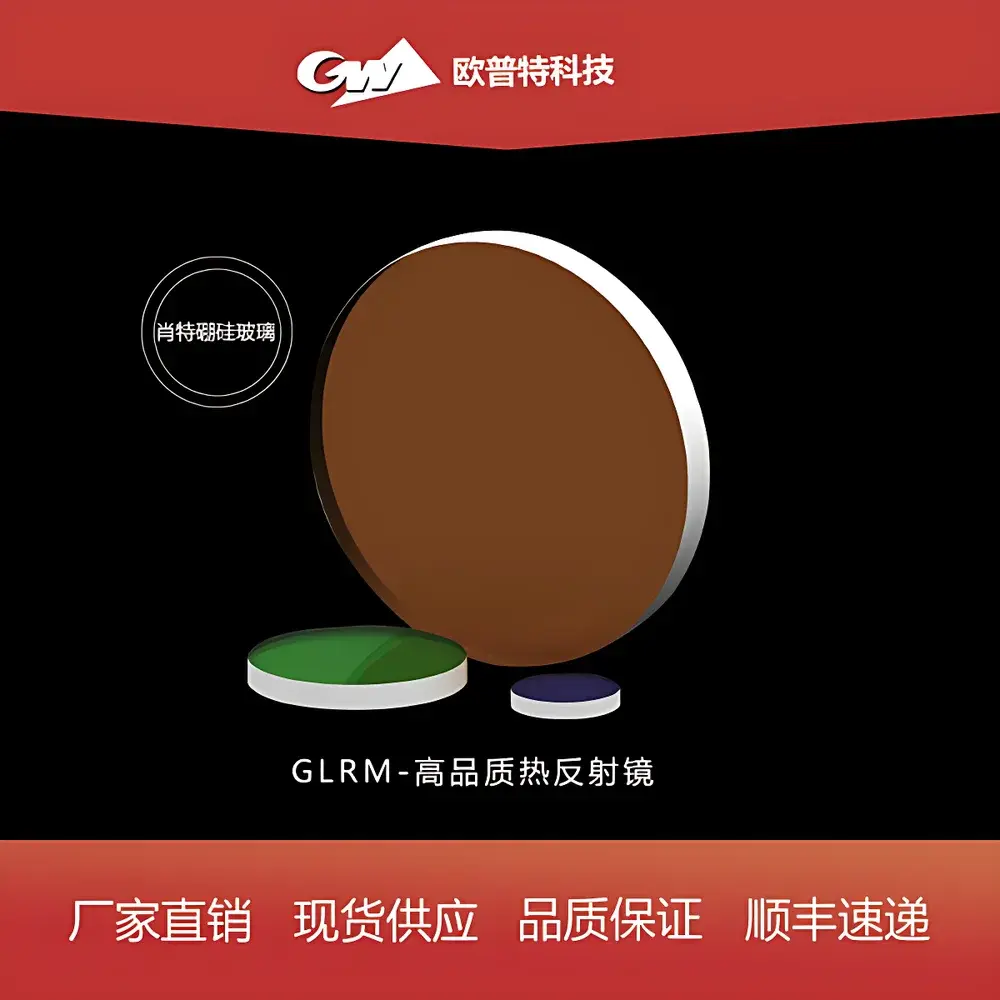
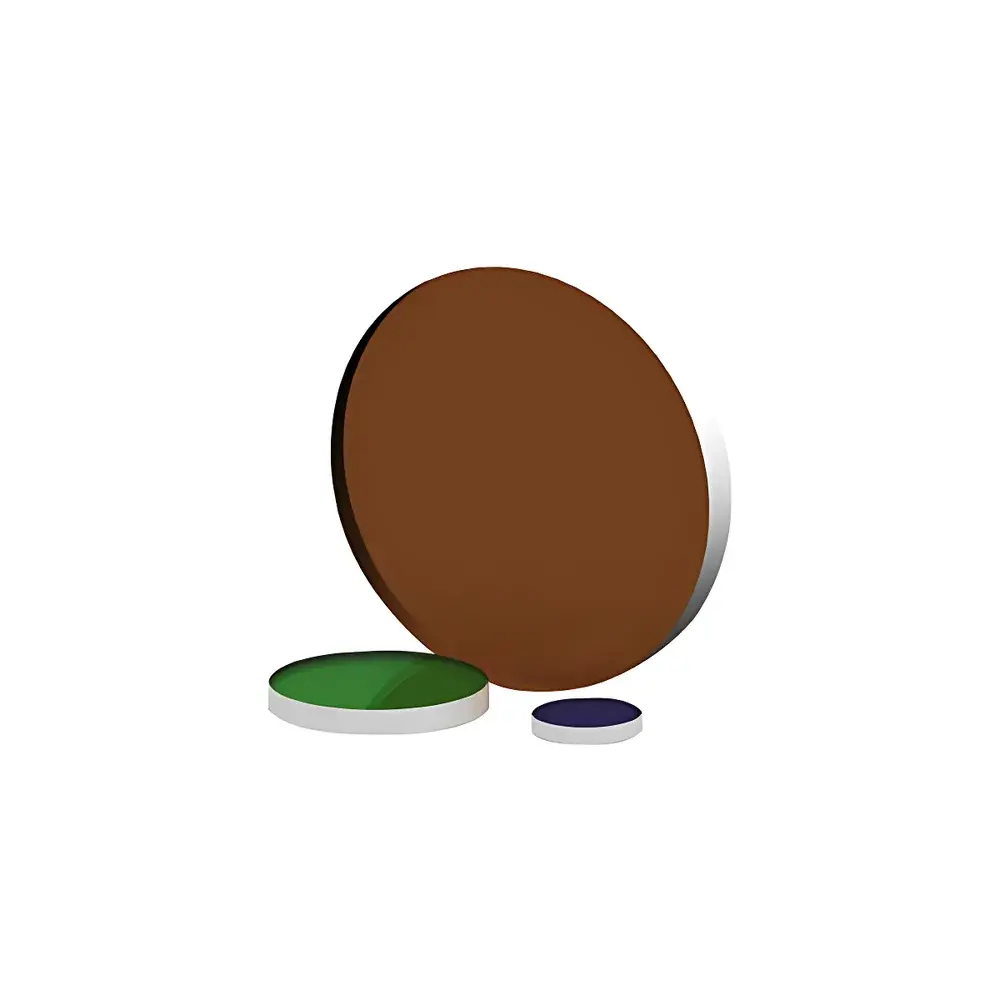
GLRM High-Performance Cold Mirror (Dielectric Hot Mirror)
| Origin | Beijing, China |
|---|---|
| Manufacturer Type | Authorized Distributor |
| Regional Origin | Domestic (PRC) |
| Model | GLRM |
| Price Range | USD 0.15–75.00 (per unit, depending on size/thickness) |
| Component Category | Optical Element |
| Incident Angle | 0° |
| Coating Type | All-Dielectric Multilayer Stack |
| Spectral Function | High Transmission in Visible (400–700 nm), High Reflection in Near-Infrared (750–1200 nm) |
Overview
The GLRM series is a precision-engineered all-dielectric cold mirror designed for high-power optical systems requiring spectral separation between visible and near-infrared (NIR) radiation. Operating at 0° angle of incidence, it leverages a robust multilayer dielectric thin-film coating deposited via ion-assisted e-beam evaporation to achieve >95% average transmission across the visible spectrum (400–700 nm) and >98% average reflection over the NIR band (750–1200 nm). Unlike absorptive heat-filtering substrates—such as doped glass or metallic-coated mirrors—the GLRM dissipates negligible optical energy (<0.5% absorption across both bands), eliminating thermal lensing, coating degradation, and substrate deformation under sustained irradiance. This makes it suitable for demanding applications including high-intensity LED projection optics, laser-based illumination engines, fluorescence microscopy beam combiners, and spectroscopic instrument dichroic elements where thermal stability and long-term spectral fidelity are critical.
Key Features
- All-dielectric multilayer coating optimized for 0° normal incidence, ensuring minimal polarization dependence and high wavefront fidelity.
- Low absorption design: <0.5% integrated absorption across 400–1200 nm, enabling stable performance under continuous-wave irradiance up to 5 kW/cm² (with appropriate heat sinking).
- Substrate options include UV-grade fused silica and BK7 optical glass, selected based on application-specific requirements for transmission uniformity, thermal expansion coefficient, and laser damage threshold.
- Standard thicknesses of 1.1 mm and 2.0 mm accommodate mechanical mounting constraints while maintaining flatness tolerance of λ/10 @ 633 nm (peak-to-valley).
- AR-coated back surface available upon request to suppress ghost reflections and enhance system contrast ratio.
- Compliant with ISO 10110-7 for surface quality (scratch-dig 10-5 standard) and ISO 9001-certified manufacturing traceability.
Sample Compatibility & Compliance
The GLRM is compatible with standard optomechanical mounts (e.g., SM1-threaded lens tubes, kinematic mirror mounts, and custom CNC-machined holders). It meets RoHS Directive 2011/65/EU for hazardous substance restrictions and conforms to ISO 14644-1 Class 5 cleanroom handling protocols during final inspection and packaging. For regulated environments—including medical device illumination subsystems and analytical instrumentation—the GLRM supports full documentation packages (CoC, CoA, spectral test reports per ISO/IEC 17025-accredited lab) and can be supplied with batch-specific spectral scans (350–1400 nm, 1 nm resolution). While not intrinsically certified to IEC 61000-4-x EMC standards (as a passive component), its dielectric construction ensures zero electromagnetic interference generation.
Software & Data Management
As a passive optical component, the GLRM requires no embedded firmware or driver software. However, spectral performance data—including measured transmission/reflection curves, coating layer stack specifications, and environmental durability test summaries—are delivered in standardized formats (CSV, PDF, and XML) compatible with optical design platforms such as Zemax OpticStudio, CODE V, and FRED. Customers may integrate these datasets directly into tolerance analysis workflows or import them into Lumerical MODE or Ansys SPEOS for multiphysics thermal-optical modeling. Traceable calibration records adhere to GLP principles and support audit readiness for FDA 21 CFR Part 11-compliant laboratories when paired with validated spectrophotometer measurement logs.
Applications
- Dichroic beam combining/splitting in RGB laser projectors and cinema light engines.
- Heat management in high-brightness microscope illuminators (e.g., confocal, super-resolution, and light-sheet systems).
- Spectral filtering in hyperspectral imaging systems operating across VIS-NIR bands.
- Protection of sensitive detectors (e.g., sCMOS, EMCCD) from NIR-induced thermal noise in astronomy and remote sensing setups.
- Optical isolation in fiber-coupled diode-pumped solid-state (DPSS) laser cavities.
- Reference-grade calibration components in NIST-traceable photometric and radiometric test benches.
FAQ
What is the maximum incident power density the GLRM can withstand without performance degradation?
Under forced-air cooling and with fused silica substrate, the GLRM maintains spectral performance at CW power densities ≤5 kW/cm² (measured at 808 nm, 1064 nm, and white-light broadband sources). Continuous operation above this threshold requires active water cooling and substrate-specific thermal modeling.
Is the coating resistant to humidity and cleaning solvents?
Yes—the dielectric stack is fully sealed and passes MIL-C-48497A humidity testing (95% RH, 40°C, 1000 h) and ASTM F1851 solvent resistance validation using methanol, isopropanol, and acetone wipes.
Can custom spectral cut-on/cut-off wavelengths be specified?
Yes. Custom designs are available for transition bands centered at 650 nm, 700 nm, 780 nm, or 850 nm, with typical edge steepness of Δλ < 25 nm (10%–90% transmission). Minimum order quantity applies.
Do you provide spectral measurement reports for each shipment?
Yes. Every production lot undergoes full-spectrum verification (350–1400 nm) on a PerkinElmer Lambda 1050+ spectrophotometer equipped with integrating sphere and calibrated NIST-traceable standards. Reports include raw data, uncertainty budgets, and pass/fail annotations against specification limits.
Are metric and imperial mounting hole patterns supported?
Mounting configurations are customer-defined. Standard products ship unmounted; custom kinematic mounts (e.g., Thorlabs KM100-compatible or Sutter Instrument M-series) can be integrated pre-shipment upon engineering review.



