
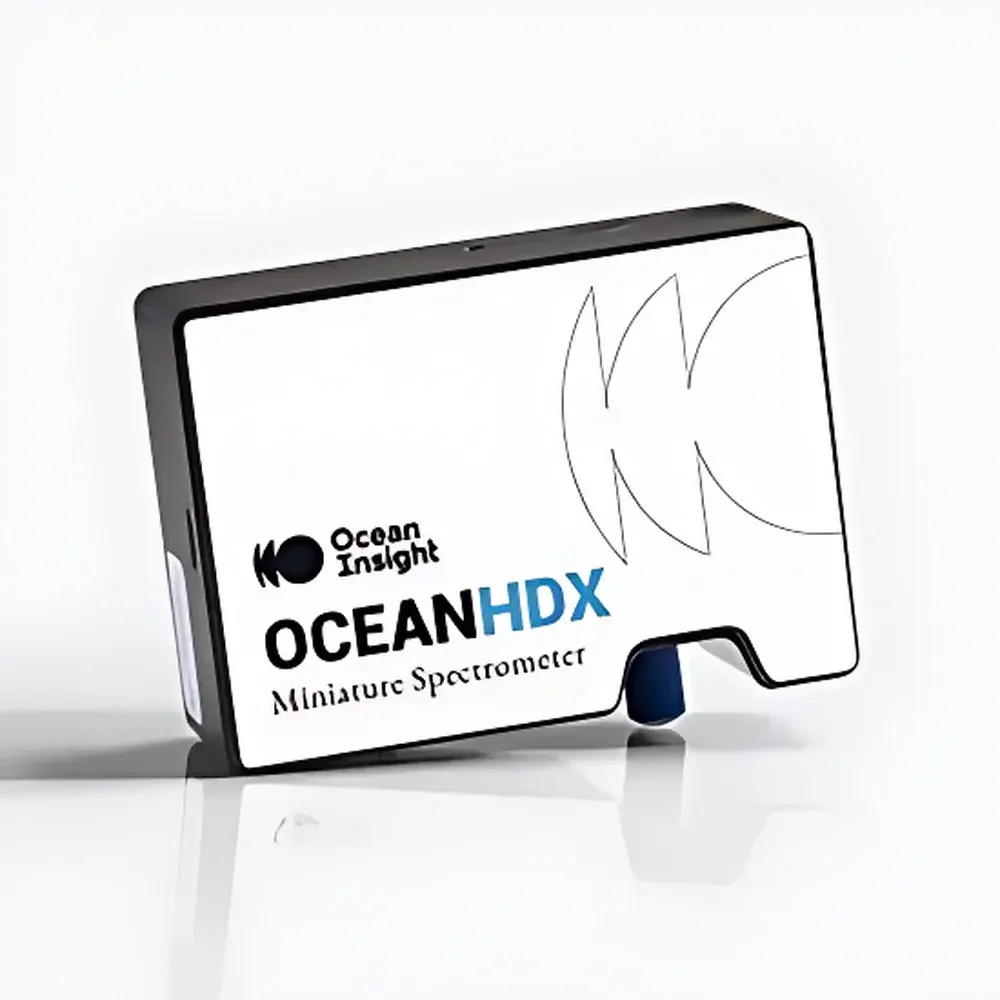
Ocean Optics Ocean HDX Fiber Optic Spectrometer
| Brand | Ocean Optics |
|---|---|
| Origin | Imported |
| Model | Ocean HDX |
| Spectral Range | 200–925 nm |
| Detector | Back-Illuminated Thin CCD |
| Resolution | 0.61–0.72 nm FWHM (with 10 µm slit) |
| Signal-to-Noise Ratio | 400:1 |
| Dynamic Range | 12,000:1 |
| Stray Light | < 0.05% (typical, 3 AU at 600 nm) |
| A/D Conversion | 16-bit |
| Integration Time | 6 ms – 10 s |
| Thermal Stability | ±1 pixel over 0–40 °C |
| f/# | f/4 |
| Onboard Memory | Up to 50,000 spectra |
| I/O | 8 programmable digital I/O lines |
| Communication Interfaces | USB 2.0, Gigabit Ethernet, Wi-Fi 802.11n, SPI, RS-232 |
| Operating Temperature | 0–40 °C |
| Dimensions | 88.9 × 63.5 × 52.4 mm |
| Weight | 400 g |
Overview
The Ocean Optics Ocean HDX Fiber Optic Spectrometer is a high-performance, compact benchtop spectrometer engineered for precision spectral acquisition in demanding industrial, embedded, and research environments. Based on a Czerny-Turner optical architecture with a back-illuminated, deep-depletion CCD detector, the HDX delivers exceptional sensitivity across the UV-VIS-NIR range (200–925 nm). Its low-stray-light design—achieving < 0.05% typical stray light at 600 nm—ensures accurate quantification of weak emission features and high-fidelity absorbance measurements, particularly critical in fluorescence, Raman, and colorimetry applications. The integrated X-electronics platform enables real-time onboard processing, eliminating latency associated with host-dependent data handling and supporting deterministic timing for synchronized multi-instrument systems.
Key Features
- High Thermal Stability: Maintains wavelength calibration within ±1 pixel over 0–40 °C, minimizing recalibration frequency in uncontrolled or field-deployed settings.
- Multi-Interface Connectivity: Native support for USB 2.0, Gigabit Ethernet, 802.11n Wi-Fi, SPI, and RS-232 ensures seamless integration into PLC-controlled production lines, IoT-enabled monitoring networks, or distributed lab instrumentation.
- Onboard Intelligence: Embedded ARM-based processor executes user-defined scripts (via OceanDirect SDK), performs real-time dark/bias correction, and stores up to 50,000 spectra internally—enabling autonomous operation during network outages or high-speed burst acquisition.
- Robust Optical Design: f/4 input optics combined with optimized grating efficiency yield high photon throughput; coupled with 16-bit A/D conversion and 12,000:1 dynamic range, the HDX resolves both strong and weak spectral features simultaneously without gain switching artifacts.
- Programmable I/O Architecture: Eight general-purpose digital I/O lines support TTL-triggered acquisition, external shutter control, LED synchronization, and hardware handshake protocols—essential for time-resolved spectroscopy and process analytical technology (PAT) workflows.
Sample Compatibility & Compliance
The Ocean HDX interfaces seamlessly with standard SMA 905 fiber-optic cables (e.g., 200 µm, 400 µm, or 600 µm core diameters), enabling flexible sampling configurations—including reflection probes, immersion probes, flow cells, and integrating spheres. Its compact form factor (88.9 × 63.5 × 52.4 mm) and low power consumption (< 3 W) make it suitable for OEM integration into handheld analyzers, portable environmental monitors, and inline pharmaceutical reactors. From a regulatory standpoint, the HDX supports audit-trail-capable data logging when deployed with compliant software (e.g., OceanView v3.x with FDA 21 CFR Part 11 add-on), and its measurement repeatability aligns with ISO/IEC 17025 requirements for spectral instrument validation. It is routinely used in ASTM E308-compliant color measurement, USP spectrophotometric system suitability testing, and GLP-compliant QC labs.
Software & Data Management
Ocean HDX is fully supported by OceanView spectroscopy software (Windows/macOS/Linux), offering intuitive spectrum visualization, multivariate analysis (PCA, PLS), and customizable reporting templates. For automated environments, the OceanDirect SDK provides native C/C++, Python, MATLAB, LabVIEW, and .NET APIs—with deterministic timing control and thread-safe multichannel acquisition. All raw spectral data are stored in vendor-neutral formats (e.g., CSV, HDF5, or JCAMP-DX), ensuring long-term archival compatibility and third-party tool interoperability. Firmware updates are delivered over-the-air via Ethernet or Wi-Fi, and onboard memory logs include timestamp, temperature, integration time, and detector gain—enabling full traceability per ISO 9001 and GMP documentation standards.
Applications
- Real-time monitoring of chemical reactions in flow reactors and bioreactors
- UV-Vis quantification of active pharmaceutical ingredients (APIs) in dissolution testing
- LED and OLED spectral power distribution (SPD) and chromaticity analysis
- Environmental water quality assessment (nitrate, chlorophyll-a, dissolved organic carbon)
- Plasma emission characterization in semiconductor etch and deposition tools
- Food authenticity screening via NIR fingerprinting and adulterant detection
- Portable Raman excitation source characterization and laser line stability verification
FAQ
What spectral resolution can be expected with different slit widths?
Resolution scales linearly with slit width. While the specified 0.61–0.72 nm FWHM is measured with a 10 µm slit, using 25 µm or 50 µm slits yields ~1.5 nm and ~3.0 nm FWHM respectively—trading resolution for increased signal-to-noise in low-light applications.
Is the Ocean HDX compatible with third-party fiber-optic accessories?
Yes. It accepts any SMA 905-terminated fiber probe or cuvette holder compliant with industry-standard coupling geometry and NA ≤ 0.22.
How is wavelength calibration maintained during thermal cycling?
The HDX employs an internal temperature-compensated grating mount and real-time pixel-to-wavelength mapping correction, validated across 0–40 °C per NIST-traceable procedures.
Can the HDX operate autonomously without a connected PC?
Yes. With preloaded acquisition scripts and trigger logic, it can log spectra to internal memory or stream via Ethernet/Wi-Fi to remote servers—ideal for edge computing deployments.
Does the HDX support dark current subtraction during integration?
Yes. Both hardware-synchronized dark reference acquisition and software-based dark frame interpolation are supported through OceanView and OceanDirect.
Related Products







