
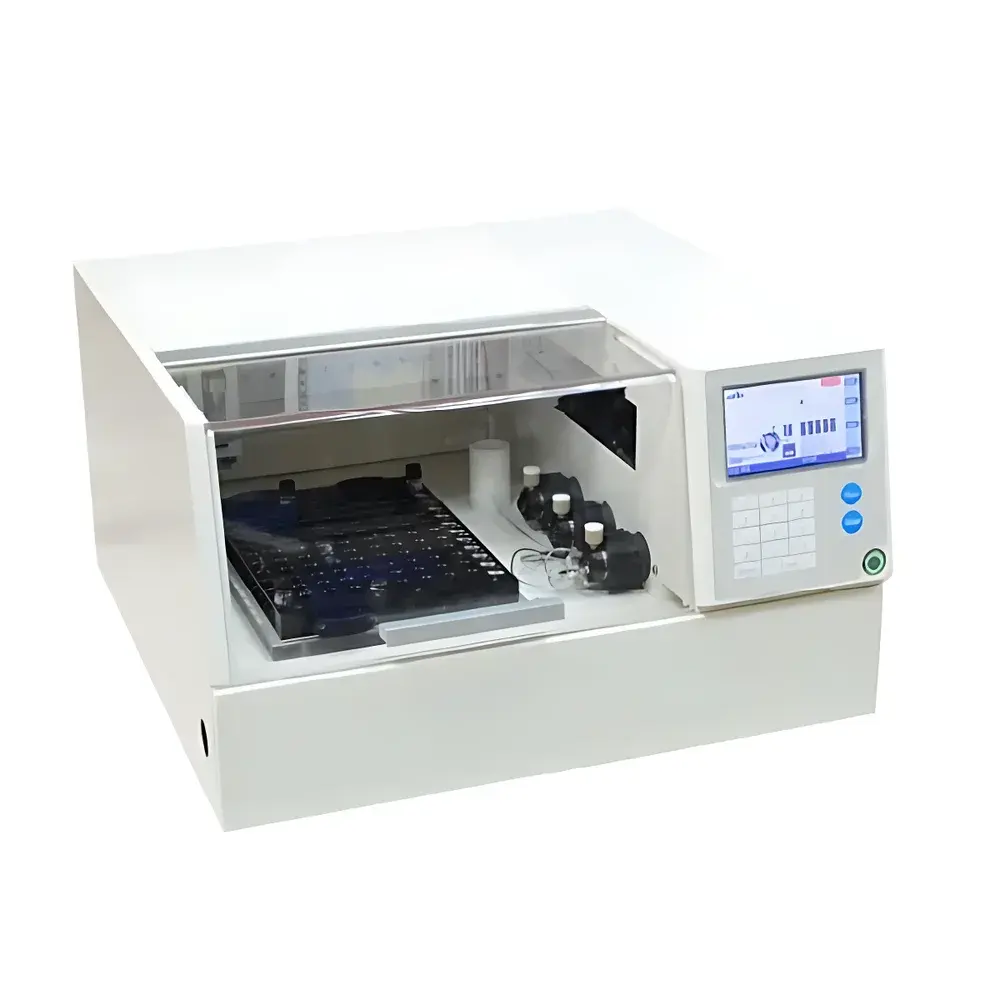
UC-3265 Multifunctional Liquid Chromatography Autosampler
| Brand | Youlian Optoelectronics |
|---|---|
| Origin | Beijing, China |
| Model | UC-3265 |
| Instrument Type | HPLC Autosampler |
| Sample Capacity | Up to 120 vials (configurable trays) |
| Injection Volume Range | 3–250 µL |
| Precision | RSD < 0.5% (peak area, typical) |
| Carryover | < 0.02% |
| Wash Volume | 0–250 µL (adjustable) |
| Wash Cycles | 1–9 (user-selectable) |
| Syringe Capacity | 250 µL |
| Gradient Accuracy | ±1% |
| Operating Temperature | 10–30 °C |
| Sample Cooling Range | 4–40 °C (±2 °C stability) |
| Display | 4.3-inch TFT LCD touchscreen |
| Controller | 32-bit ARM7 embedded microprocessor |
| Communication | RS-232 / RS-485 |
| Injection Mode | X-Y-Z robotic motion with repeat-injection capability (1–99× per vial) |
Overview
The UC-3265 Multifunctional Liquid Chromatography Autosampler is an engineered solution for high-throughput, reproducible sample introduction in reversed-phase, ion-exchange, size-exclusion, and other HPLC/UHPLC applications. Designed for integration with major vendor LC systems—including Agilent, Waters, Shimadzu, and Thermo Fisher—the UC-3265 employs a precise X-Y-Z robotic arm architecture to position the sampling needle over target vials with sub-millimeter repeatability. Its core fluidic path utilizes a fixed-loop or direct-injection syringe-driven mechanism, minimizing dwell volume and ensuring minimal band broadening during transfer. The system supports both single-injection and programmable repeat-injection protocols (1–99 cycles per vial), enabling robust method development for low-abundance analytes, calibration curve verification, and system suitability testing. All critical operational parameters—including aspiration volume, injection volume, wash volume, wash cycles, and thermal management—are fully programmable via an intuitive embedded interface.
Key Features
- High-precision 250 µL glass syringe with PTFE-coated plunger, delivering accurate volumetric delivery from 3 µL to full capacity with <0.5% RSD on peak area under standardized test conditions.
- Configurable sample handling: accommodates standard 12 × 75 mm, 15 × 45 mm, and 18 × 90 mm vials; optional trays support up to 120 samples per run.
- Dual-stage cleaning protocol: programmable wash volume (0–250 µL) and cycle count (1–9) ensure carryover remains below 0.02%, validated using caffeine or acetaminophen challenge tests per ASTM D7982 guidelines.
- Integrated Peltier-based cooling module maintains sample tray temperature between 4 °C and 40 °C with ±2 °C uniformity—critical for thermally labile compounds and long unattended runs.
- ARM7 32-bit embedded controller ensures deterministic real-time operation, independent of host PC performance; firmware supports field-upgradable logic via serial interface.
- RS-232 and RS-485 communication ports enable bidirectional handshake with LC controllers and LIMS environments, supporting ASCII command sets compatible with most chromatography data systems (CDS).
Sample Compatibility & Compliance
The UC-3265 is compatible with aqueous, organic, and mixed-solvent mobile phases commonly used in HPLC analysis, including acetonitrile, methanol, phosphate buffers, and trifluoroacetic acid solutions. All wetted parts—including syringe barrel, needle, rotor seal, and wash port—are chemically resistant (e.g., stainless steel 316, PEEK, ruby, and sapphire components) to withstand aggressive solvents and pH ranges from 1.5 to 12.0. The system meets mechanical safety requirements per IEC 61010-1 and electromagnetic compatibility standards EN 61326-1. While not certified as GMP-compliant out-of-the-box, its audit-trail-capable firmware architecture (with timestamped method logs and error registers) supports validation under FDA 21 CFR Part 11 when deployed with compliant CDS software and procedural controls.
Software & Data Management
Operation is managed locally via a 4.3-inch true-color LCD touchscreen running a dedicated real-time OS. Users define methods directly on-device—including injection sequence, volume ramping, pre- and post-injection wash routines, and temperature setpoints—without requiring external software. Full method export/import is supported via USB memory stick in CSV format. For enterprise integration, ASCII-based command protocols allow seamless scheduling through third-party CDS platforms. System event logs—including syringe stall detection, temperature excursions, and communication timeouts—are retained for ≥30 days and can be retrieved via serial dump. Optional firmware extensions support GLP-aligned features such as electronic signatures, user role-based access control, and immutable method archiving.
Applications
- Pharmaceutical QC: dissolution testing, assay quantification, and impurity profiling per USP & EP monographs.
- Environmental analysis: PAHs, pesticides, and pharmaceutical residues in wastewater matrices using EPA Method 8330B-compatible workflows.
- Clinical research: therapeutic drug monitoring (TDM) of immunosuppressants and antiepileptics requiring low-volume, high-reproducibility injections.
- Academic labs: method scouting for column screening, gradient optimization, and retention time locking studies.
- Food & beverage: mycotoxin screening, vitamin quantification, and preservative analysis where sample stability and carryover control are critical.
FAQ
Does the UC-3265 support partial-loop injection mode?
Yes—users may configure aspiration volume independently from injection volume, enabling partial-loop and overflow injection strategies without hardware modification.
Can it be controlled remotely via Ethernet or USB?
No native Ethernet or USB device-mode control is provided; communication is limited to RS-232/RS-485. However, USB-to-serial adapters are widely deployed in production environments for host connectivity.
Is method validation documentation available?
A comprehensive IQ/OQ protocol template—including linearity, precision, carryover, and temperature uniformity test procedures—is supplied with the instrument and aligns with ISO/IEC 17025 and ASTM E2656 guidance.
What maintenance intervals are recommended?
Syringe and needle replacement every 10,000 injections; rotor seal replacement every 5,000 injections; annual calibration verification using NIST-traceable volumetric standards is advised.
Does it support 96-well plate sampling?
Not natively—only vial-based trays are supported. Plate-handling requires external robotics integration or custom adapter fixtures, which fall outside standard warranty coverage.



