
UC-3268 Ultra-Integrated HPLC Workstation with Full Instrument Control
| Brand | Youlian Optoelectronics |
|---|---|
| Origin | Beijing, China |
| Model | UC-3268 |
| Manufacturer Type | Authorized Distributor |
| Regional Classification | Domestic (PRC) |
| Pricing | Available Upon Request |
Overview
The UC-3268 Ultra-Integrated HPLC Workstation is a fully controlled, PC-based chromatographic data system engineered for precision liquid chromatography analysis. Designed to operate in tandem with modular HPLC hardware—including pumps, autosamplers, column ovens, and UV/Vis or fluorescence detectors—the workstation implements real-time bidirectional communication via standard RS-232, USB, or Ethernet interfaces. It operates on the principle of digital signal acquisition, peak detection, retention time alignment, and quantitative calculation based on calibrated response factors. The system supports isocratic and gradient elution methods, enabling method development, routine QC testing, stability-indicating assays, and impurity profiling in compliance with pharmaceutical, environmental, and academic laboratory requirements.
Key Features
- Comprehensive Quantitation Engine: Supports four standardized quantitation algorithms—area normalization, corrected area normalization, external standard calibration, and internal standard correction—with user-defined weighting options and dynamic integration threshold adjustment.
- Monolithic Data Architecture (ALL-IN-ONE): Each acquired dataset is stored as a single binary file containing chromatograms, sample metadata (ID, injection volume, operator, timestamp), processed peak tables, calibration curves, instrument control parameters (flow rate, wavelength, gradient profile), and report templates—ensuring full traceability and audit readiness.
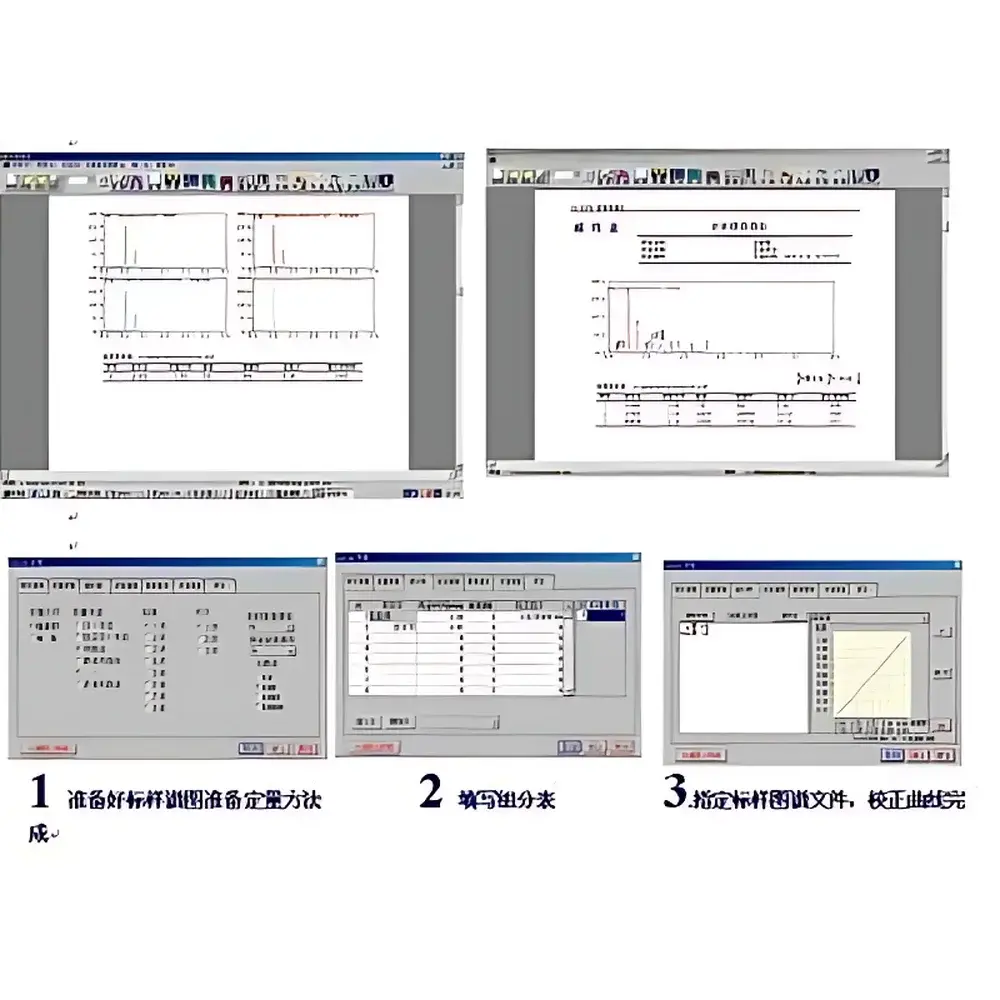
- WYSIWYG Report Designer: A Microsoft Word–style drag-and-drop interface allows users to construct customizable reports with embedded chromatograms, tabular results, statistical summaries (RSD%, % recovery, linearity R²), and company-branded headers/footers—without scripting or third-party tools.
- Multi-Chromatogram Reporting: Enables side-by-side or overlaid display of up to 16 chromatograms on a single page, with independent scaling, shared x-axis alignment, and synchronized peak labeling. Statistical aggregation across batches (e.g., mean RT, %RSD of area) is auto-generated within the report.
- Unified Graphical Workflow: All operations—peak identification, baseline correction, integration event definition, calibration curve fitting, and result export—are executed within a single, tabbed application window, minimizing context switching and reducing operator error risk.
Sample Compatibility & Compliance
The UC-3268 workstation is compatible with reversed-phase, normal-phase, ion-exchange, and size-exclusion HPLC configurations using standard 4.6 mm × 150 mm columns and common mobile phases (acetonitrile/water, methanol/buffer, THF/hexane). It accepts analog voltage inputs (0–1 V or 0–5 V) from legacy detectors and digital outputs from modern smart modules. From a regulatory standpoint, the software architecture supports ALCOA+ principles: attributable, legible, contemporaneous, original, and accurate data handling. Audit trail functionality records all method modifications, result reprocessing events, and user logins with timestamps and operator IDs. While not pre-certified for FDA 21 CFR Part 11, the system can be configured to meet GLP/GMP documentation requirements when deployed with appropriate SOPs, electronic signature protocols, and periodic validation documentation (IQ/OQ/PQ).
Software & Data Management
Built on a .NET Framework foundation, the UC-3268 software runs on Windows 10/11 (64-bit) and supports local database storage (SQL Server Express) or network-shared project folders. Raw data files are immutable; all processing steps generate new versions with version stamps and parent-child relationships. Export formats include CSV (for LIMS integration), PDF/A-2b (archival), PNG/SVG (publication-ready graphics), and XML (for cross-platform instrument method transfer). Backup and restore routines support scheduled incremental backups with SHA-256 checksum verification. Multi-user access control allows role-based permissions (e.g., analyst, supervisor, administrator) aligned with ISO/IEC 17025 laboratory management systems.
Applications
The UC-3268 is routinely deployed in pharmaceutical QC labs for assay determination of active pharmaceutical ingredients (APIs), related substances testing per ICH Q2(R2), and dissolution profile comparison. In environmental labs, it supports EPA Method 8330B (PAHs) and 8082A (PCBs) analysis. Academic researchers use it for natural product isolation monitoring, polymer molecular weight distribution assessment (SEC-GPC), and chiral separation method optimization. Its flexible calibration engine also accommodates non-linear response models (quadratic, cubic) required for high-concentration analyte quantification.
FAQ
Does the UC-3268 support FDA 21 CFR Part 11 compliance out of the box?
No—compliance requires additional configuration including electronic signature implementation, audit trail activation, and documented validation. It provides the foundational capabilities but must be qualified per site-specific regulatory requirements.
Can I import legacy chromatograms from other vendors’ software?
Yes—via ASCII (.txt) or AIA/CDF format import, though peak table reconstruction may require manual validation due to vendor-specific integration logic.
Is remote monitoring or control possible?
Remote desktop access is supported; however, real-time instrument control over WAN is not recommended due to latency-sensitive timing constraints in pump/detector synchronization.
What detector types are natively supported?
UV/Vis absorbance, diode array (DAD), fluorescence (FLD), conductivity, and electrochemical detectors with analog output or RS-232/USB command sets.
How often is software updated, and are updates included in maintenance?
Minor version updates (bug fixes, minor enhancements) are provided free for licensed users within the first 12 months; major version upgrades require a maintenance agreement.





