
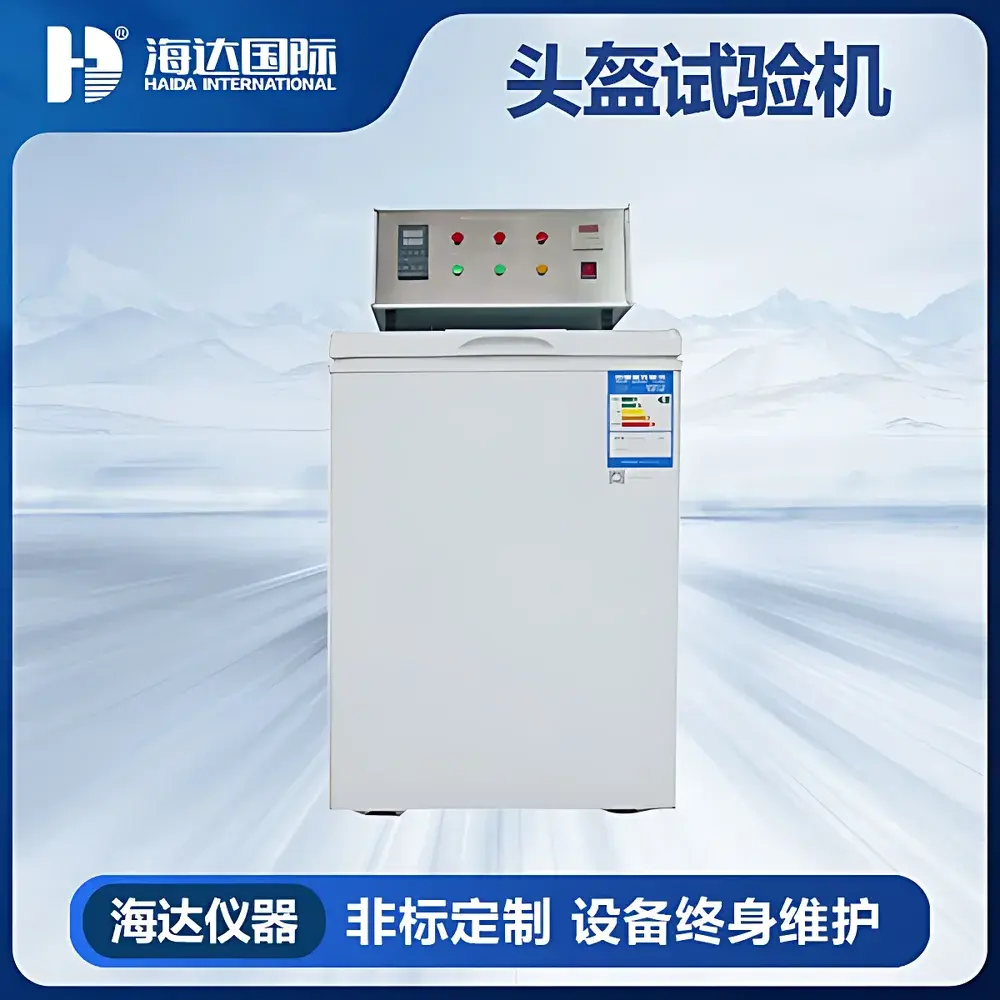
HAIDA HD-K507 Helmet Low-Temperature Water Immersion Preconditioning Chamber
| Brand | HAIDA INTERNATIONAL |
|---|---|
| Origin | Guangdong, China |
| Manufacturer Type | Direct Manufacturer |
| Product Category | Domestic Equipment |
| Model | HAIDA HD-K507 Helmet Low-Temperature Water Immersion Preconditioning Chamber |
| Pricing | Available Upon Request |
Overview
The HAIDA HD-K507 Helmet Low-Temperature Water Immersion Preconditioning Chamber is a purpose-built environmental conditioning system engineered to perform standardized low-temperature water immersion pretreatment of protective helmets prior to impact, penetration, or retention testing. Designed in strict accordance with international test protocols—including ISO 10819:2013 (hand-arm vibration), EN 397:2012+A1:2012 (industrial safety helmets), ASTM F1163 (equestrian headgear), and GB/T 2812–2006 (test methods for safety helmets in China)—the chamber enables precise thermal equilibration of helmet assemblies in aqueous media at controlled sub-zero temperatures. The unit operates on the principle of forced-circulation glycol-water bath immersion, ensuring uniform temperature distribution across the entire test specimen volume while maintaining thermal stability within ±0.5 °C over extended preconditioning durations (typically 4 h to 24 h). Its robust stainless-steel tank construction, insulated chamber housing, and programmable digital temperature controller support repeatable, traceable, and auditable preconditioning cycles required for GLP-compliant laboratories and third-party certification bodies.
Key Features
- Stainless-steel immersion tank with corrosion-resistant interior finish and integrated overflow drainage system
- Digital PID temperature controller with real-time display, setpoint resolution of 0.1 °C, and adjustable ramp rate
- Glycol-water refrigeration system capable of sustaining stable operation from –20 °C to +10 °C (ambient-dependent; nominal range: –15 °C to +5 °C at 25 °C ambient)
- Programmable timer with up to 99-hour duration and automatic power-off function upon cycle completion
- Integrated water level sensor with audible/visual low-level alarm and pump interlock protection
- CE-marked electrical architecture compliant with IEC 61000-6-2 (immunity) and IEC 61000-6-4 (emission) standards
- Modular design supporting optional accessories: specimen support racks, calibrated NIST-traceable PT100 probe, and external data logging interface (RS485)
Sample Compatibility & Compliance
The HD-K507 accommodates full-size industrial, motorcycle, equestrian, and construction helmets—including composite shell designs with EPS liners, chin straps, retention systems, and accessory mounts. Internal dimensions (W × D × H) allow vertical immersion of helmets up to 350 mm tall and 280 mm wide. The chamber satisfies preconditioning requirements specified in multiple regulatory frameworks: EN 397 Annex A (cold water immersion at 0 °C ± 2 °C for 4 h), ASTM F1163 Section 6.2.1 (–10 °C ± 2 °C for 4 h), and GB/T 2812–2006 Clause 5.2 (–10 °C ± 2 °C for 2 h). All thermal performance verifications are conducted per ISO/IEC 17025-accredited procedures using certified reference thermometers and calibrated immersion baths. Documentation includes factory calibration certificate (traceable to CNAS), compliance declaration per RoHS 2011/65/EU, and conformity statement to Machinery Directive 2006/42/EC.
Software & Data Management
While the base HD-K507 operates via standalone hardware control, an optional HAIDA DataLink Module enables serial communication (RS485 Modbus RTU) for integration into centralized laboratory information management systems (LIMS). Temperature profiles, start/stop timestamps, and alarm events can be exported in CSV format for audit trail generation. When used in conjunction with HAIDA’s optional Validation Package (VP-HD-K507), users receive IQ/OQ documentation templates aligned with FDA 21 CFR Part 11 expectations—supporting electronic signature capability, user access levels, and change-controlled configuration logs. Raw temperature data meets ALCOA+ principles (Attributable, Legible, Contemporaneous, Original, Accurate, Complete, Consistent, Enduring, Available) for regulatory submissions.
Applications
- Preconditioning helmets prior to drop testing per EN 397, ANSI Z89.1, or CSA Z94.1
- Simulating cold-weather service conditions for PPE validation under ISO 12100 risk assessment frameworks
- Supporting accelerated aging studies where thermal shock resistance of helmet adhesives and foam liners is evaluated
- Providing controlled thermal history for comparative analysis of liner compression recovery after low-temperature exposure
- Enabling reproducible test sequencing in accredited conformity assessment laboratories conducting CE marking or CCC certification
FAQ
What is the minimum immersion depth required for helmet preconditioning in this chamber?
The standard immersion depth is defined by test standards—not equipment specifications. EN 397 requires full submersion of the helmet shell; the HD-K507 tank depth (300 mm) ensures compliance for all helmets meeting EN 397 dimensional limits.
Does the unit include a water chiller or require external refrigeration?
The HD-K507 integrates a self-contained refrigeration system with hermetic compressor and glycol-water heat exchange loop—no external chiller is needed.
Can the chamber be validated for GMP or ISO 17025 compliance?
Yes. With the optional Validation Package (VP-HD-K507), users receive IQ/OQ protocols, calibration records, and deviation handling guidance aligned with ISO/IEC 17025:2017 Clause 6.4 and Annex A.
Is the water bath solution compatible with deionized or distilled water?
Yes. Glycol concentration (typically 30–40% v/v propylene glycol) must be maintained to prevent freezing and ensure thermal homogeneity; DI water is recommended as the base solvent.
What maintenance intervals are recommended for long-term reliability?
Compressor oil and refrigerant charge verification every 24 months; glycol solution replacement and tank cleaning every 12 months; annual recalibration of the PT100 sensor against a certified reference standard.



