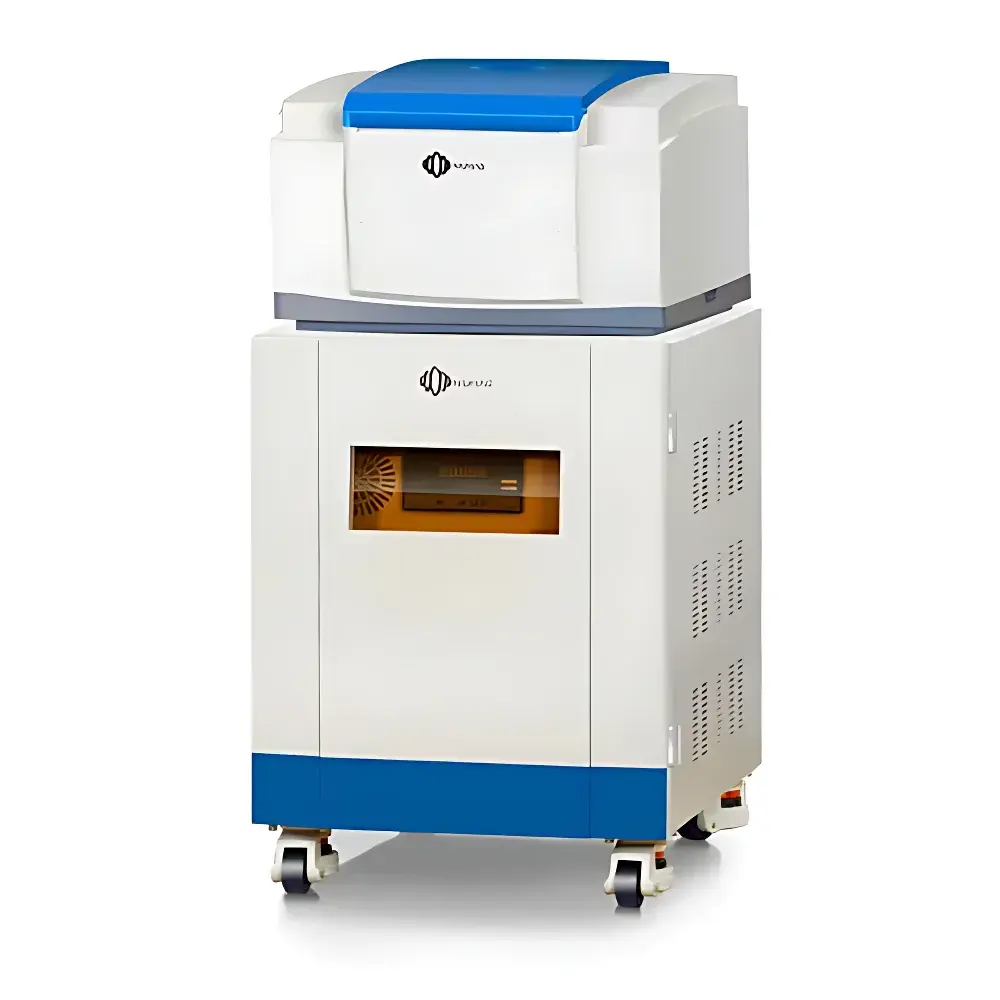
NIUMAG PQ001-lh Low-Field NMR Analyzer for Oil-in-Sulfur Powder Quantification
| Brand | NIUMAG |
|---|---|
| Origin | Jiangsu, China |
| Manufacturer Type | Authorized Distributor |
| Regional Classification | Domestic (China) |
| Model | PQ001-lh |
| Pricing | Available Upon Request |
Overview
The NIUMAG PQ001-lh is a dedicated low-field nuclear magnetic resonance (LF-NMR) analyzer engineered for rapid, non-destructive quantification of oil and water content in sulfur powder and other hygroscopic or oil-modified industrial powders. It operates on the fundamental principle of proton spin relaxation contrast between immiscible liquid phases—specifically, the differential transverse relaxation times (T₂) of hydrogen nuclei in water versus hydrocarbon-based oils. By applying a Carr–Purcell–Meiboom–Gill (CPMG) spin-echo pulse sequence, the instrument acquires decay signals from mobile ¹H protons in both phases. The initial echo amplitude (A₁) reflects total mobile proton density (oil + water), while the late-echo amplitude (A₂), acquired after sufficient T₂ decay of the faster-relaxing water component, isolates the oil-specific signal. The difference (A₁ − A₂) correlates linearly with water content, enabling simultaneous dual-component quantification without chemical separation. This physics-based methodology eliminates reliance on empirical solvent extraction, delivering measurement repeatability within ±0.15 wt% under controlled temperature and calibration conditions.
Key Features
- Non-invasive, solvent-free analysis: No hazardous chlorinated or aromatic solvents required—fully compliant with OSHA and REACH occupational safety guidelines.
- Rapid single-sample throughput: Full oil/water quantification completed in 30–180 seconds per measurement, supporting real-time batch release and process monitoring.
- Robust solid-powder compatibility: Optimized RF coil design and sample holder geometry accommodate heterogeneous sulfur powder matrices (particle size range: 20–500 µm) without compaction or dilution.
- Temperature-stabilized magnet system: Permanent NdFeB magnet with active thermal regulation (±0.2 °C) ensures T₂ stability critical for quantitative reproducibility across shifts and ambient fluctuations.
- Self-calibrating workflow: Built-in reference standard mode enables daily verification using traceable oil/water phantoms; calibration curves validated against ASTM D6304 (Karl Fischer titration) and ISO 16967 (solvent extraction) protocols.
Sample Compatibility & Compliance
The PQ001-lh is validated for direct analysis of elemental sulfur powders, including sublimed, precipitated, and colloidal grades, as well as analogous hydrophobic industrial powders (e.g., calcium carbonate, talc, and polymer masterbatches) where oil dispersion or surface lubrication is applied. It complies with GLP documentation requirements through audit-ready measurement logs, user-access-level permissions, and timestamped raw FID/CPMG data export. While not FDA 21 CFR Part 11 certified out-of-the-box, its software architecture supports electronic signature implementation and secure audit trails when deployed in regulated QC environments. All hardware meets IEC 61000-6-3 (EMC) and IEC 61000-6-2 (immunity) standards.
Software & Data Management
NIUMAG’s proprietary MesoMR Studio v4.2 provides intuitive acquisition control, automated T₂ inversion (non-negative least squares), and multi-parameter regression modeling. Raw time-domain data are stored in HDF5 format with embedded metadata (operator ID, timestamp, temperature, pulse sequence parameters). Batch reporting exports CSV/Excel files containing oil %, water %, T₂ distribution width (Dₜ₂), and measurement uncertainty estimates. Optional integration with LIMS via RESTful API enables automated result transfer to enterprise quality databases. All processing algorithms are transparent and user-auditable—no black-box curve-fitting.
Applications
- Quality assurance of sulfur granules in fertilizer and rubber vulcanization feedstock production.
- In-process monitoring of oil-coating uniformity during fluidized-bed surface treatment of mineral powders.
- Stability assessment of oil-retention performance under thermal cycling (40–70 °C).
- Method validation studies comparing LF-NMR against reference methods per ISO/IEC 17025 accreditation requirements.
- R&D screening of alternative lubricants (e.g., bio-based esters vs. mineral oils) in powder formulation development.
FAQ
Is sample preparation required before measurement?
No centrifugation, drying, or solvent addition is needed. Simply load 3–5 g of representative sulfur powder into the standard 15 mm OD glass tube and insert into the probe.
Can the instrument distinguish between different oil types (e.g., paraffinic vs. naphthenic)?
Not directly—quantification assumes consistent T₂ contrast between oil and water phases. However, multivariate calibration models can be trained for specific oil chemistries if reference data are available.
What is the minimum detectable oil content?
Detection limit is 0.05 wt% oil in dry sulfur matrix at 30 °C, verified per ISO 11843-2 (capability of detection).
Does ambient humidity affect measurement accuracy?
Yes—samples must be analyzed within 15 minutes of opening sealed packaging to prevent moisture equilibration. Optional desiccator-integrated sample loading module is available.
Is routine maintenance required?
The permanent magnet requires no cryogen refills or shimming. Annual RF coil impedance verification and temperature sensor calibration are recommended per ISO/IEC 17025 preventive maintenance schedules.
Related Products