
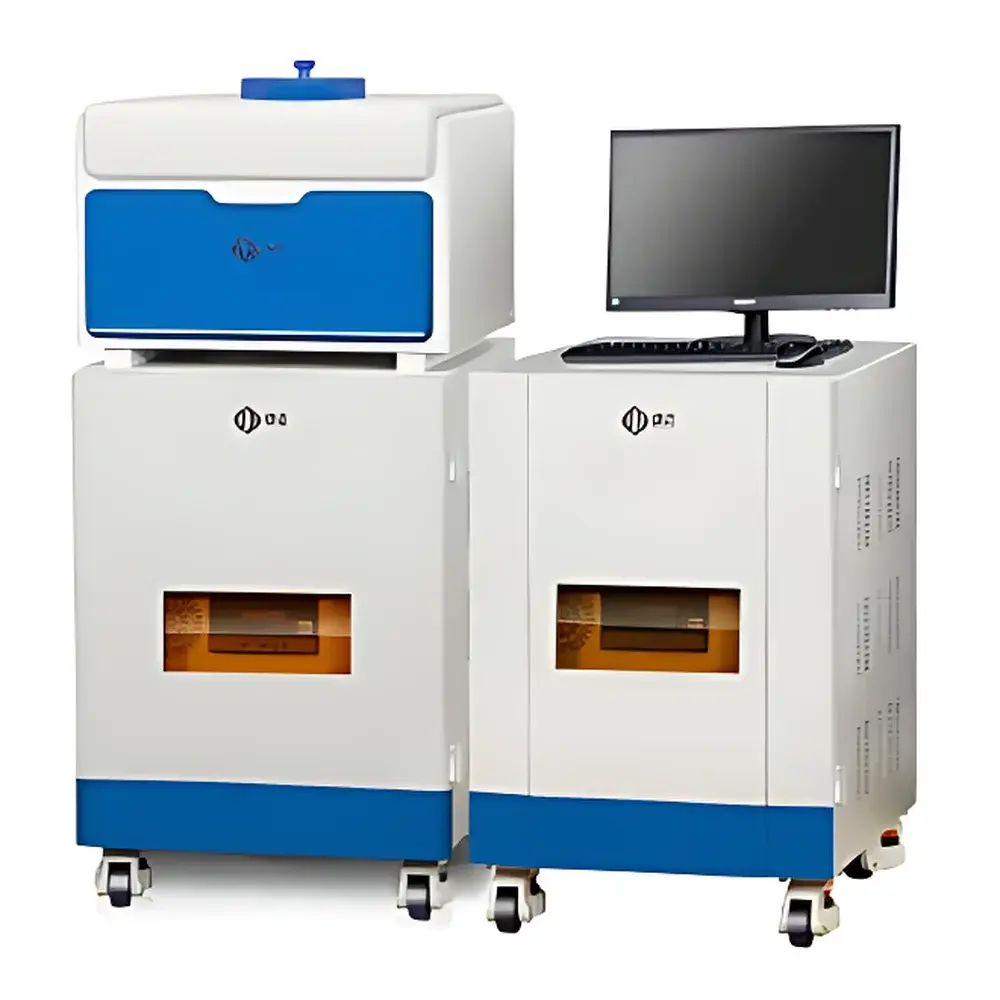
NIUMAG VTMR Variable-Temperature Low-Field Nuclear Magnetic Resonance Analyzer
| Brand | NIUMAG |
|---|---|
| Origin | Jiangsu, China |
| Manufacturer Type | Authorized Distributor |
| Product Category | Domestic |
| Model | VTMR |
| Instrument Type | Low-Field NMR Analyzer |
| Sample Compatibility | Solid-Liquid Dual-Phase |
| Magnet Type | Permanent Magnet |
| Static Field Strength | 0.5 ± 0.05 T |
| Standard Temperature Range | Ambient to 130 °C |
| Optional Cryo/High-Temp Module | –100 °C to 200 °C |
| Imaging Capability | Optional |
| Core Technology | FLAT (Fast Low-Amplitude Transient) Acquisition for Short-T₂/Weak-Signal Detection |
| Primary Measurement Modes | T₁ & T₂ Relaxometry, Diffusion-Weighted Analysis, MR Imaging (optional) |
Overview
The NIUMAG VTMR Variable-Temperature Low-Field Nuclear Magnetic Resonance Analyzer is an engineered platform for quantitative, non-invasive characterization of molecular dynamics and microstructural evolution under controlled thermal conditions. Operating at a static magnetic field of 0.5 ± 0.05 T generated by a stable permanent magnet system, the VTMR leverages pulsed NMR principles—including spin-echo, inversion-recovery, and stimulated-echo sequences—to extract fundamental relaxation parameters (T₁, T₂, and diffusion coefficients) from heterogeneous samples across solid, semi-solid, gel, and liquid phases. Its integrated variable-temperature probe enables in situ thermal ramping and isothermal hold protocols, facilitating kinetic studies of crosslinking, phase transitions, solvent migration, crystallization, and aging processes. Unlike high-field NMR systems, the VTMR prioritizes robustness, operational simplicity, and process-relevant throughput—making it suitable for QC laboratories, R&D centers, and pilot-scale process monitoring environments where repeatability, long-term stability, and minimal sample preparation are critical.
Key Features
- Thermally Controlled Probe Architecture: Standard temperature range spans ambient to +130 °C; optional extended-range module supports operation from –100 °C to +200 °C with ±0.1 °C thermal stability and programmable ramp rates (0.1–10 °C/min).
- FLAT Acquisition Technology: Proprietary signal averaging and pulse sequence optimization designed specifically for low-SNR regimes typical of short-T₂ materials (e.g., rubber networks, hydrated polymers, porous solids), enabling reliable detection of weak, fast-decaying transverse magnetization.
- Dual-Mode Operation: Seamless switching between relaxometry (T₁/T₂ mapping, D-T₂ correlation) and optional MR imaging (2D/3D slice selection, gradient echo, spin echo), all within the same hardware framework.
- Modular Design & Expandability: Supports add-on modules including diffusion encoding gradients (up to 100 G/cm), RF coil kits for diverse sample geometries (10–50 mm OD), and automated sample changers for unattended batch analysis.
- Self-Contained Software Stack: NIUMAG’s proprietary NMI (Nuclear Magnetic Imaging) software includes instrument control, pulse sequence editor, real-time data visualization, multi-exponential fitting (SVD, NNLS), and customizable report generation compliant with GLP documentation requirements.
Sample Compatibility & Compliance
The VTMR accommodates a broad spectrum of physical states without destructive pretreatment: intact rubber compounds, polymer pellets, food matrices (cheese, meat, grains), battery electrode slurries, catalysts, pharmaceutical tablets, and geological cores. Its non-ionizing, non-destructive measurement modality satisfies ISO/IEC 17025 requirements for method validation in accredited testing labs. Data acquisition workflows support audit trails, electronic signatures, and user-access controls aligned with FDA 21 CFR Part 11 for regulated industries. All calibration procedures—including field homogeneity mapping, RF power calibration, and temperature sensor verification—are traceable to national metrology standards (CNAS-accredited).
Software & Data Management
NMI software provides full lifecycle data handling—from experiment design and remote scheduling to post-processing and export. Built-in sequence templates cover ASTM D8141 (rubber crosslink density), USP <1058> (analytical instrument qualification), and custom-developed methods for competitive adsorption or hydration kinetics. Raw FID and processed parameter maps can be exported in HDF5, CSV, or DICOM formats. Integration with LIMS via RESTful API and OPC UA ensures interoperability with enterprise lab infrastructure. Version-controlled method libraries allow centralized deployment across multi-site installations, with change logs maintained per ICH Q9 guidelines.
Applications
- Materials Science: Quantification of crosslink density in elastomers; monitoring vulcanization kinetics; evaluating filler dispersion homogeneity; characterizing pore size distribution in mesoporous catalysts.
- Food & Agriculture: Measuring moisture migration during drying/storage; assessing fat crystallinity in chocolate; detecting freeze-thaw damage in frozen vegetables; quantifying oil binding capacity in plant-based meats.
- Pharmaceuticals: Studying drug-polymer miscibility in amorphous solid dispersions; mapping water mobility in lyophilized formulations; evaluating tablet coating integrity via T₂ contrast.
- Energy Materials: Analyzing electrolyte uptake and distribution in lithium-ion battery separators; probing ion transport restrictions in solid-state electrolytes; characterizing degradation pathways in fuel cell membranes.
- Academic Research: Supporting graduate-level NMR education through open pulse programming; enabling time-resolved studies of polymer blending, hydrogel swelling, or clay-water interactions under thermal stress.
FAQ
What is the minimum detectable T₂ value supported by the VTMR?
The FLAT acquisition architecture achieves effective T₂ resolution down to ~10 µs for optimized samples using tailored CPMG echo trains and hardware-tuned receiver bandwidths.
Is the VTMR compliant with Good Manufacturing Practice (GMP) documentation standards?
Yes—NMI software includes full 21 CFR Part 11 compliance features: role-based access, electronic signatures, immutable audit trails, and IQ/OQ/PQ protocol templates validated per ASTM E2500.
Can the system be integrated into an automated production line?
The VTMR supports industrial Ethernet (PROFINET, EtherCAT) and Modbus TCP interfaces, enabling synchronization with PLCs and MES systems for inline quality surveillance.
Does NIUMAG provide application-specific method development support?
Yes—NIUMAG maintains an in-house Applications Development Lab with dedicated scientists offering collaborative method transfer, SOP drafting, and on-site training programs tailored to client sample sets and regulatory needs.
What maintenance intervals and service coverage are offered internationally?
Standard warranty covers 24 months parts-and-labor; extended service plans include biannual preventive maintenance, remote diagnostics, and priority dispatch for field engineers—with local technical support available in North America, EU, and APAC regions.





