
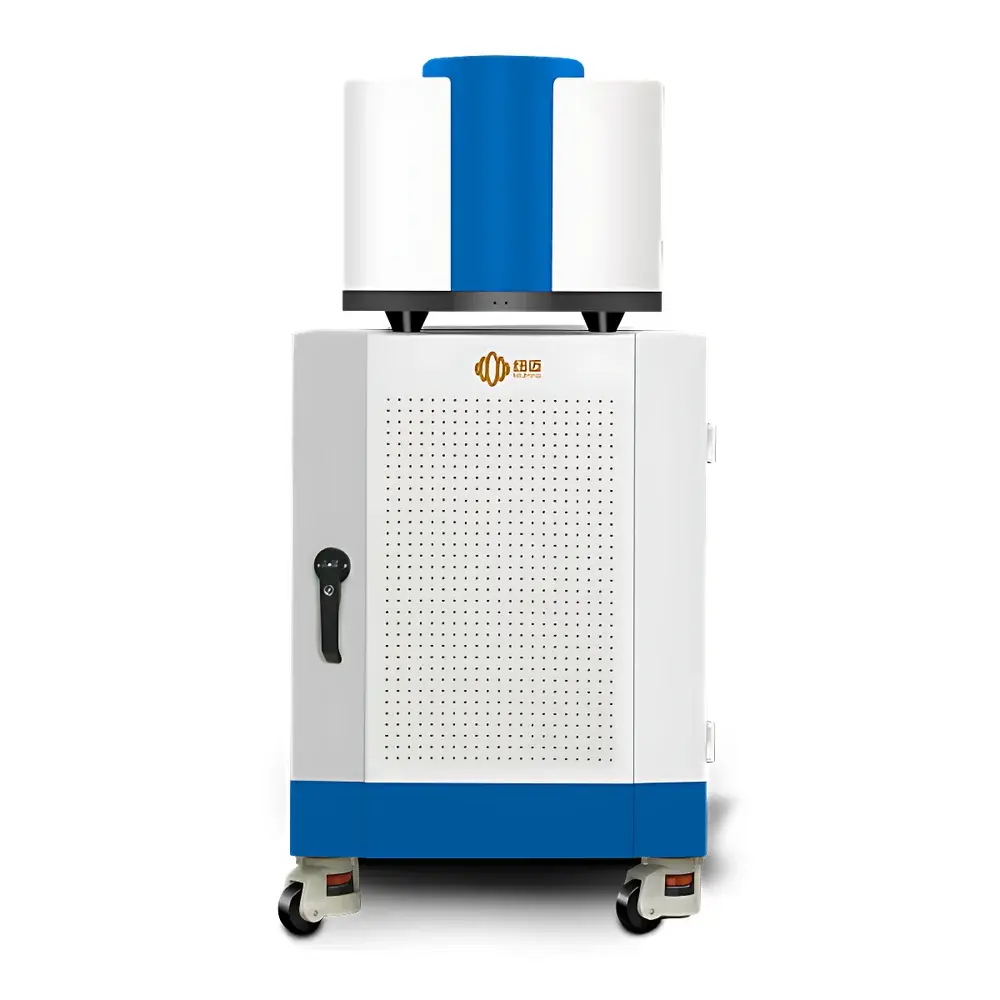
NIUMAG PQ001-8 Low-Field Nuclear Magnetic Resonance Analyzer for Battery Separator Moisture Content and Spatial Distribution
| Brand | NIUMAG |
|---|---|
| Origin | Jiangsu, China |
| Manufacturer Type | Authorized Distributor |
| Origin Category | Domestic |
| Model | PQ001-8 |
| Instrument Type | Low-Field NMR Analyzer |
| Sample Type | Solid-Liquid Hybrid |
| Magnet Type | Permanent Magnet |
| Magnetic Field Strength | 0.5 T ± 0.03 T |
| Sample Dimensions | Ø12.5 mm × H15 mm (cylindrical) |
| Magnetic Field Homogeneity | ≤30 ppm over H-volume |
| Measurement Time per Sample | ≤3 min |
| Probe Options | Multi-size RF probes available |
| Moisture Quantification Capability | Distinguishes free water vs. bound water |
| Spatial Resolution | Capable of 1D/2D moisture distribution profiling |
| Software Compliance | Audit trail, user permission levels, data integrity features aligned with GLP/GMP principles |
Overview
The NIUMAG PQ001-8 Low-Field Nuclear Magnetic Resonance Analyzer is a purpose-built analytical platform engineered for non-invasive, quantitative assessment of moisture content and spatial distribution within lithium-ion battery separators. Leveraging the physical principles of low-field nuclear magnetic resonance (LF-NMR), this instrument detects hydrogen proton signals from water molecules embedded in polyolefin or ceramic-coated separator matrices. Unlike destructive gravimetric or Karl Fischer titration methods, LF-NMR differentiates between mobile (free) and immobilized (bound) water populations based on transverse relaxation time (T2) decay profiles—enabling functional insight into water’s physicochemical state rather than bulk mass alone. Its 0.5 T permanent magnet system delivers stable field homogeneity (<30 ppm over the H-volume), ensuring high reproducibility across repeated measurements. Designed specifically for high-throughput quality assurance in battery material manufacturing, the PQ001-8 operates without sample drying, crushing, or chemical reagents—preserving structural integrity while delivering statistically robust moisture maps correlated to electrochemical performance thresholds.
Key Features
- Non-destructive, contactless measurement preserving separator morphology and coating integrity
- Simultaneous quantification and spatial mapping of free/bound water via multi-exponential T2 analysis
- Standard cylindrical sample cavity (Ø12.5 mm × 15 mm height) optimized for industry-standard separator disc specimens
- Sub-3-minute acquisition time per sample—compatible with inline QA/QC workflows
- Modular RF probe architecture supporting interchangeable coil sizes for flexible geometry adaptation
- Integrated temperature-controlled sample holder (optional) for thermal stability during extended profiling
- Robust mechanical design with compact footprint and castor-mounted chassis for lab-to-fab floor mobility
Sample Compatibility & Compliance
The PQ001-8 accepts solid-liquid hybrid samples including dry, pre-wetted, or electrolyte-impregnated battery separators—regardless of base polymer (PE, PP, PET) or surface modification (SiO2, Al2O3). It accommodates heterogeneous morphologies such as multilayer laminates, gradient-coated films, and asymmetric pore structures. No solvent extraction or vacuum drying is required prior to analysis. From a regulatory standpoint, the system supports Good Laboratory Practice (GLP) and Good Manufacturing Practice (GMP) compliance through configurable electronic signatures, full audit trails, and 21 CFR Part 11–ready software modules—including user role-based access control, immutable raw data archiving, and versioned method storage. All moisture calibration protocols align with ISO 15512:2019 (plastics—determination of water content) and ASTM D6980–22 (standard guide for moisture analysis in battery materials).
Software & Data Management
The proprietary NIUMAG NMR Analysis Suite provides an intuitive, workflow-driven interface for pulse sequence selection (CPMG, IR-CPMG), real-time signal visualization, and automated T2 spectrum deconvolution. Raw FID data are stored in vendor-neutral formats (e.g., HDF5) with embedded metadata (timestamp, operator ID, instrument serial, calibration status). Batch processing enables comparative analysis across production lots, with statistical reporting tools generating RSD values for repeatability assessment (e.g., wet specific surface area RSD ≤1.0% per ASTM D7847–21). Data export supports CSV, XML, and PDF report generation with customizable templates compliant with internal QA documentation standards.
Applications
- Quantitative moisture specification verification of incoming separator rolls prior to electrode lamination
- Spatial heterogeneity mapping of residual moisture after drying ovens—identifying edge-rich or center-depleted zones
- Correlation studies between T2 distribution profiles and ionic conductivity degradation in aged cells
- Process validation of hydrophobic coating uniformity via bound-water signal attenuation
- Stability testing of separators under controlled humidity cycling (25–85% RH)
- Supporting root-cause analysis of gas evolution events during formation cycling
FAQ
What distinguishes LF-NMR from FTIR or Karl Fischer for separator moisture analysis?
LF-NMR provides molecular mobility context—differentiating electrochemically benign bound water from reactive free water—whereas FTIR lacks quantification linearity and Karl Fischer destroys sample integrity.
Can the PQ001-8 analyze full-size separator sheets or only cut discs?
It requires cylindrical specimens conforming to Ø12.5 mm × 15 mm dimensions; larger sheets must be die-cut using ISO-compliant tooling to ensure representative sampling.
Is T2 calibration traceable to certified reference materials?
Yes—NIUMAG supplies NIST-traceable water-in-oil emulsion standards for daily system verification and drift correction.
Does the system support automated batch loading?
Not natively; however, third-party robotic sample changers can be integrated via RS-232/Modbus TCP API for unattended operation.
How is data security maintained during remote diagnostics?
All remote sessions use TLS 1.2–encrypted VNC with one-time session keys; no data leaves the local network unless explicitly exported by authorized users.





