
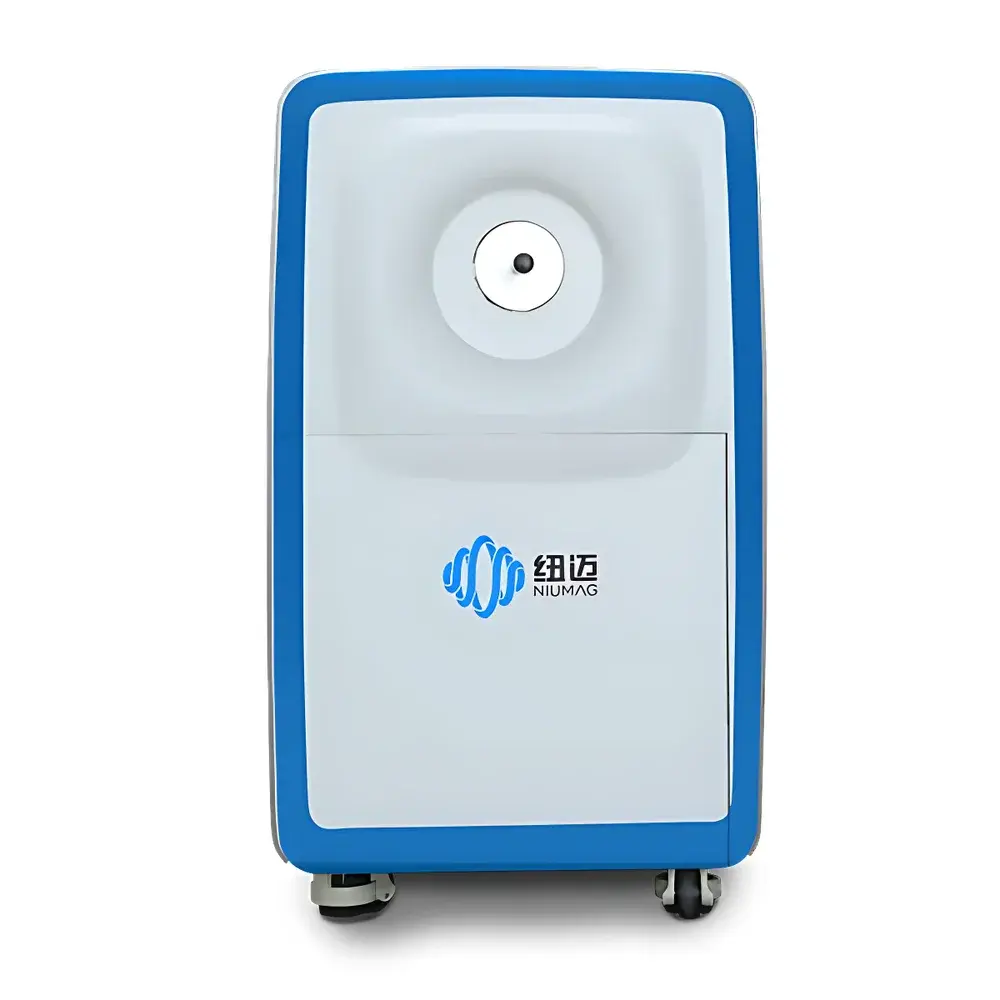
NIUMAG QMR06-090H-2 Low-Field Nuclear Magnetic Resonance Analyzer for In Vivo Rodent Lipid Metabolism and Nutritional Deficiency Studies
| Brand | NIUMAG |
|---|---|
| Origin | Jiangsu, China |
| Instrument Type | Low-Field NMR Analyzer |
| Model | QMR06-090H-2 |
| Sample Compatibility | Solid-Liquid Dual-Phase (Live Small Animals) |
| Measurement Principle | T₂ Relaxometry-Based Quantitative Fat/Muscle/Water Composition Analysis |
| Typical Scan Time | 60–180 s per animal |
| Operating Field Strength | ~0.06–0.09 T (6–9 MHz ¹H Larmor Frequency) |
| Animal Handling | Non-invasive, conscious-state measurement |
| Regulatory Context | Designed for preclinical GLP-compliant metabolic phenotyping |
Overview
The NIUMAG QMR06-090H-2 is a dedicated low-field nuclear magnetic resonance (LF-NMR) analyzer engineered for non-invasive, quantitative body composition analysis in live rodent models. It operates on the physical principle of transverse relaxation time (T₂) differentiation: protons in adipose tissue, lean muscle, and free water exhibit distinct T₂ decay profiles under a static magnetic field (~0.06–0.09 T). By acquiring and deconvoluting multi-exponential T₂ relaxation spectra from whole-body or regional signals, the system quantifies fat mass, lean body mass, and total body water—without ionizing radiation, surgical intervention, or chemical labeling. Unlike high-field NMR spectrometers used for molecular structure elucidation, this instrument is purpose-built for longitudinal metabolic phenotyping in preclinical nutrition, obesity pharmacology, and nutritional deficiency research. Its compact permanent magnet architecture ensures operational stability, minimal infrastructure requirements (no cryogens or RF-shielded rooms), and compatibility with standard vivarium environments.
Key Features
- Non-invasive in vivo quantification: Enables repeated measurements on the same animal across timepoints—critical for longitudinal studies of dietary intervention, drug efficacy, or disease progression.
- Conscious-animal operation: Eliminates confounding variables introduced by anesthesia or euthanasia; animals remain unrestrained and physiologically unaltered during acquisition.
- Rapid single-scan protocol: Full-body composition analysis completed in 60–180 seconds per subject, supporting high-throughput screening in multi-cohort studies.
- No sample preparation required: No tissue extraction, fixation, homogenization, or solvent extraction—preserving native physiological state and eliminating analytical bias from ex vivo handling.
- Robust T₂ spectral deconvolution algorithm: Differentiates overlapping relaxation components using constrained non-negative least squares (NNLS) fitting, validated against gravimetric and DEXA reference methods in peer-reviewed rodent studies.
- Dual-mode probe design: Optimized for both whole-body scans (e.g., Sprague-Dawley rats, C57BL/6 mice) and localized region-of-interest (ROI) analysis (e.g., abdominal depot, hindlimb musculature).
Sample Compatibility & Compliance
The QMR06-090H-2 supports live small mammals including rats (up to 500 g), mice (15–45 g), and rabbits (up to 2.5 kg), with adjustable bore geometry and animal positioning fixtures. All protocols comply with the ARRIVE 2.0 guidelines for reporting animal research. Data acquisition workflows are structured to support Good Laboratory Practice (GLP) documentation standards—including operator ID logging, timestamped scan metadata, and audit-trail-enabled parameter versioning. While not FDA-cleared as a diagnostic device, the system’s measurement traceability aligns with ISO/IEC 17025 principles for testing laboratories, and its T₂-based fat quantification methodology has been referenced in multiple publications adhering to NIH and EFSA preclinical reporting frameworks.
Software & Data Management
The proprietary NMIQ software suite provides integrated acquisition control, real-time signal visualization, automated T₂ spectrum fitting, and export-ready composition reports (fat %, lean mass g, water mass g, fat-to-lean ratio). Raw FID data and processed spectra are stored in vendor-neutral HDF5 format, enabling third-party analysis via Python (NumPy, SciPy) or MATLAB. Audit trail functionality records all user actions, parameter modifications, and calibration events—supporting 21 CFR Part 11 compliance when deployed with institutional electronic signature infrastructure. Batch processing mode allows parallel analysis of up to 24 subjects per session, with QC flags triggered by signal-to-noise ratio (SNR) thresholds or motion artifact detection.
Applications
- Preclinical evaluation of anti-obesity therapeutics: Quantifying dose-dependent changes in visceral adiposity and lean mass preservation following chronic compound administration.
- Nutritional deficiency modeling: Monitoring dynamic shifts in fat storage, muscle catabolism, and hydration status in vitamin B12-, choline-, or protein-restricted rodent cohorts.
- Metabolic syndrome phenotyping: Correlating NMR-derived body composition metrics with serum metabolomics, insulin tolerance tests, and hepatic triglyceride quantification.
- Dietary intervention studies: Validating efficacy of ketogenic, high-fat, or calorie-restricted regimens through serial, non-terminal composition tracking.
- Toxicology endpoints: Detecting early-onset sarcopenia or edema formation in repeat-dose toxicity studies where traditional necropsy endpoints are delayed.
FAQ
What is the magnetic field strength of the QMR06-090H-2, and why is low-field advantageous for in vivo rodent studies?
The system operates at 0.06–0.09 Tesla (6–9 MHz ¹H frequency), optimized for robust T₂ contrast between fat, lean, and water compartments while minimizing susceptibility artifacts common in high-field systems. Low-field design enables stable, maintenance-free operation without cryogens or RF shielding.
Can the instrument distinguish between subcutaneous and visceral fat depots?
Yes—using optional ROI-selective pulse sequences and spatial encoding modules (sold separately), users can isolate and quantify regional fat fractions, including intra-abdominal adipose tissue volumes.
Is method validation data available for regulatory submissions?
NIUMAG provides application notes demonstrating correlation with gold-standard DEXA and chemical carcass analysis (r² > 0.98 for total fat mass in Sprague-Dawley rats), along with inter-laboratory reproducibility data per ISO 5725-2 guidelines.
Does the system support integration with external metabolic monitoring platforms?
Yes—via TTL trigger I/O and TCP/IP API, the QMR06-090H-2 synchronizes with indirect calorimetry systems (e.g., Promethion, CLAMS) and activity monitoring cages for multimodal phenotyping.
What maintenance is required for long-term operational stability?
The permanent magnet requires no routine servicing; annual verification of RF coil tuning, gradient linearity, and T₂ calibration phantom response is recommended per manufacturer’s service protocol.






