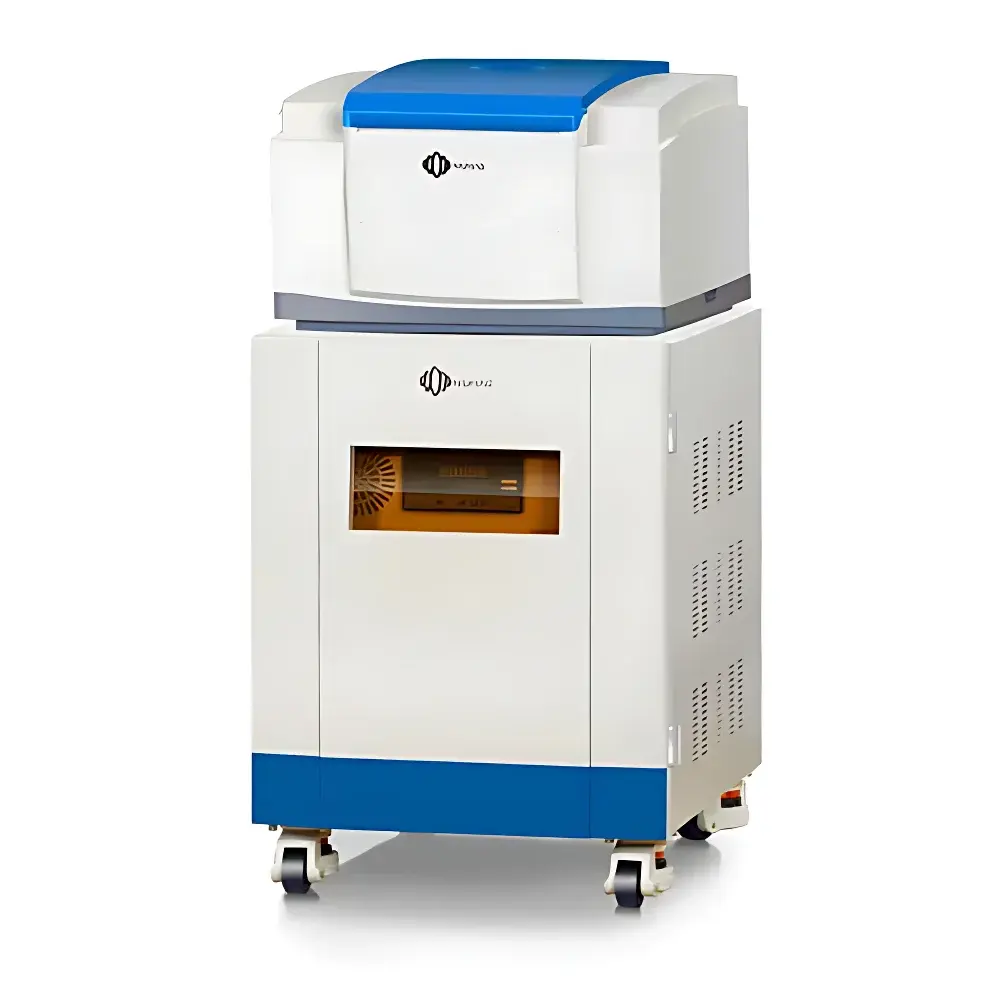
NIUMAG PQ001 Benchtop Nuclear Magnetic Resonance Analyzer for Oil & Moisture Content in Snack Foods
| Brand | NIUMAG |
|---|---|
| Origin | Shanghai, China |
| Manufacturer Type | Authorized Distributor |
| Regional Classification | Domestic (China) |
| Model | PQ001-xx |
| Pricing | Available Upon Request |
| Magnet Type | Permanent Magnet |
| Magnetic Field Strength | 0.5 ± 0.08 T |
| Probe Coil Diameter | 25 mm |
Overview
The NIUMAG PQ001 is a compact, benchtop nuclear magnetic resonance (NMR) analyzer engineered for rapid, non-destructive quantification of oil and moisture content in dry snack foods—including potato chips, extruded puffs, baked crackers, roasted nuts, and similar low-moisture solid matrices. Unlike conventional solvent-based extraction methods (e.g., Soxhlet or acid hydrolysis), the PQ001 leverages the fundamental NMR principle of transverse relaxation time (T₂) differentiation to distinguish between hydrogen protons residing in bound water (shorter T₂) and mobile triglyceride protons in free oil (longer T₂). This intrinsic physical contrast enables selective signal separation without chemical reagents, sample homogenization, or destructive preparation. The system operates at a stable static field of 0.5 ± 0.08 T generated by a high-homogeneity permanent magnet, ensuring consistent resonance conditions across daily operation. Designed for integration into QC laboratories and production-floor environments, the PQ001 delivers measurement repeatability < 1.2% RSD (n = 10, standard reference snacks) and requires no cryogens or RF shielding infrastructure.
Key Features
- Non-invasive, solvent-free analysis—eliminates hazardous chlorinated solvents (e.g., petroleum ether, chloroform) and associated disposal compliance burdens
- Benchtop footprint (< 450 × 350 × 320 mm) with integrated magnet, probe, and console—no external chillers or power conditioners required
- 25 mm diameter radiofrequency (RF) probe optimized for heterogeneous solid samples; accommodates irregular shapes up to 30 g without grinding or pelletizing
- Pre-configured calibration protocols for common snack categories (e.g., fried vs. baked chips, nut kernels, cereal bars) compliant with internal method validation requirements
- Temperature-stabilized magnet housing maintains field homogeneity within ±0.01% over ambient fluctuations (15–30 °C)
- Embedded pulse sequence engine supporting CPMG (Carr–Purcell–Meiboom–Gill) acquisition with user-adjustable echo spacing (0.1–2.0 ms) and total echo train length (up to 512 echoes)
Sample Compatibility & Compliance
The PQ001 accepts intact, unprocessed snack specimens—including whole chips, fragmented pieces, granules, powders, and thin films—without size reduction or matrix dilution. Its robust RF coil design ensures uniform excitation across heterogeneous density distributions typical of extruded or fried products. Method development aligns with internationally recognized principles for NMR-based fat quantification, including ASTM D7496-21 (Standard Practice for Determination of Fat Content in Dry Food Products by Low-Field NMR) and ISO 10565:1998 (Oilseeds — Simultaneous Determination of Oil and Water Contents — Reference Method). While not certified under FDA 21 CFR Part 11 out-of-the-box, the instrument supports audit-trail-enabled software mode (optional upgrade) compatible with GLP/GMP documentation workflows. All firmware and acquisition modules are traceable to NIST-traceable reference standards via factory calibration certificates.
Software & Data Management
Controlled via NIUMAG’s proprietary NMIQ v3.2 software suite, the PQ001 provides intuitive workflow navigation, real-time T₂ decay curve visualization, and automated multi-component fitting using singular value decomposition (SVD) algorithms. Raw FID data and processed T₂ spectra are stored in vendor-neutral HDF5 format, enabling third-party analysis in MATLAB, Python (SciPy), or JMP. Batch reporting exports comply with ISO/IEC 17025 documentation requirements: each result includes timestamp, operator ID, sample ID, instrument serial number, calibration status flag, and uncertainty estimation per GUM (Guide to the Expression of Uncertainty in Measurement). Data integrity safeguards include password-protected method editing, electronic signature capture for report approval, and optional networked backup to secure NAS storage.
Applications
- Real-time monitoring of frying oil uptake during continuous extrusion/frying processes
- Verification of post-drying moisture equilibrium in baked or air-fried snack lines
- Raw material screening for oil content variability in incoming nut or seed lots
- Stability testing of shelf-life trials—tracking oil oxidation onset via T₂ relaxation profile shifts
- Formulation optimization: correlating oil/water ratios with texture metrics (e.g., fracture force, crispness index)
- Regulatory submission support: generating reproducible, auditable datasets for nutritional labeling compliance (e.g., FDA Nutrition Facts, EU Regulation No. 1169/2011)
FAQ
What sample mass is recommended for optimal signal-to-noise ratio?
A representative mass of 15–25 g is recommended for solid snacks; the 25 mm probe ensures full volume excitation while minimizing dielectric losses.
Can the PQ001 differentiate between saturated and unsaturated fats?
No—the instrument quantifies total mobile lipid protons based on T₂ relaxation kinetics but does not resolve fatty acid composition; GC-FAME remains required for saturation profiling.
Is routine shimming required?
No—permanent magnet design eliminates active shimming; field homogeneity is factory-locked and verified annually via proton linewidth measurement (≤ 150 Hz at 21 MHz).
How often must calibration be performed?
Initial calibration uses certified reference materials (e.g., sesame oil/water emulsions); subsequent verification is recommended before each shift using a stable internal check standard (provided with instrument).
Does the system support remote diagnostics or preventive maintenance alerts?
Yes—embedded Ethernet interface enables secure remote access for firmware updates, spectral health checks, and predictive maintenance notifications based on magnet temperature drift and RF amplifier duty cycle logs.
Related Products