
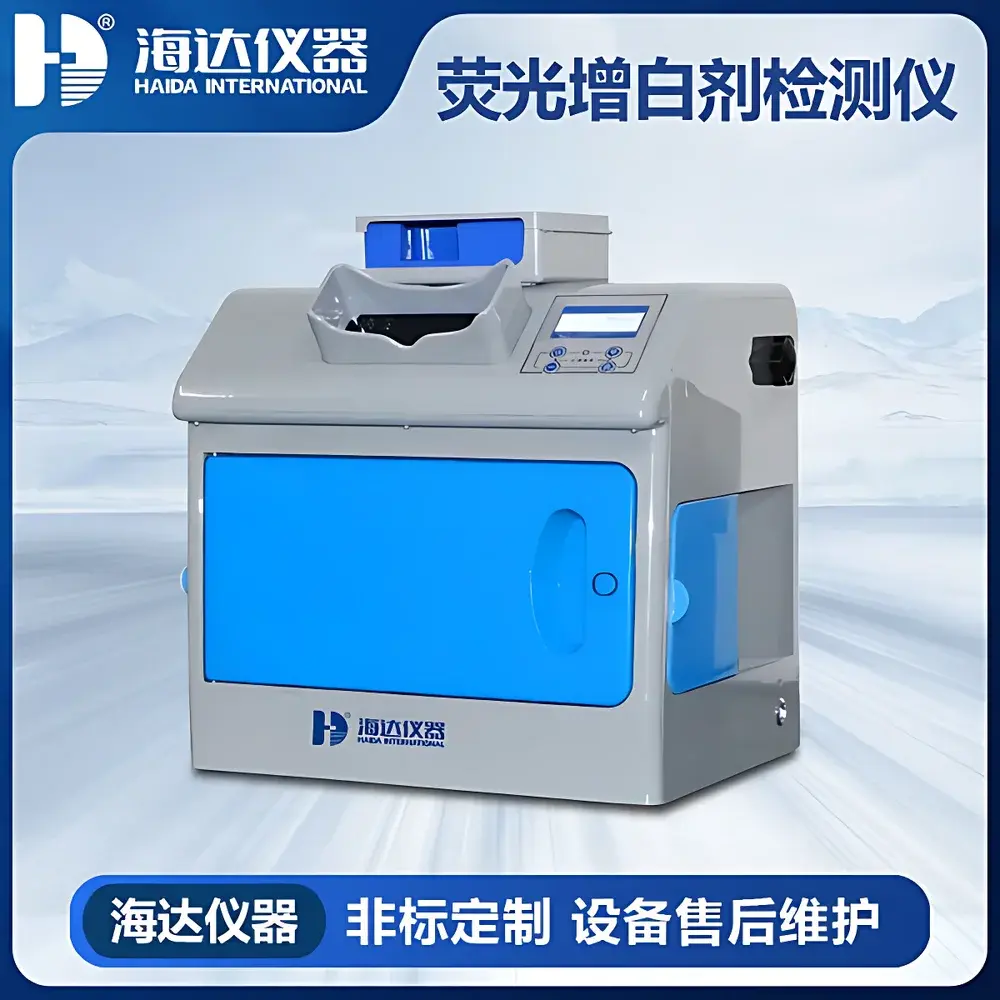
HAIDA INTERNATIONAL HD-D015 Fluorescent Whitening Agent Detector
| Brand | HAIDA INTERNATIONAL |
|---|---|
| Origin | Guangdong, China |
| Manufacturer Type | Original Equipment Manufacturer (OEM) |
| Country of Origin | China |
| Model | HD-D015 |
| Pricing | Available upon Request |
Overview
The HAIDA INTERNATIONAL HD-D015 Fluorescent Whitening Agent Detector is a dedicated benchtop optical instrumentation system engineered for qualitative and semi-quantitative detection of fluorescent whitening agents (FWAs) in textiles, paper, plastics, detergents, and other consumer or industrial materials. It operates on the principle of ultraviolet-induced fluorescence excitation and visible-spectrum emission capture under controlled illumination geometry. The instrument employs a calibrated UV-A light source (365 nm nominal peak wavelength) to excite FWAs—commonly stilbene-, coumarin-, or triazine-based compounds—that re-emit characteristic blue-white fluorescence (typically 420–470 nm). Detection is performed visually under standardized viewing conditions and may be supplemented with integrated reference standards for comparative assessment. Designed in accordance with FZ/T 64046–2014 (“Hot Air Nonwovens — Technical Specification”), the HD-D015 supports routine quality control in textile manufacturing, nonwoven production, and regulatory screening workflows where presence/absence or relative intensity of fluorescence must be reliably documented.
Key Features
- Fixed-wavelength UV-A excitation source (365 nm ±5 nm) with stable output intensity and uniform irradiance distribution across the sample stage
- Light-tight observation chamber with matte-black interior finish to minimize ambient light interference and enhance contrast sensitivity
- Ergonomic viewing port equipped with UV-blocking safety filter (OD ≥4 at 365 nm) compliant with EN 166:2002 personal eye protection requirements
- Integrated sample positioning guide for consistent placement of flat or folded specimens (max. 200 mm × 200 mm)
- Adjustable timer-controlled illumination cycle (1–60 s) to prevent photobleaching during repeated testing
- Modular design supporting optional calibration verification using NIST-traceable fluorescent reference tiles (sold separately)
- No moving parts or consumables—designed for long-term operational stability in QC laboratories and production floors
Sample Compatibility & Compliance
The HD-D015 accommodates a broad range of solid and semi-rigid substrates including woven/nonwoven fabrics, tissue paper, cardboard, synthetic films, molded plastic components, and detergent powder samples placed on inert white ceramic tiles. It complies with the optical measurement methodology defined in FZ/T 64046–2014 for hot-air-bonded nonwovens, and its operational parameters align with general practice guidelines referenced in ISO 105-X12 (Textiles — Tests for colour fastness — Assessment of fluorescent brightening agents) and GB/T 2910.17–2019 (Textiles — Quantitative chemical analysis — Part 17: Polyamide fibres and certain other fibres). While not a quantitative spectrophotometric system, the HD-D015 satisfies GLP-aligned documentation requirements when used with standardized test protocols, including traceable operator logs and batch-specific reference comparisons.
Software & Data Management
The HD-D015 is a standalone hardware detector with no embedded microprocessor or digital interface. All observations are recorded manually using provided documentation forms—including the Product Quality Tracking & Feedback Form (dual-copy carbonless set)—to support audit-ready recordkeeping per ISO/IEC 17025:2017 clause 7.5.2 (Control of records). Laboratories implementing electronic lab notebooks (ELN) or LIMS can integrate HD-D015 test outcomes via structured entry templates. Optional accessories include a calibrated digital lux/UV radiometer (model HUVR-200) for periodic irradiance validation, with calibration certificates issued by CNAS-accredited third-party labs—fully traceable to national metrology institutes.
Applications
- Routine screening of raw materials (e.g., pulp, spunbond polypropylene, viscose rayon) for unauthorized FWA addition prior to processing
- Final product verification in hygiene product manufacturing (diapers, wipes, surgical gowns) to ensure compliance with EU Ecolabel criteria and Oeko-Tex Standard 100 Class I/II limits
- Supplier qualification audits where FWA content affects dye uptake, print clarity, or biodegradability claims
- Failure analysis in color-matching deviations attributed to unexpected fluorescence interference in spectrophotometric measurements
- Training and demonstration platform for textile chemistry education programs focusing on optical brightener mechanisms and regulatory thresholds
FAQ
Does the HD-D015 provide quantitative concentration values (e.g., ppm or %)?
No. It is a pass/fail or comparative intensity detector—not a fluorimeter or HPLC system. Quantification requires complementary analytical methods such as HPLC-FLD per ISO 105-X18 or LC-MS/MS.
Can it detect FWAs in liquid samples like laundry detergents?
Yes, when applied as thin films on white ceramic tiles or filter paper; however, turbidity, surfactant quenching, or solvent absorption may affect visibility. Pre-filtration and standardized drying are recommended.
Is UV safety certification included with the unit?
The device incorporates an EN 166-compliant viewing filter and meets IEC 62471:2006 Photobiological Safety classification for UV-A lamps (Risk Group 1 – Exempt). A full safety dossier is available upon request.
What maintenance is required?
Annual visual inspection of UV lamp output consistency and replacement every 2,000 operating hours (lamp life specification); no alignment or recalibration needed.
Is the HD-D015 suitable for ISO/IEC 17025-accredited testing laboratories?
Yes—when operated within a documented method (SOP), with trained personnel, traceable references, and controlled environmental conditions (e.g., ambient light <5 lux), it fulfills the technical validity requirements for non-quantitative FWA screening per Clause 7.2.2.



