
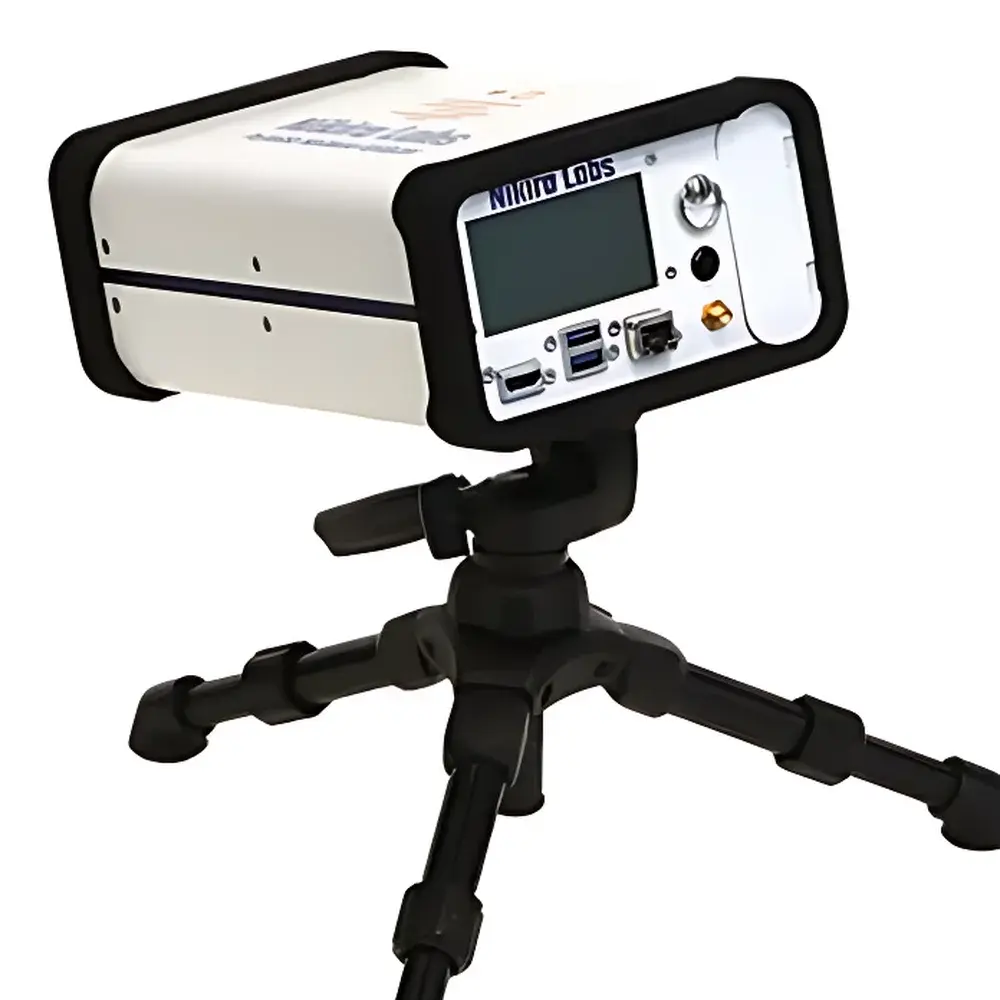
Nikira LI-G3003 Portable Cavity-Enhanced Methane and Carbon Dioxide Analyzer (PMCA)
| Brand | Nikira |
|---|---|
| Origin | USA |
| Manufacturer Type | Authorized Distributor |
| Origin Category | Imported |
| Model | LI-G3003 Portable Cavity-Enhanced Methane and Carbon Dioxide Analyzer (PMCA) |
| Price | Upon Request |
| Measurement Principle | Cavity-Enhanced Absorption Spectroscopy (CEAS) |
| CH₄ Accuracy | <10 ppb (1σ, 1 s) |
| CO₂ Accuracy | <10 ppm (1σ, 1 s) |
| H₂O Accuracy | <200 ppm (1σ, 1 s) |
| CH₄ Range | 0–10,000 ppm |
| CO₂ Range | 0–20,000 ppm |
| H₂O Range | 0–30,000 ppm |
| Data Output Rate | 3 Hz |
| Response Time | τ = 1/e at 3 Hz |
| Sample Flow Rate | 3 SLPM |
| Operating Temperature | 0–50 °C |
| Operating Humidity | 0–95% RH (non-condensing) |
| Sample Interface | Quick-Disconnect Coupler (QDC) |
| Connectivity | Integrated Wi-Fi, Ethernet (RJ-45), 2× USB 3.0, HDMI |
| Dimensions | 22.9 × 15.2 × 8.9 cm (9″ × 6″ × 3.5″) |
| Weight | 2.3 kg |
| Power Consumption | 15 W |
| Input Power | 16–24 VDC, 5 A |
| Onboard Storage | 30 GB SSD |
| Calibration Interval | Annual |
| Inlet Filter | Replaceable particulate/moisture filter |
| Warranty | 12 months |
Overview
The Nikira LI-G3003 Portable Cavity-Enhanced Methane and Carbon Dioxide Analyzer (PMCA) is a field-deployable, dual-gas trace gas analyzer engineered for high-fidelity quantification of CH₄ and CO₂ in eddy covariance, soil flux chamber, and mobile survey applications. Built upon cavity-enhanced absorption spectroscopy (CEAS), the PMCA leverages high-finesse optical cavities to achieve extended effective path lengths (>1 km), enabling sub-ppb detection limits for methane and ppm-level precision for carbon dioxide—without cryogenic cooling or chemical scrubbing. Its compact form factor (22.9 × 15.2 × 8.9 cm) and 2.3 kg mass enable single-operator deployment across remote terrestrial ecosystems, agricultural plots, landfill perimeters, and wetland transects. The instrument operates continuously on external DC power (16–24 VDC) and integrates thermal stabilization and pressure-compensated spectral fitting algorithms to maintain measurement integrity across ambient temperature gradients (0–50 °C) and humidity extremes (0–95% RH, non-condensing).
Key Features
- Simultaneous, real-time quantification of CH₄, CO₂, and H₂O vapor with independent calibration traceability to NIST-traceable standards
- Cavity-enhanced absorption spectroscopy platform delivering <10 ppb CH₄ precision (1σ, 1 s) and <10 ppm CO₂ precision (1σ, 1 s)
- 3 Hz data acquisition rate with exponential response time (τ = 1/e) optimized for turbulent flux partitioning and chamber closure dynamics
- Robust mechanical architecture with shock-absorbing chassis, conformal coating on PCBs, and sealed optical path for operation in dusty, humid, or vibration-prone environments
- Integrated sample conditioning: heated inlet line (optional), particulate/moisture filtration (replaceable QDC-coupled filter cartridge), and flow-controlled sampling at 3 SLPM
- Low-power design (15 W typical) compatible with portable battery packs, solar-charged systems, or vehicle auxiliary power
Sample Compatibility & Compliance
The PMCA accepts gaseous samples via standardized QDC (Quick-Disconnect Coupler) interface, supporting direct connection to automated soil chambers (e.g., LICOR LI-8100A-compatible manifolds), eddy covariance intakes, or UAV-mounted sampling probes. It complies with ISO 14064-3 requirements for greenhouse gas quantification methodology validation and supports data reporting aligned with IPCC Tier 2/3 inventory protocols. All firmware and data logging routines adhere to GLP-compliant audit trail structures—including timestamped calibration events, sensor diagnostics, and configuration change logs. While not FDA 21 CFR Part 11 certified (as it is not used in clinical or pharmaceutical release testing), its secure data export (encrypted CSV/NetCDF), user-access controls, and immutable onboard storage meet EPA Method TO-15 and ASTM D6348-22 documentation expectations for environmental monitoring.
Software & Data Management
The PMCA ships with Nikira FieldLink™ v4.x software suite, providing cross-platform (Windows/macOS/Linux) configuration, real-time spectral visualization, and automated baseline correction. Data are streamed simultaneously via Ethernet (RJ-45), Wi-Fi (WPA2-Enterprise capable), or USB 3.0 to external DAQ systems or cloud platforms. Onboard 30 GB SSD stores raw spectra, processed concentration time series, diagnostic logs, and GPS-synchronized metadata (when paired with optional GNSS module). Export formats include CF-compliant NetCDF4, comma-separated values with ISO 8601 timestamps, and binary HDF5 for advanced spectral reprocessing. Firmware updates are delivered via signed OTA packages; all communication channels support TLS 1.2+ encryption.
Applications
- Soil-atmosphere CH₄ and CO₂ flux measurements using static/dynamic closed chambers and automated chamber networks
- Mobile ground-based surveys along transects (e.g., pipeline right-of-ways, dairy barn perimeters, rice paddy grids)
- Integration into eddy covariance towers for gap-filling and footprint validation
- Validation of satellite-based XCH₄/XCO₂ retrievals through coordinated ground truth campaigns
- Landfill cover gas migration studies and biogas collection system efficiency audits
- Carbon sequestration project monitoring under Verra VM0042 or Gold Standard methodologies
FAQ
What calibration standards are required for field deployment?
The PMCA is factory-calibrated against NIST-traceable CH₄ and CO₂ reference gases. An annual recalibration is recommended; users may perform zero/span verification in situ using certified span gases (e.g., 5 ppm CH₄ in air, 500 ppm CO₂ in air) and synthetic zero air.
Can the PMCA operate unattended for extended periods?
Yes—when powered by a regulated 24 VDC source and housed in a weather-protected enclosure, the PMCA supports continuous operation for >30 days with onboard storage. External telemetry (e.g., cellular modem) enables remote health monitoring and data retrieval.
Is spectral raw data accessible for post-processing?
Yes. Full-resolution absorption spectra (wavenumber vs. intensity) are stored alongside concentration outputs and can be exported for custom fitting, interference correction, or algorithm development.
How does the instrument handle water vapor interference?
The CEAS engine performs concurrent H₂O measurement (0–30,000 ppm) and applies physics-based water vapor cross-sensitivity correction during CH₄ and CO₂ quantification, eliminating need for external dryers in most ambient conditions.
Does the PMCA support synchronization with external timing sources?
Yes—via PTP (IEEE 1588) over Ethernet or optional GPS-disciplined oscillator input, enabling microsecond-level timestamp alignment with co-located sensors (e.g., sonic anemometers, IRGAs).







