
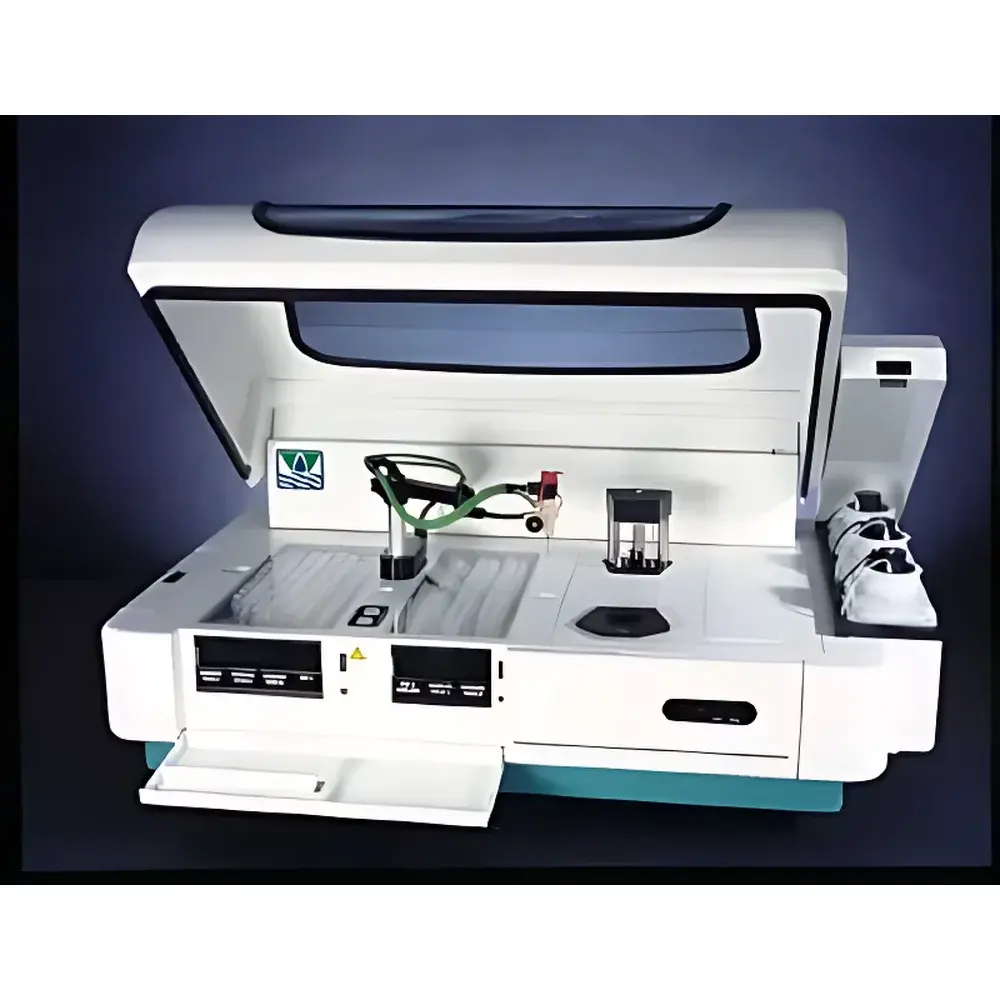
AMS Smartchem Series Fully Automated Discrete Analyzer
| Origin | Italy |
|---|---|
| Manufacturer Type | Authorized Distributor |
| Origin Category | Imported |
| Model | Smartchem |
| Pricing | Upon Request |
Overview
The AMS Smartchem Series Fully Automated Discrete Analyzer is a high-precision, benchtop wet-chemistry platform engineered for reliable, ISO-compliant quantitative analysis of ions and low-molecular-weight analytes in liquid matrices. Unlike continuous-flow or segmented-flow systems, Smartchem employs discrete (batch-style) analysis—each sample and reagent combination is processed independently in a dedicated cuvette, eliminating carryover and inter-sample contamination inherent in shared-channel architectures. The system operates on the principle of spectrophotometric detection via standardized colorimetric reactions, fully compliant with classical wet-chemistry methodologies referenced in USEPA, ASTM, AOAC, ISO, and AFNOR protocols. Its core measurement engine integrates a dual-beam digital photometer, programmable wavelength selection across 420–880 nm, and thermally stabilized reaction kinetics at 37.0 ± 0.1 °C—ensuring reproducibility required for environmental monitoring, food safety testing, and regulatory QC/QA workflows.
Key Features
- Discrete analysis architecture: Eliminates cross-contamination through independent pipetting, dedicated cuvettes, and post-aspiration tip cleaning/drying—no air/water segmentation required.
- Dual-beam digital photometer: Linear absorbance range 0.001–2.500 AUFS; resolution 0.0001 AU; 9-position filter wheel + black reference position; halogen lamp (6 V / 10 W) with 10 mm optical path.
- Flexible liquid handling: Robotic arm with high-precision syringe pump; dispensing volume 3–450 µL per step; depth-controlled sampling (2 mm fixed immersion); integrated level sensing for low-reagent alerts.
- Scalable sample throughput: Up to 126 samples per batch across five sample racks; 16 total reagent positions (10 refrigerated, 6 ambient); 10 calibration standard positions + 2 diluent reservoirs.
- Onboard dilution capability: Non-syringe-based dilution module enabling up to 100× automated dilution without external hardware or manual intervention.
- Reaction management: 60-position rotating cuvette carousel with automatic wash cycle and real-time cuvette integrity verification prior to each measurement.
- Multi-mode kinetic detection: Supports endpoint, fixed-time, differential, bichromatic, and kinetic assays—enabling method flexibility across EPA 353.2 (nitrate/nitrite), phosphorus, ammonia, chloride, and over 100 other validated parameters.
Sample Compatibility & Compliance
Smartchem accepts aqueous liquid samples including drinking water, seawater, wastewater, groundwater, industrial effluents, soil extracts, wine, dairy, and food digestates. It complies with international method standards including USEPA Methods 353.2 (nitrate/nitrite), 365.4 (phosphate), and 350.1 (ammonia); ISO 6878 (phosphorus), ISO 11908 (nitrate); ASTM D3370, D1293, D3590; AOAC 973.42; and AFNOR T90-015. All analytical runs support full audit trail generation, user-level access control, and electronic signature compliance per FDA 21 CFR Part 11 when operated under validated software configurations. System validation documentation aligns with GLP and GMP laboratory requirements for regulated environments.
Software & Data Management
The Smartchem Control Suite runs natively on Windows OS (Windows 10/11 64-bit) and provides intuitive graphical interface navigation—including instrument status visualization, real-time assay progress tracking, and drag-and-drop method sequencing. Pre-loaded methods cover >120 parameters; users may import custom protocols or develop new ones using built-in scripting tools compatible with IUPAC-standard reaction kinetics definitions. Software features include automatic calibration curve generation, adaptive dilution logic for out-of-range samples, QC charting (Levey-Jennings, Westgard rules), raw absorbance data export (CSV, XML), and LIMS integration via ASTM E1384-compliant drivers. Audit logs record all critical events—including parameter changes, reagent lot entries, calibration updates, and operator actions—with time stamps and user IDs.
Applications
Smartchem is deployed globally in municipal water utilities (compliance reporting per EU Drinking Water Directive and US Safe Drinking Water Act), environmental testing labs (EPA-certified wastewater analysis), food & beverage QA departments (wine acidity, sulfite, sugar profiling), agricultural research centers (soil nutrient leaching studies), and pharmaceutical excipient testing (chloride, sulfate, nitrate impurities). Its discrete design ensures traceability per sample—not per channel—making it ideal for heterogeneous sample sets requiring mixed-parameter analysis without method switching downtime. Typical use cases include simultaneous determination of NO₃⁻/NO₂⁻/PO₄³⁻/NH₄⁺/SiO₂ in a single run, or rapid screening of heavy metals (e.g., Fe²⁺, Cu²⁺, Mn²⁺) via complexometric colorimetry.
FAQ
Does Smartchem require dedicated laboratory infrastructure beyond standard bench space?
No. The analyzer operates on standard 90–250 VAC power (300 W max), consumes only 2 mL water per test, and functions within ambient conditions of 18–30 °C and 20–85% RH.
Can the system be validated for regulated pharmaceutical or clinical use?
Yes—when configured with Part 11-compliant software settings, electronic signatures, and documented IQ/OQ/PQ protocols, Smartchem meets FDA, EMA, and WHO GMP requirements for release testing.
How does Smartchem handle sample carryover compared to flow injection analyzers?
Each sample and reagent is aspirated separately using a dedicated tip; rigorous post-aspiration washing and drying cycles ensure <0.001% carryover—validated per CLSI EP26-A guidelines.
Is method development supported for non-standard analytes?
Yes. Users can define custom reaction sequences, kinetics models, and calibration algorithms using the embedded method editor, subject to optical and thermal constraints of the platform.
What maintenance routines are required for long-term operational stability?
Daily: Tip cleaning verification and cuvette integrity check. Weekly: Reagent line priming and photometer baseline calibration. Quarterly: Cuvette carousel alignment and temperature sensor validation per manufacturer SOPs.
Related Products






