
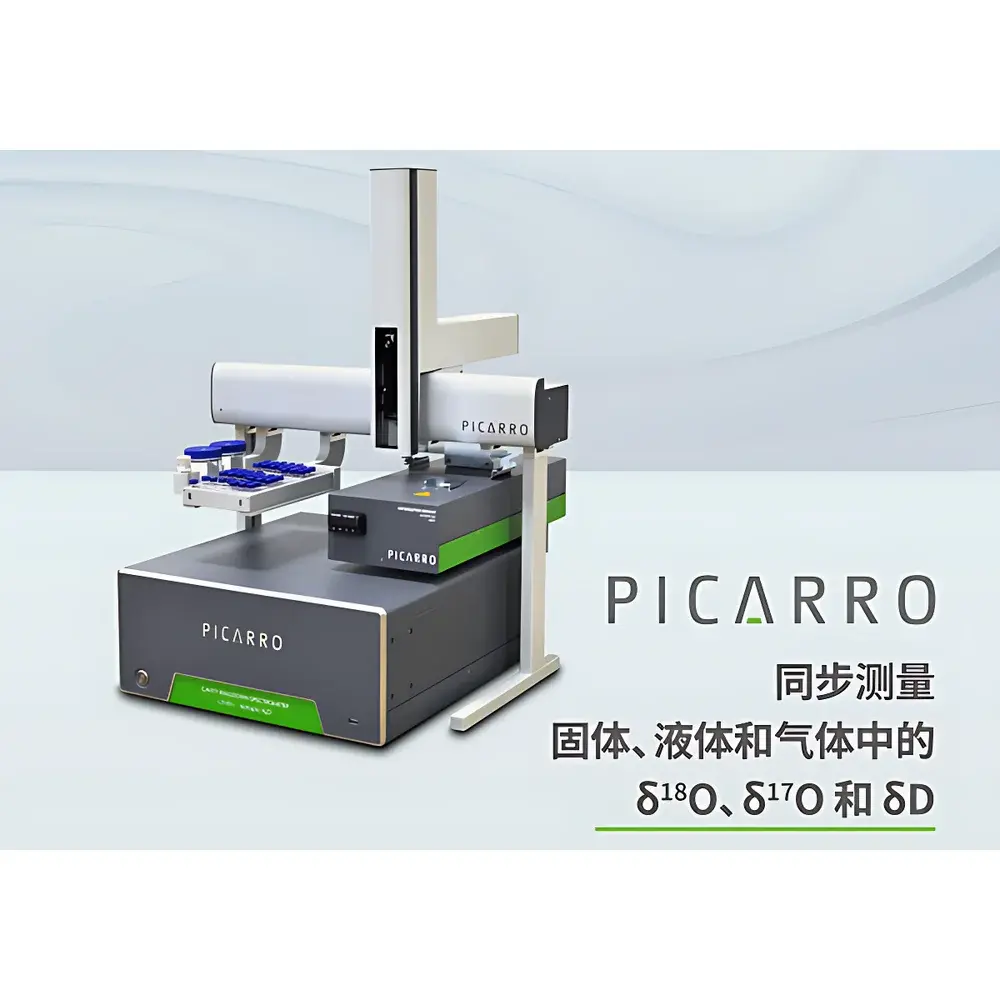
Picarro L2140-i Isotope Ratio Spectrometer for Water Vapor and Liquid Water Analysis
| Brand | Picarro |
|---|---|
| Origin | USA |
| Model | L2140-i |
| Instrument Type | Stable Isotope Ratio Analyzer for δ¹⁸O, δ¹⁷O, δD and Δ¹⁷O |
| Measurement Principle | Cavity Ring-Down Spectroscopy (CRDS) |
| Precision (1σ, 1 hr avg) | Δ¹⁷O < 15 per meg (< 0.015‰) |
| Sample Forms | Ambient water vapor, evaporated liquid water, or direct liquid injection (via optional autosampler) |
| Compliance | Designed for GLP/GMP-aligned workflows |
Overview
The Picarro L2140-i Isotope Ratio Spectrometer is a high-precision, turnkey instrument engineered for the simultaneous, real-time measurement of stable isotopic ratios in water—specifically δ¹⁸O, δ¹⁷O, δD (δ²H), and the derived parameter Δ¹⁷O (17O-excess). Unlike traditional isotope ratio mass spectrometry (IRMS) systems that require complex offline sample conversion (e.g., CO₂ equilibration or H₃⁺ correction protocols), the L2140-i employs proprietary Cavity Ring-Down Spectroscopy (CRDS) to directly quantify isotopologue-specific absorption features in the near-infrared spectrum. This optical approach eliminates dependence on ion source stability, Faraday cup calibration drift, or vacuum system maintenance—key sources of long-term uncertainty in IRMS. The analyzer achieves an effective optical path length exceeding 20 km within a compact, thermally stabilized multipass cavity, enabling sub-per-meg precision in Δ¹⁷O without cryogenic trapping or chemical conversion. Its design targets laboratories engaged in paleoclimatology, ecohydrology, atmospheric chemistry, and biogeochemical tracer studies where quantification of subtle isotopic anomalies—often < 0.1‰ in natural Δ¹⁷O—is essential for discriminating between kinetic, equilibrium, and mass-independent fractionation processes.
Key Features
- Simultaneous quantification of δ¹⁸O, δ¹⁷O, δD, and Δ¹⁷O from a single water sample introduction—no manual reconfiguration or sequential runs required
- Δ¹⁷O precision of < 15 per meg (≤ 0.015‰) at 1-hour averaging for water vapor; equivalent performance demonstrated for liquid water via evaporation interface
- Integrated temperature- and pressure-controlled optical cavity ensures minimal instrumental drift (< 0.05‰/day for δ¹⁸O) and high inter-day reproducibility
- Direct analysis capability: accepts water vapor from ambient air, headspace, or gas streams; accommodates liquid water via heated vaporization module or optional high-throughput liquid autosampler
- No consumables, no carrier gases, no vacuum pumps—reducing operational cost and footprint versus IRMS-based workflows
- Factory-calibrated using NIST-traceable VSMOW–SLAP reference waters; supports user-defined two-point calibration with in-house standards
Sample Compatibility & Compliance
The L2140-i is validated for aqueous matrices including precipitation, groundwater, plant xylem sap, soil pore water, and atmospheric moisture. It meets analytical requirements specified in ISO 18593:2016 (water isotope analysis by laser spectroscopy) and aligns with ASTM D8200–20 guidelines for stable isotope measurements in environmental waters. When operated with Picarro’s LogPro software v3.0+ and configured with role-based user accounts, electronic signatures, and immutable audit trails, the system satisfies documentation expectations under FDA 21 CFR Part 11 and EU Annex 11 for regulated environments. Data integrity is preserved through timestamped raw absorbance spectra storage, automated metadata tagging (operator ID, sample ID, environmental conditions), and export-compatible .csv/.xlsx outputs traceable to original spectral integrals.
Software & Data Management
Picarro’s proprietary Analyze software provides real-time spectral visualization, automated peak fitting, and isotopic ratio calculation using physically constrained least-squares fitting algorithms. All raw ring-down time decays are archived alongside processed results, enabling retrospective re-analysis without signal degradation. The platform supports batch processing of hundreds of samples with customizable QC flags (e.g., water concentration outliers, cavity pressure excursions, spectral fit residuals > 3σ). Integration with LIMS is achieved via standard OPC-UA or RESTful API interfaces. For compliance-driven labs, optional LogPro software enables full 21 CFR Part 11 compliance—including electronic signatures, change control logs, and secure user authentication—with validation documentation available upon request.
Applications
- Paleoclimate reconstruction: High-precision Δ¹⁷O in ice cores constrains stratospheric-tropospheric exchange and past humidity gradients independent of δ¹⁸O–temperature relationships
- Ecohydrological partitioning: Discriminates plant transpiration vs. soil evaporation fluxes using triple-oxygen isotope systematics in leaf water and xylem sap
- Atmospheric water cycle modeling: Quantifies moisture source regions and rainout history via Δ¹⁷O anomalies in precipitation and vapor across synoptic scales
- Groundwater recharge studies: Resolves mixing proportions between snowmelt, rainfall, and deep geothermal inputs using non-linear Δ¹⁷O–δ¹⁸O trajectories
- Biogeochemical tracer development: Supports calibration of enzymatic isotope effects in microbial metabolism through controlled incubation experiments with isotopically labeled water
FAQ
What sample forms can the L2140-i analyze?
It measures water vapor directly from gas streams or ambient air, and liquid water via integrated evaporation or optional autosampler.
Does the L2140-i require external calibration gases or reference materials?
No external gases are needed; calibration relies on certified liquid water standards (e.g., VSMOW, SLAP, GISP) introduced as liquids or vapors.
How is Δ¹⁷O calculated, and what is its physical significance?
Δ¹⁷O = ln(¹⁷O/¹⁶O) − 0.528 × ln(¹⁸O/¹⁶O); deviations from zero reflect mass-independent fractionation, primarily occurring in ozone formation and photochemical reactions.
Can the L2140-i be deployed in field settings?
Yes—it operates unattended for >30 days with stable temperature control; optional ruggedized enclosures and DC power support mobile lab and remote station deployments.
Is method validation support available for regulatory submissions?
Picarro provides IQ/OQ documentation templates, performance qualification protocols, and application notes aligned with ISO/IEC 17025 and CLIA requirements.
Related Products




