
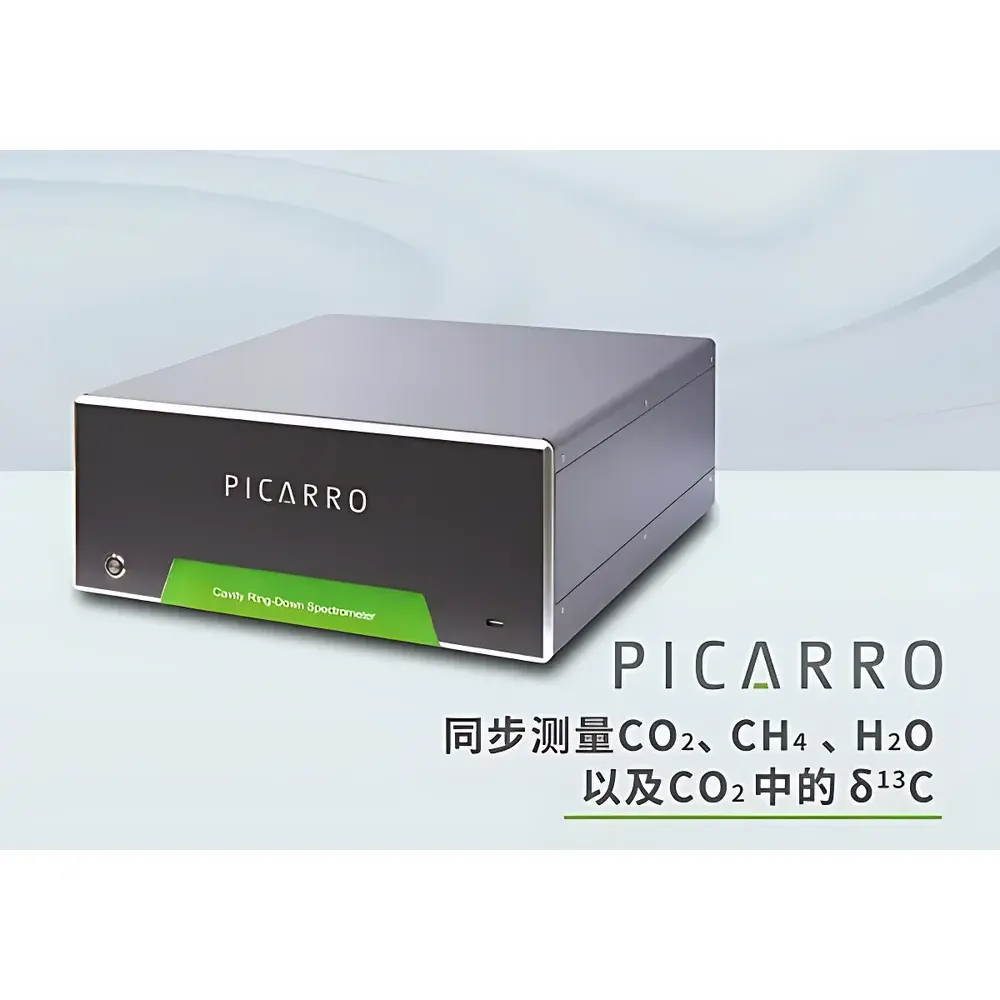
Picarro G2131-i Isotope Ratio and Gas Concentration Analyzer for δ¹³C in CO₂
| Brand | Picarro |
|---|---|
| Origin | USA |
| Model | G2131-i |
| Measurement Principle | Cavity Ring-Down Spectroscopy (CRDS) |
| δ¹³C Precision (1σ, 1-hr average) | < 0.1‰ (CO₂ > 380 ppm) |
| CO₂ Concentration Precision (30 s, 1σ) | 200 ppb (¹²C), 10 ppb (¹³C) |
| CH₄ Concentration Precision (30 s, 1σ) | 50 ppb + 0.05% of reading |
| H₂O Concentration Precision (30 s, 1σ) | 100 ppm |
| CO₂ Dynamic Range (precision-guaranteed) | 380–2000 ppm |
| CH₄ Dynamic Range (precision-guaranteed) | 0–500 ppm |
| H₂O Dynamic Range (precision-guaranteed) | 0–2.4% |
| Temperature Stability | ±0.005 °C (cavity) |
| Pressure Stability | ±0.0002 atm (cavity) |
| Sample Flow Rate | < 50 sccm at 760 Torr |
| Sample Temperature Range | −10 to +45 °C |
| Sample Pressure Range | 300–1000 Torr (40–133 kPa) |
| Environmental Operating Temp | 10–35 °C |
| Power Requirement | 100–240 VAC, 47–63 Hz, < 260 W peak |
Overview
The Picarro G2131-i Isotope Ratio and Gas Concentration Analyzer is a high-precision, field-deployable instrument engineered for simultaneous, real-time measurement of carbon isotope ratios (δ¹³C) and absolute concentrations of CO₂, CH₄, and H₂O in gas-phase samples. Utilizing proprietary Cavity Ring-Down Spectroscopy (CRDS), the G2131-i achieves isotopic precision of 380 ppm), with enhanced performance down to 20 km effective) within a compact, thermally and pressure-stabilized measurement cavity—eliminating moving parts and minimizing calibration drift. The analyzer operates on first-principles spectroscopic quantification, requiring no external reference gases during routine operation, though traceable laboratory standards are recommended for method validation and long-term QA/QC compliance per ISO/IEC 17025 and EPA Method TO-15 guidelines.
Key Features
- Simultaneous, continuous measurement of δ¹³C (CO₂), CO₂ (ppm), CH₄ (ppm), and H₂O (ppm) with sub-second temporal resolution and <2-second measurement interval
- Thermally stabilized optical cavity (±0.005 °C) and pressure-regulated measurement cell (±0.0002 atm) ensure long-term baseline stability (<0.5‰ max δ¹³C drift over 24 h)
- Integrated water vapor correction algorithm computes dry-mole-fraction-corrected CO₂ and CH₄ values using real-time H₂O concentration data
- ChemDetect™ spectral diagnostics software identifies spectral contamination from interfering species (e.g., NH₃, C₂H₆, C₂H₄, SO₂) via automated residual analysis of recorded absorption features
- Ruggedized mechanical design compliant with MIL-STD-810F for shock and vibration resistance—suitable for mobile lab, shipboard, and remote field deployments
- Support for optional Small Sample Injection Module (SSIM2, A0314) enabling high-fidelity δ¹³C analysis of pure CO₂ samples (≥99.9%) with injection volumes as low as 10 µL (0.45 µmol)
Sample Compatibility & Compliance
The G2131-i accepts gas-phase samples across a broad operational envelope: sample temperature from −10 to +45 °C, pressure from 300 to 1000 Torr, and flow rates up to 50 sccm (at 760 Torr). It is compatible with ambient air, headspace vials, flask networks, eddy covariance systems, and continuous emission monitoring streams. Critical interference considerations include elevated concentrations of H₂O (>5%), CH₄ (>1000 ppm), or organic vapors (e.g., ethanol, acetone), which may induce spectral overlap or pressure-broadening artifacts; users are advised to implement pre-analytical scrubbing (e.g., Nafion dryers, hydrocarbon traps) where such interferences are anticipated. The system supports GLP/GMP-aligned workflows through audit-trail-enabled data logging, timestamped metadata embedding (including environmental sensor readings), and export formats compatible with LIMS integration. While not certified for regulatory compliance out-of-the-box, its performance meets or exceeds requirements for ISO 13833 (greenhouse gas isotope analysis) and ASTM D7861 (isotopic characterization of biogenic CO₂).
Software & Data Management
Picarro’s proprietary Analyzers Software Suite provides full instrument control, real-time spectral visualization, automated baseline subtraction, and configurable reporting templates. All raw absorbance spectra, derived concentration time series, and δ¹³C values are stored in HDF5 format with embedded calibration coefficients, cavity parameters, and environmental metadata (T, P, flow). Data export supports CSV, NetCDF, and XML schemas for interoperability with MATLAB, Python (via h5py), and commercial statistical platforms. ChemDetect™ operates as a background process, flagging anomalous spectral residuals above user-defined thresholds and generating diagnostic reports—including wavelength-specific interference scores and recommended mitigation steps. Remote monitoring and firmware updates are supported via secure Ethernet or RS-232 connections; analog 0–10 V outputs enable direct integration into SCADA or PLC-based infrastructure.
Applications
The G2131-i serves critical roles in atmospheric science (e.g., partitioning fossil vs. biogenic CO₂ sources via Keeling plot analysis), ecosystem flux studies (soil respiration, forest-atmosphere exchange), paleoclimate reconstruction (ice core CO₂ isotope stratigraphy), food authenticity verification (geographic origin of dairy, wine, and honey via δ¹³C fingerprinting), and industrial process monitoring (biofuel fermentation, carbon capture verification). Its ability to resolve δ¹³C dynamics at sub-0.1‰ precision under variable H₂O and CH₄ backgrounds makes it uniquely suited for eddy covariance towers, urban emission inventories, and landfill gas characterization—where co-varying interferents demand robust cross-sensitivity correction.
FAQ
What is the minimum CO₂ concentration required for reliable δ¹³C measurement?
Reliable δ¹³C quantification is guaranteed at CO₂ ≥ 380 ppm; however, the instrument maintains <0.05‰ precision down to 200 ppm and supports qualitative analysis below that threshold with appropriate signal averaging.
Can the G2131-i measure δ¹³C in liquid or solid samples directly?
No—it is a gas-phase analyzer. Solid or liquid samples require prior conversion to CO₂ gas via offline combustion (e.g., EA-IRMS coupling) or online acid digestion (e.g., with Picarro’s A0314 SSIM2 module for carbonate analysis).
Is the system compliant with FDA 21 CFR Part 11 for electronic records?
The hardware and firmware support audit trails, electronic signatures, and data integrity controls; however, full Part 11 compliance requires site-specific validation protocols and documented SOPs aligned with your quality system.
How often does the instrument require calibration or maintenance?
No daily calibration is needed. Routine verification using certified reference gases (e.g., USGS-40, IAEA-603) is recommended every 7–30 days depending on application stringency; optical cavity cleaning is typically required only annually under clean-air operation.
Does the G2131-i support multi-point calibration for non-linear response correction?
Yes—the software includes a multi-point calibration workflow supporting up to 12 reference standards per analyte, enabling polynomial fitting and uncertainty propagation for expanded dynamic range applications.





