
LGR Fast Methane Analyzer (CH₄, H₂O) Model 907-0001 / 908-0001 / 911-0001
| Brand | LGR |
|---|---|
| Origin | USA |
| Model Numbers | 907-0001, 908-0001, 911-0001 |
| Measurement Principle | Off-Axis Integrated Cavity Output Spectroscopy (OA-ICOS) |
| CH₄ Range (standard) | 0.1–100 ppm |
| CH₄ Range (extended) | up to 1000 ppm or 0–10% vol |
| H₂O Range | 7000–70000 ppm (0–100% RH) |
| Precision (1σ, 1 s) | CH₄: 1 ppb, H₂O: 100 ppm |
| Precision (1σ, 100 s) | CH₄: 0.3 ppb, H₂O: 30 ppm |
| Drift (24 h, EP model) | CH₄: 0.8 ppb, H₂O: max(100 ppm, 1% of reading) |
| Accuracy (uncalibrated) | <1% (standard), <0.03% (EP) |
| Sampling Rate | 0.01–20 Hz |
| Operating Temperature | 5–45 °C (standard), 0–45 °C (EP) |
| Power | 80 W (standard), 150 W (EP) |
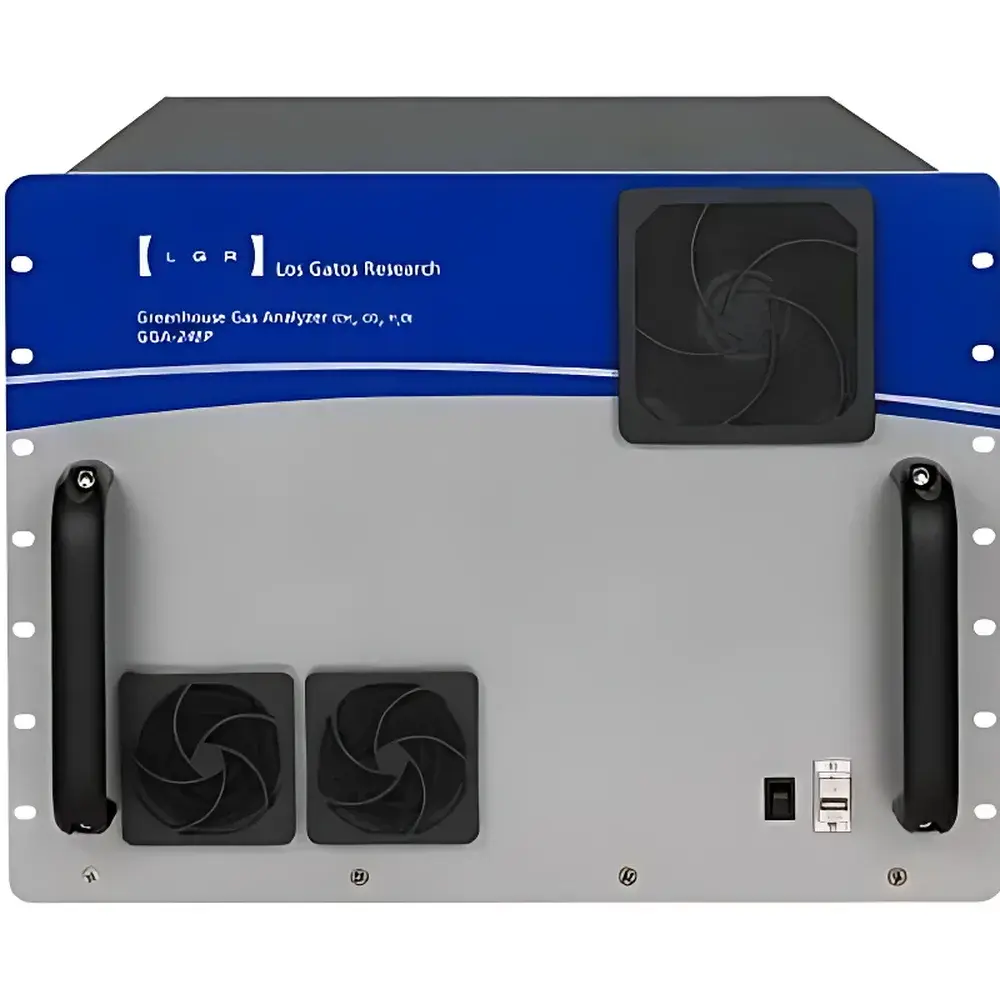
| Dimensions & Weight | varies by configuration (e.g., rack-mount EP: 35.6 × 48.3 × 61 cm, 40 kg) |
Overview
The LGR Fast Methane Analyzer (FMA) is a high-performance, field-deployable gas analyzer engineered for precise, real-time quantification of methane (CH₄) and water vapor (H₂O) in ambient air and controlled environments. Built upon Los Gatos Research’s proprietary Off-Axis Integrated Cavity Output Spectroscopy (OA-ICOS) platform, the FMA eliminates the optical alignment sensitivity and thermal drift limitations inherent in conventional Cavity Ring-Down Spectroscopy (CRDS) systems. OA-ICOS enables robust, maintenance-free operation by decoupling laser wavelength stabilization from cavity resonance requirements—resulting in stable spectral acquisition without active cavity-length feedback or stringent temperature control. This architecture delivers continuous, high-resolution absorption spectra in real time, supporting both quantitative analysis and instrument health diagnostics. The FMA operates at up to 20 Hz, making it uniquely suited for eddy covariance (EC) flux measurements, soil chamber studies, natural gas leak detection, and mobile atmospheric profiling. Its immunity to cross-interference from CO₂, CO, N₂O, and other common atmospheric constituents—combined with intrinsic pressure insensitivity—ensures metrological integrity across variable field conditions without empirical correction.
Key Features
- 20 Hz measurement rate optimized for high-frequency eddy covariance flux calculations and dynamic chamber-based emission studies
- OA-ICOS technology providing exceptional long-term stability, zero pressure-broadening artifacts, and no cross-sensitivity to interfering gases
- Two operational configurations: Standard models (907-0001, 908-0001) and Enhanced Performance (EP) model (911-0001), featuring sub-ppb CH₄ precision and <0.03% absolute accuracy without calibration
- Dynamic Dilution System (DDS) option (part #907-0005-9002) extends CH₄ linear range by >100× while preserving noise-equivalent sensitivity and linearity
- Integrated Linux-based embedded computer enabling autonomous data logging, timestamped spectral storage, and on-board post-processing
- Full remote operation via Ethernet: web-based GUI, SSH access, real-time data streaming, and firmware updates over standard TCP/IP networks
- Ruggedized mechanical design rated for continuous outdoor deployment (IP54 equivalent); operating range: 0–45 °C (EP), 5–45 °C (standard), 0–100% RH non-condensing
Sample Compatibility & Compliance
The FMA accepts sample gas streams across a broad temperature (0–50 °C) and humidity (0–100% RH) envelope without condensation. It complies with WMO/GAW specifications for greenhouse gas monitoring and meets key requirements outlined in ISO 14644-1 (cleanroom air quality), ASTM D6729 (natural gas composition), and EPA Method TO-15 (VOC analysis support). Its traceable accuracy and documented uncertainty budget support GLP and GMP-aligned workflows. Data integrity is ensured through built-in audit trails, time-stamped raw spectra, and optional 21 CFR Part 11–compliant software modules (via third-party integration). All models are CE-marked and RoHS-compliant; electrical safety conforms to IEC 61010-1.
Software & Data Management
The analyzer ships with LGR’s proprietary Data Acquisition Software (DAS v4.x), included with part #904-0002. DAS supports synchronized multi-instrument logging—including GPS, anemometers, and co-located CO₂ analyzers—via USB or RS-232 interfaces. Raw spectral files (in HDF5 format) and processed concentration time series are stored locally on the embedded SSD and can be exported in CSV, NetCDF, or MATLAB-compatible formats. Remote users may access live data streams using standard protocols (HTTP/HTTPS, MQTT), configure measurement parameters, perform spectral diagnostics, and trigger calibration routines via a browser-based interface. Optional API libraries (Python, LabVIEW, MATLAB) enable custom integration into automated environmental monitoring networks or cloud-based IoT platforms.
Applications
- Eddy covariance flux towers for ecosystem-scale CH₄ exchange studies (e.g., wetlands, rice paddies, permafrost regions)
- Soil flux chambers and static/dynamic enclosure systems for agricultural and landfill emission quantification
- Natural gas infrastructure monitoring: pipeline leak detection, compressor station emissions, LNG terminal fugitive surveys
- Urban atmospheric monitoring networks requiring high temporal resolution and low detection limits
- Aircraft- and drone-mounted campaigns for vertical profiling and regional source attribution
- Calibration transfer standards and reference instruments in metrology labs and intercomparison exercises
FAQ
What measurement principle does the FMA use, and how does it differ from CRDS?
The FMA employs Off-Axis ICOS (OA-ICOS), which avoids the cavity-length locking requirement of CRDS. This eliminates need for active laser frequency tuning and reduces sensitivity to vibration and thermal drift.
Can the FMA operate unattended for extended periods in remote field sites?
Yes—its low power consumption (80–150 W), wide operating temperature range, and embedded Linux OS enable fully autonomous operation with local data storage and remote diagnostics.
Is factory calibration required before deployment?
No. The EP model achieves <0.03% absolute accuracy without calibration; standard models maintain <1% uncertainty under ambient conditions without recalibration.
How is water vapor interference handled in CH₄ measurement?
H₂O is measured simultaneously and used in real-time spectroscopic fitting to correct for its spectral overlap with CH₄—no external drying or compensation algorithms are needed.
What vacuum pump options are available, and how do they affect response time?
Three options: Dry Scroll (<0.1 s gas exchange), N940 (0.7 s), and N920 (1.2 s). Selection depends on required time resolution and sampling line configuration.







