
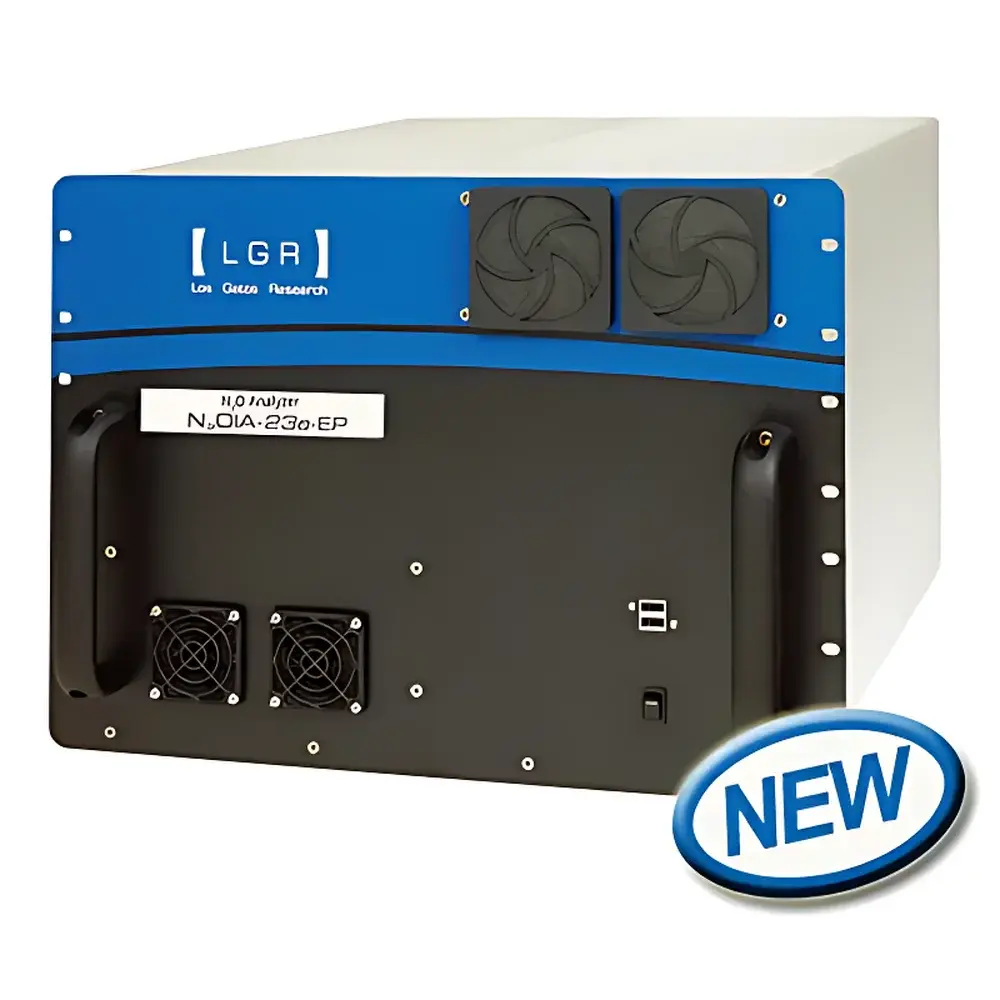
LGR Model 914-0060 Oxide Nitrous (N₂O) Isotope Analyzer
| Brand | LGR |
|---|---|
| Origin | USA |
| Model | 914-0060 |
| N₂O Concentration Detection Limit | 0.2 ppb (1σ, >300 ppb N₂O) |
| δ¹⁵N, δ¹⁵Nα, δ¹⁵Nβ Precision | <1‰ (300 s integration) |
| δ¹⁷O Precision | <1‰ (300 s, N₂O >10 ppm) |
| δ¹⁸O Precision | <1‰ (1000 s) |
| N₂O Measurement Range | 0.3–100 ppm (full-spec) |
| Spectral Resolution | <1‰ for all isotopic ratios |
| N₂O Mass Range Coverage | 0–1000 ppm |
| Operating Temperature | 0–45 °C |
| Relative Humidity | 0–100% RH (non-condensing) |
| Temperature Stability | ±0.003 °C |
| Pressure Control Accuracy | ±0.001 torr |
| Power | 115/230 VAC, 50/60 Hz, 400 W |
| Dimensions | 35.6 cm (H) × 48.3 cm (W) × 114.3 cm (D) |
| Weight | 68 kg |
Overview
The LGR Model 914-0060 Oxide Nitrous (N₂O) Isotope Analyzer is the world’s first and only instrument to apply high-resolution mid-infrared laser absorption spectroscopy—specifically Off-Axis Integrated Cavity Output Spectroscopy (OA-ICOS)—to the simultaneous, real-time quantification of all major N₂O isotopologues and their associated isotopic ratios. Unlike traditional isotope ratio mass spectrometry (IRMS), which requires cryogenic trapping, chemical conversion, and suffers from isobaric interference (e.g., CO₂ at m/z 44), the 914-0060 delivers direct, molecule-specific detection without sample pre-treatment or vacuum system dependency. It resolves and quantifies 14N15N16O, 15N14N16O, 14N14N18O, and 14N14N17O in a single optical path using a quantum cascade laser (QCL), enabling unambiguous discrimination between site-specific 15N isotopomers (δ15Nα and δ15Nβ). This capability is foundational for mechanistic studies of microbial nitrogen cycling—including nitrification, denitrification, and nitrate ammonification—in soils, sediments, aquatic systems, and atmospheric boundary layers.
Key Features
- Patented OA-ICOS architecture eliminates cavity alignment drift and wavelength-locking complexity inherent in CRDS systems—enabling stable, maintenance-free operation over extended deployments.
- Mid-IR quantum cascade laser provides intrinsic specificity for N₂O isotopologues; no spectral overlap with CO₂, CH₄, H₂O, or other common atmospheric interferents.
- Simultaneous measurement of δ15N, δ15Nα, δ15Nβ, δ17O, and δ18O—critical for distinguishing enzymatic pathways (e.g., NH₂OH vs. NO₂⁻ oxidation in ammonia-oxidizing bacteria).
- EP-grade thermal and pressure control (±0.003 °C, ±0.001 torr) ensures long-term baseline stability (<1‰ drift over 24 h for all isotopic ratios).
- No liquid nitrogen or cryogenic cooling required—reducing operational overhead and field-deployment constraints.
- Hybrid sampling support: continuous in-situ monitoring via flow-through cell or discrete analysis of gas samples (e.g., Tedlar® bags) using the optional manual injection unit (Model 908-0005-9002).
- Integrated Linux-based embedded computer enables local data logging, timestamped spectral storage, and automated QA/QC flagging per measurement cycle.
Sample Compatibility & Compliance
The 914-0060 is validated for use with ambient air, soil flux chambers, eddy covariance systems, headspace gases from incubation experiments, and purified laboratory standards. Its robust optical design tolerates variable humidity (0–100% RH, non-condensing) and temperature fluctuations (0–45 °C), making it suitable for unattended operation in remote field stations or controlled-environment laboratories. The analyzer complies with ISO/IEC 17025 requirements for analytical method validation when operated under documented SOPs. While not an IRMS platform, its precision and reproducibility meet or exceed ASTM D8203–21 criteria for isotopic characterization of reactive nitrogen species. Data integrity is preserved through internal audit trails, time-stamped raw spectra, and configurable metadata tagging—supporting GLP/GMP-aligned workflows where traceability is mandated.
Software & Data Management
LGR’s proprietary Data Acquisition Software (Model 904-0002) provides cross-platform (Windows/macOS/Linux) control, real-time spectral visualization, and synchronized multi-instrument logging (e.g., co-registered GPS position, wind speed, temperature, and auxiliary sensor inputs). All measurements are stored in HDF5 format with embedded calibration coefficients, environmental metadata, and signal-to-noise metrics. Remote access is enabled via secure SSH or HTTPS web interface—allowing full instrument diagnostics, firmware updates, and live spectral review from any network-connected location. Export options include CSV, NetCDF, and MATLAB-compatible binaries, facilitating integration into custom modeling pipelines (e.g., Bayesian isotope mixing models or process-based biogeochemical simulators).
Applications
- Quantifying source partitioning of atmospheric N₂O emissions (e.g., agricultural soils vs. wastewater treatment plants) using dual- and triple-isotope signatures.
- Elucidating kinetic isotope effects (KIEs) during enzymatic N transformations—particularly the intramolecular 15N site preference (SP = δ15Nα – δ15Nβ) as a diagnostic tracer for nitrifier-denitrification versus fungal denitrification.
- Validating isotopic fractionation models in climate-relevant biogeochemical simulations (e.g., Earth System Models with explicit N cycling).
- Supporting regulatory monitoring under national greenhouse gas inventories (e.g., EPA GHGRP, UNFCCC reporting) where isotopic fingerprinting strengthens emission attribution.
- Calibration and intercomparison of IRMS reference materials (e.g., USGS32, USGS34, IAEA-N3) via direct laser-based ratio determination.
FAQ
Does the 914-0060 require external calibration gases for routine operation?
No—its OA-ICOS architecture enables absolute concentration and isotopic ratio quantification using fundamental spectroscopic line parameters. However, periodic verification with certified N₂O isotopic standards (e.g., USGS34) is recommended for long-term metrological traceability.
Can the instrument be integrated into an automated flux measurement system?
Yes—via analog voltage outputs, RS-232 serial commands, or Ethernet TCP/IP protocols. Optional multiport switchers (8- or 16-channel) allow sequential analysis of multiple soil collars or chamber outlets without manual intervention.
Is spectral data accessible for post-acquisition reprocessing?
Yes—every measurement includes a fully resolved, time-stamped absorption spectrum stored locally. Users may re-fit baselines, adjust fitting windows, or apply alternative line-shape models using LGR’s open-format spectral analysis toolkit.
What is the minimum detectable N₂O concentration for isotopic analysis?
For δ15N and δ15Nα/δ15Nβ precision <1‰ (300 s), N₂O must exceed 300 ppb. At lower concentrations (≥0.3 ppm), isotopic uncertainty increases predictably and is reported alongside each result.
How does the 914-0060 handle water vapor interference?
The mid-IR QCL operates in a spectral region where H₂O absorption is minimal and spectrally resolvable. Internal compensation algorithms correct for residual broadening effects, and active humidity control (optional dry gas purge) further enhances performance in high-moisture environments.





