
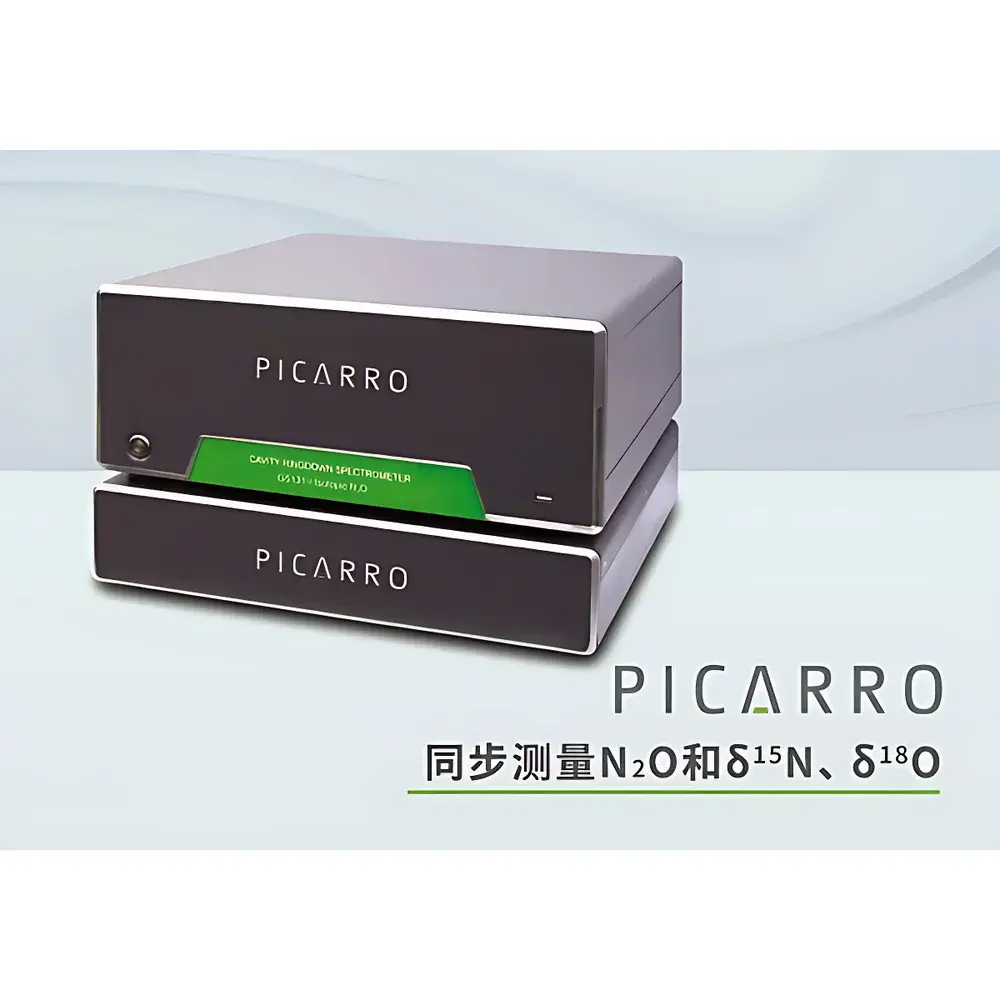
Picarro G5131-i Isotope Ratio Laser Spectrometer for N₂O Site-Specific and Bulk δ¹⁵N and δ¹⁸O Analysis
| Brand | Picarro |
|---|---|
| Origin | USA |
| Model | G5131-i |
| Instrument Type | Stable Gas Isotope Ratio Analyzer |
| Measurement Principle | Cavity Ring-Down Spectroscopy (CRDS) in Mid-Infrared |
| Precision (1σ, 10-min avg) | δ¹⁵N / δ¹⁵Nα / δ¹⁵Nβ ≤ 0.5‰, δ¹⁸O ≤ 0.7‰ |
| Concentration Range | 300–1500 ppb N₂O in air |
| Measurement Interval | < 10 s |
| Sample Flow Rate | < 30 sccm |
| Operating Temperature | −10 to 45 °C |
| Power Consumption | 210 W (steady-state) |
| Dimensions | 43 × 32 × 69 cm (W × H × D) |
| Weight | 40 kg |
Overview
The Picarro G5131-i is a high-precision, field-deployable isotope ratio laser spectrometer engineered for simultaneous, real-time quantification of site-specific (δ¹⁵Nα, δ¹⁵Nβ) and bulk (δ¹⁵N, δ¹⁸O) isotopic composition of nitrous oxide (N₂O) in ambient air or collected gas samples. Unlike conventional magnetic-sector isotope ratio mass spectrometers (IRMS), the G5131-i employs cavity ring-down spectroscopy (CRDS) in the mid-infrared spectral region—specifically targeting rovibrational transitions of N₂O near 2198 cm⁻¹—to deliver absolute isotopic ratios without reliance on reference gases during measurement. This optical approach eliminates ion source drift, mass discrimination artifacts, and vacuum system complexity inherent to IRMS platforms. The instrument’s 48 mL low-pressure optical cavity enables exceptional signal stability (<0.001 ppb/°C temperature sensitivity for concentration, <0.1‰/°C for isotopes), robust noise performance, and compatibility with micro-volume sampling—making it uniquely suited for eddy covariance flux studies, soil incubation experiments, and discrete flask analysis across terrestrial and marine biogeochemical research.
Key Features
- Simultaneous quantification of δ¹⁵N, δ¹⁵Nα, δ¹⁵Nβ, and δ¹⁸O in N₂O with metrologically traceable precision (≤0.5‰ for nitrogen isotopologues, ≤0.7‰ for oxygen, 1σ, 10-minute averaging)
- Mid-infrared CRDS technology providing >8 km effective pathlength within a compact, alignment-free optical cavity—ensuring long-term stability and minimal calibration drift
- No cryogens or liquid nitrogen required; fully solid-state operation with continuous 24/7 monitoring capability under laboratory or remote field conditions
- Compact dual-box configuration (43 × 32 × 69 cm; 40 kg) optimized for mobile labs, tower-mounted deployments, and space-constrained clean rooms
- Low sample consumption (<30 sccm at STP) and wide dynamic range (300–1500 ppb N₂O) compatible with ambient air, headspace, and pre-concentrated samples
- Integrated environmental compensation algorithms correcting for pressure, temperature, and humidity-induced spectral baseline shifts in real time
Sample Compatibility & Compliance
The G5131-i is validated for direct analysis of dry, filtered ambient air and N₂O-enriched gas matrices (e.g., soil headspace, water equilibration extracts, cryogenically trapped flasks). It operates within a sample pressure range of 300–1000 Torr (40–133 kPa) and tolerates up to 2% v/v H₂O (18 °C dew point) without condensation. While CO and CH₄ at elevated concentrations (>100 ppm) may introduce spectral interference, the instrument’s narrow-linewidth laser and multi-wavelength fitting algorithm provide built-in cross-sensitivity mitigation. Data acquisition and reporting support GLP-compliant workflows: full audit trails, user-access logging, and timestamped raw absorbance spectra are retained locally and exportable via Ethernet or USB. Though not certified to FDA 21 CFR Part 11 out-of-the-box, the system architecture supports integration with validated LIMS environments through standardized ASCII/CSV output formats and RS-232 serial protocol.
Software & Data Management
Picarro’s proprietary Analyzers Control Software (ACS) provides real-time visualization of concentration and isotopic time series, Allan deviation plots for stability assessment, and automated quality control flagging (e.g., pressure excursions, flow anomalies, cavity contamination alerts). All spectral data—including raw ring-down decay times, fitted line intensities, and isotopic ratio calculations—are stored in HDF5 format with embedded metadata (instrument ID, calibration history, environmental sensor readings). Batch processing tools enable post-acquisition correction using secondary standards (e.g., USGS-N2, IAEA-N1) and propagation of uncertainty according to ISO/IEC Guide 98-3 (GUM). Export options include netCDF for climate modeling interoperability and Excel-compatible CSV for statistical analysis in R or Python.
Applications
- Discriminating microbial sources of N₂O emissions (nitrification vs. denitrification) via site-specific ¹⁵N signatures in agricultural soils, wastewater treatment plants, and permafrost thaw zones
- Quantifying atmospheric N₂O budget imbalances by coupling high-frequency in situ measurements with inverse modeling frameworks (e.g., NOAA CarbonTracker, TM5)
- Validating satellite-based N₂O retrievals (e.g., TROPOMI, ACE-FTS) through ground-truthing at GAW stations and tall-tower observatories
- Tracing anthropogenic nitrogen inputs in aquatic systems—estuarine sediments, hypoxic zones, and groundwater—using δ¹⁸O as a tracer of nitrification substrate (NO₃⁻ vs. O₂)
- Supporting IPCC Tier 3 inventories by delivering isotopically resolved emission factors aligned with Good Practice Guidance for Land Use, Land-Use Change and Forestry (LULUCF)
FAQ
Does the G5131-i require external calibration gases during routine operation?
No. CRDS-based isotopic quantification is fundamentally absolute, relying on first-principles spectroscopic cross-sections. However, periodic verification using certified reference materials (e.g., USGS-N2, IAEA-NO-3) is recommended every 3–6 months for long-term traceability.
Can the instrument operate on DC power in off-grid field stations?
Yes. With an appropriate DC-to-AC inverter (≥500 W surge capacity), the G5131-i has been successfully deployed in solar-powered Arctic and tropical field campaigns. Picarro provides detailed electrical interface specifications for integration with battery management systems.
What is the minimum detectable N₂O concentration for isotopic analysis?
At 10-minute integration, the lower limit of quantitation (LOQ) is ~300 ppb for all isotopic parameters while maintaining ≤1‰ 1σ precision. Below this, concentration uncertainty dominates isotopic uncertainty; signal averaging beyond 10 minutes yields diminishing returns due to atmospheric variability.
How does the G5131-i handle water vapor interference?
The analyzer includes an integrated thermoelectric cooler and Nafion™ dryer option. For uncorrected humid samples, the software applies empirical H₂O-correction coefficients derived from controlled humidity chamber experiments, validated per ASTM D6348-10 Annex A3 protocols.
Is remote diagnostics and firmware updates supported?
Yes. Via secure Ethernet connection, Picarro’s Remote Support Portal enables encrypted log retrieval, spectral health monitoring, and over-the-air firmware upgrades—subject to customer-configured firewall permissions and TLS 1.2+ encryption policies.





