
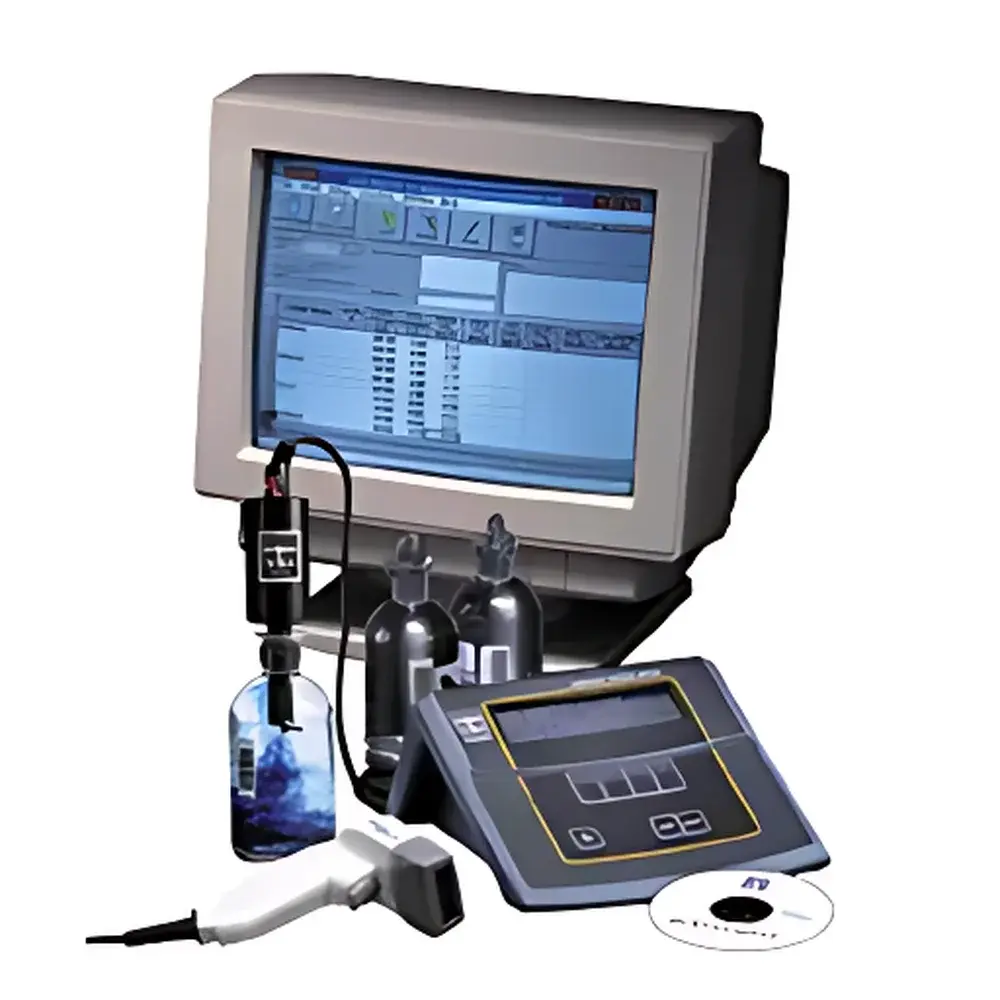
YSI 5000 Series Laboratory BOD Analyzer
| Brand | YSI |
|---|---|
| Origin | USA |
| Model | YSI 5000 |
| Compliance | HJ/T 99–2003, GB 7488–1987, GB 11913–1989 |
| Probe Type | Self-stirring electrochemical DO/BOD sensor (YSI 5906 membrane cap) |
| Data Storage | 100 timestamped readings |
| Software | Optional YSI BOD Analysis Software with automated calculation, report generation, and audit-ready export |
| Stirring | Integrated constant-speed magnetic stirrer |
| Membrane | Pre-tensioned 5906 polarographic membrane cap |
| Zero Drift | None – factory-calibrated, no user zero adjustment required |
| Alarm Functions | Supersaturation warning, temperature out-of-range alert, membrane integrity failure detection |
Overview
The YSI 5000 Series Laboratory BOD Analyzer is a dedicated, regulatory-compliant instrument engineered for precise biochemical oxygen demand (BOD) determination in wastewater, surface water, drinking water, and effluent samples. It operates on the principle of dissolved oxygen (DO) depletion measurement over a standardized 5-day incubation period (as defined in GB 7488–1987 and APHA Standard Methods 5210B), using an integrated self-stirring polarographic DO sensor. Unlike conventional manual dilution methods requiring external stirrers and discrete DO measurements, the YSI 5000 employs a closed-system, probe-based approach where the sensor simultaneously measures DO concentration and maintains controlled, reproducible hydrodynamic conditions at the electrode surface—eliminating diffusion-layer variability and enhancing inter-laboratory reproducibility. The system is fully aligned with Chinese national standards HJ/T 99–2003 (for BOD analytical instrumentation) and GB 11913–1989 (electrochemical DO probe methodology), and its design reflects foundational principles consistent with ISO 5815-1:2016 and ASTM D5210–92.
Key Features
- Integrated self-stirring DO/BOD probe (YSI 5906 sensor assembly) with constant-speed magnetic drive—ensures stable boundary-layer thickness and eliminates operator-dependent stirring artifacts
- Pre-tensioned 5906 polarographic membrane cap: factory-installed, eliminating installation-related tension errors and ensuring consistent O2 permeability across batches
- Zero-drift-free operation: calibrated at manufacture; no field zero adjustment required—reducing calibration drift and procedural variability
- Real-time membrane integrity monitoring: algorithmic detection of membrane rupture or delamination, triggering audible/visual alerts to prevent invalid data acquisition
- Onboard data logging: stores up to 100 BOD test records with embedded timestamps (date, time, temperature, DO reading, calculated BOD5)
- Temperature-compensated DO measurement: automatic correction per Nernst equation across 0–45 °C range; alarm triggers outside operational limits
- Supersaturation detection logic: identifies non-equilibrium DO conditions that may bias BOD calculation, flagging such events prior to result finalization
Sample Compatibility & Compliance
The YSI 5000 is validated for use with raw sewage, treated effluents, river water, lake water, and potable water matrices. Its probe design accommodates suspended solids up to 100 mg/L without clogging, and the self-stirring mechanism mitigates biofilm accumulation during extended incubations. Regulatory alignment includes full conformance with GB 7488–1987 (determination of BOD5 in water quality), GB 11913–1989 (electrochemical DO measurement), and HJ/T 99–2003 (technical specifications for BOD analyzers). While not inherently 21 CFR Part 11 compliant in standalone mode, when paired with the optional YSI BOD Analysis Software (v3.2+), the system supports electronic signatures, audit trails, and secure user access control—meeting GLP and routine QC lab documentation requirements.
Software & Data Management
The optional YSI BOD Analysis Software provides a validated Windows-based interface for method setup, real-time data visualization, automated BOD5 calculation (including dilution factor application and nitrification inhibition handling), and PDF/CSV report generation. All raw sensor outputs—including DO vs. time curves, temperature logs, and alarm event timestamps—are retained with immutable metadata. Exported files include digital signatures, version-stamped software identifiers, and traceable instrument serial numbers—supporting laboratory accreditation under CNAS-CL01 (equivalent to ISO/IEC 17025). Data backups are encrypted and compatible with LIMS integration via standard ODBC drivers.
Applications
- Regulatory compliance testing for municipal and industrial wastewater discharge permits (e.g., China’s Discharge Standards of Pollutants for Municipal Wastewater Treatment Plants, GB 18918–2002)
- Process control monitoring in activated sludge, MBR, and oxidation ditch treatment systems
- Environmental impact assessment (EIA) studies requiring BOD load quantification
- Research applications in biodegradability screening of novel organic compounds or pharmaceutical residues
- Educational laboratories conducting standardized APHA/GB-method BOD training exercises with reduced manual error potential
FAQ
Does the YSI 5000 require daily calibration?
No—its factory-calibrated sensor exhibits negligible zero drift; only span verification using air-saturated water or certified DO standard solutions is recommended before each batch of analyses.
Can the instrument measure BOD beyond 5 days (e.g., BOD20)?
Yes—the system supports customizable incubation durations up to 28 days; BODn values are calculated using the same first-order kinetics model embedded in GB 7488–1987 Annex A.
Is the 5906 membrane cap replaceable in-house?
Yes—replacement caps are supplied pre-assembled and require no user stretching or adhesive application; typical membrane service life is 6–12 months depending on sample matrix.
How does the system handle nitrification interference?
The software allows manual input of nitrification inhibitor addition (e.g., allylthiourea); if enabled, the algorithm excludes DO consumption attributable to nitrifying bacteria in final BOD5 computation.
What power source options are available?
The analyzer operates on 100–240 VAC, 50/60 Hz; battery operation is not supported—intended for benchtop laboratory deployment with stable AC supply.
Related Products







