
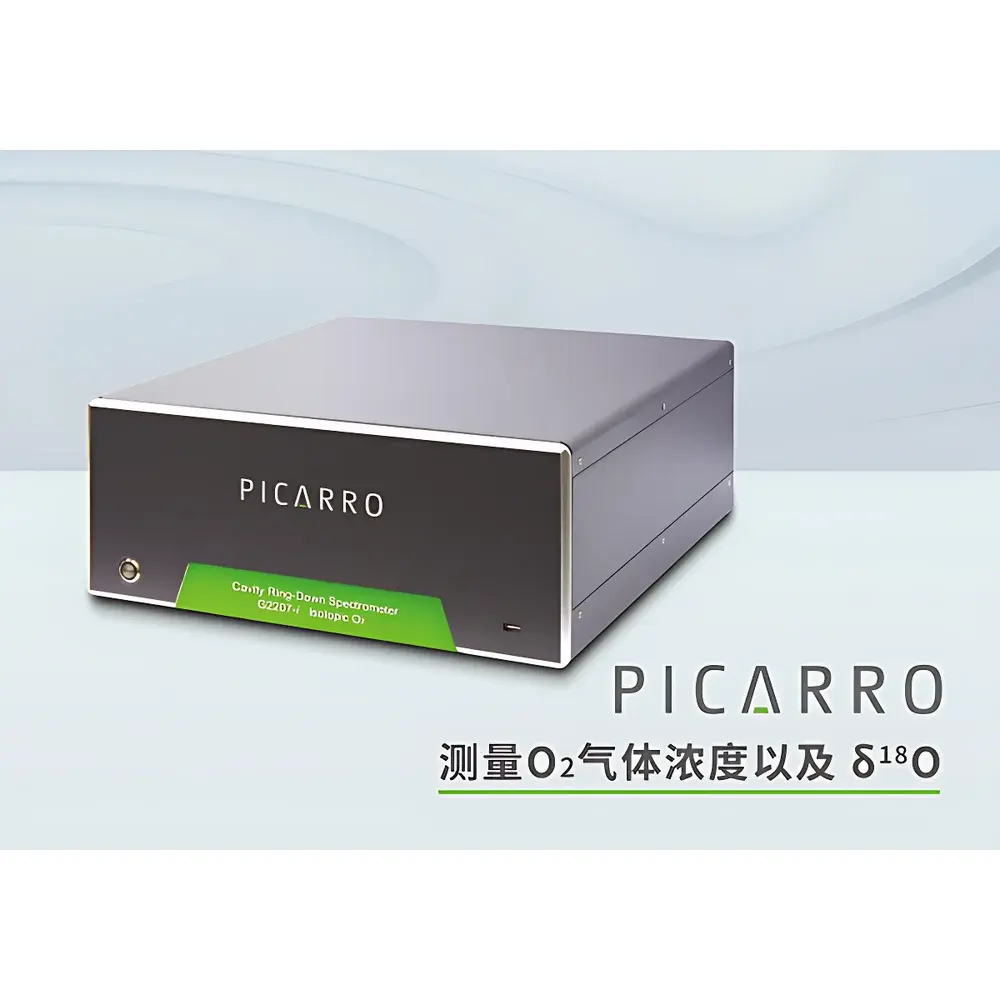
Picarro G2207-i Isotope Ratio and Gas Concentration Analyzer
| Brand | Picarro |
|---|---|
| Origin | USA |
| Model | G2207-i |
| Instrument Type | Stable Isotope Ratio Mass Spectrometer (IRMS) – Gas-Phase |
| Measurement Principle | Cavity Ring-Down Spectroscopy (CRDS) |
| O₂ Concentration Precision | < 2 ppm (5-min avg, dry basis) |
| δ¹⁸O Precision | < 1‰ (5-min avg) |
| H₂O Precision | 5 ppm + 0.1% of reading |
| O₂ Range | 5–25% |
| Operating Pressure | 300–1000 Torr |
| Sample Flow Rate | 80–110 sccm @ 760 Torr |
| Cavity Temperature Stability | ±0.005 °C |
| Cavity Pressure Stability | ±0.0002 atm |
| Environmental Operating Temp | 10–35 °C |
| Compliance | MIL-STD-810F (shock/vibration), CE, RoHS |
Overview
The Picarro G2207-i Isotope Ratio and Gas Concentration Analyzer is a high-performance, turnkey instrument engineered for simultaneous, real-time quantification of molecular oxygen (O₂) concentration and oxygen isotope ratio (δ¹⁸O) in gas-phase samples. Unlike conventional isotope ratio mass spectrometers (IRMS), the G2207-i employs proprietary Cavity Ring-Down Spectroscopy (CRDS), a laser-based absorption technique that delivers exceptional precision and long-term stability without requiring vacuum systems, ion sources, or complex sample preparation. Its optical measurement cell—thermally and barometrically stabilized to ±0.005 °C and ±0.0002 atm—provides an effective path length exceeding 20 km within a compact, monolithic cavity. This architecture enables sub-ppm O₂ concentration resolution and sub-permil δ¹⁸O precision under ambient conditions, making it uniquely suited for field-deployable and laboratory-based studies of atmospheric biogeochemistry, ecosystem respiration, paleoclimate proxy validation, and carbon cycle partitioning.
Key Features
- Simultaneous dual-mode operation: dedicated high-precision O₂ concentration mode (< 2 ppm, 5-min average, dry-mole-fraction reported) and integrated δ¹⁸O + O₂ mode (δ¹⁸O precision < 1‰, 5-min average)
- Patented CRDS technology with active thermal and pressure stabilization ensures ultra-low drift (< 6 ppm peak-to-peak O₂ drift over 24 h; < 2‰ δ¹⁸O drift over 24 h)
- Onboard water vapor (H₂O) measurement (5 ppm + 0.1% of reading) for real-time dilution correction and automatic dry-basis reporting of O₂
- Ruggedized optical cavity design qualified to MIL-STD-810F for shock and vibration resistance—enabling reliable operation in mobile labs, tower installations, and remote observatories
- Wide operational envelope: sample temperature range −10 °C to +45 °C; pressure range 300–1000 Torr; relative humidity up to 99% RH (non-condensing)
- Modular connectivity: native RS-232, Ethernet, and USB interfaces; optional analog output (0–10 V); compatible with industrial SCADA and data acquisition systems
Sample Compatibility & Compliance
The G2207-i accepts untreated, humid ambient air or pre-conditioned gas streams without mandatory drying—eliminating artifacts from desiccant-induced isotopic fractionation. It complies with ISO/IEC 17025 requirements for measurement uncertainty estimation and supports GLP/GMP workflows through time-stamped, audit-trail-enabled data logging. While not an IRMS per strict ASTM D7871 definition, its δ¹⁸O performance meets or exceeds the precision benchmarks established in ISO 18592 for stable isotope analysis of atmospheric gases. The instrument’s firmware implements secure user authentication, configurable data retention policies, and exportable metadata compliant with FAIR (Findable, Accessible, Interoperable, Reusable) principles. All calibration traceability is maintained to NIST-certified reference gases (e.g., NIST SRM 1660 for O₂, USGS-46 for δ¹⁸O).
Software & Data Management
Picarro’s Analyzers Control Software (ACS) v4.x provides intuitive configuration, real-time spectral visualization, automated baseline correction, and multi-parameter trending. Raw absorbance spectra, cavity ring-down times, and derived concentrations are stored in HDF5 format with embedded calibration coefficients and environmental metadata (T, P, flow). The software supports scheduled calibration sequences using internal zero/gas standards and external reference cylinders. Export options include CSV, NetCDF, and direct database push via ODBC. For regulated environments, optional 21 CFR Part 11 compliance packages provide electronic signatures, role-based access control, and immutable audit logs—fully validated for use in EPA Method TO-15–adjacent applications and ISO 14067 carbon accounting verification.
Applications
- Atmospheric O₂ monitoring for constraining global net primary productivity (NPP) and oceanic O₂ fluxes
- Soil and ecosystem respiration studies linking δ¹⁸O of respired O₂ to photosynthetic fractionation and microbial metabolism
- Validation of ice-core δ¹⁸O records against modern instrumental baselines
- Industrial process monitoring where O₂ stoichiometry and isotopic signatures indicate combustion efficiency or catalytic pathway dominance
- Calibration transfer between laboratory IRMS and field-deployed CRDS platforms via intercomparison campaigns
- Long-term observatory networks requiring unattended, low-maintenance operation with remote diagnostics
FAQ
Does the G2207-i require vacuum pumping or cryogenic cooling?
No. CRDS operates at ambient pressure with thermoelectrically cooled lasers and no moving parts in the optical path.
Can it measure δ¹⁸O in CO₂ or CH₄?
No. The G2207-i is optimized exclusively for O₂ and H₂O isotopologues in the near-IR (780 nm region). For CO₂ or CH₄, Picarro offers the G5131-i and G2201-i models.
Is external drying necessary for accurate δ¹⁸O measurement?
Not required. The instrument’s co-located H₂O measurement enables mathematically rigorous dilution correction, preserving isotopic integrity without chemical drying.
How is calibration traceability maintained?
Via daily automated zero-air checks and periodic bracketing with NIST-traceable O₂ and δ¹⁸O reference gases; all calibrants are logged with certificate IDs and expiration dates.
What is the minimum detectable change in δ¹⁸O under field conditions?
At 5-minute integration, the 1σ precision is < 1‰—sufficient to resolve biospheric signals such as leaf-water enrichment effects or soil-atmosphere exchange gradients.





