
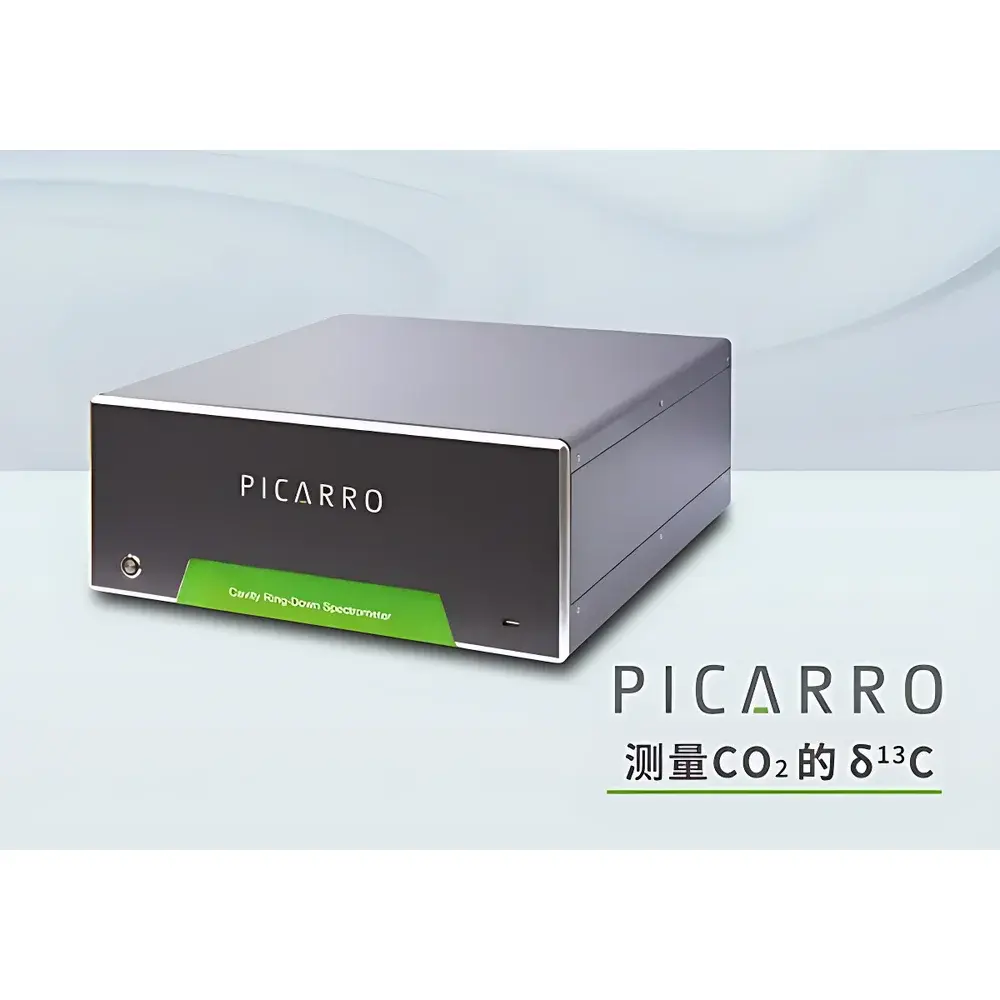
Picarro G2121-i Isotope Ratio and Gas Concentration Analyzer for δ¹³C in CO₂
| Brand | Picarro |
|---|---|
| Origin | USA |
| Model | G2121-i |
| Measurement Principle | Cavity Ring-Down Spectroscopy (CRDS) |
| Target Analyte | δ¹³C in CO₂ |
| Precision (5-min avg) | ≤0.4‰ (typical 0.2–0.3‰) |
| CO₂ Concentration Range | 2000–4000 ppm |
| Measurement Interval | ~10 s |
| Operating Temperature | 10–35 °C |
| Sample Pressure | 300–1000 Torr (40–133 kPa) |
| Sample Flow Rate | <0.1 slm at 760 Torr |
| Sample Humidity | <99% RH, non-condensing at 40 °C |
| Dimensions (Analyzer) | 43.2 × 17.8 × 44.6 cm (W×H×D) |
| Weight | 27.4 kg (incl. external pump) |
| Power | 90–220 V AC, 50/60 Hz, <300 W |
Overview
The Picarro G2121-i Isotope Ratio and Gas Concentration Analyzer is a high-precision, field-deployable instrument engineered for continuous, real-time measurement of carbon isotope ratios (δ13C) and absolute concentration of carbon dioxide (CO2) in gas-phase samples. Unlike traditional isotope ratio mass spectrometers (IRMS), the G2121-i employs proprietary Cavity Ring-Down Spectroscopy (CRDS), a laser-based optical technique that quantifies isotopic absorption signatures with exceptional specificity and stability. This method eliminates the need for ion sources, vacuum systems, or consumable filaments—key differentiators from conventional IRMS platforms. The analyzer is optimized for CO2 concentrations between 2000 and 4000 ppm, delivering δ13C precision of ≤0.4‰ (5-minute averaging), with typical performance reaching 0.2–0.3‰ under controlled laboratory conditions. Its robust thermal and pressure control architecture ensures long-term measurement integrity without routine recalibration, making it suitable for both fixed-laboratory applications and mobile deployments across environmental monitoring networks, soil flux studies, and carbon cycle research.
Key Features
- Optical isotope analysis via CRDS—no vacuum pumps, no ionization, no consumables required
- Integrated cavity temperature and pressure stabilization for sub-‰ isotopic reproducibility
- Minimal drift (<0.1‰/day) over extended unattended operation; no daily calibration necessary
- Compact, benchtop form factor (27.4 kg total) with rapid deployment—operational within 60 minutes of setup
- Environmental resilience: insensitive to ambient temperature fluctuations (10–35 °C operating range); stable performance across 300–1000 Torr sample pressure
- Low sample demand: <0.1 standard liter per minute (slm) at 760 Torr; no inline filtration or drying required for RH <99% (non-condensing)
- Flexible connectivity: RS-232, Ethernet, and optional analog outputs (4–20 mA / −10 to +10 V) for integration into SCADA or data acquisition systems
Sample Compatibility & Compliance
The G2121-i is designed for direct analysis of dry or humid CO2-rich gas streams, including headspace air, combustion effluents, and exhaled breath. When coupled with Picarro’s A0201 Total Combustion Module or AutoMate FX DIC Preparation System, it supports solid, liquid, and aqueous sample introduction—including soils, plant tissues, carbonate minerals, and dissolved inorganic carbon (DIC) in seawater or freshwater. All configurations maintain traceability to international reference materials (e.g., NIST SRM 1610, IAEA-CO-1, USGS24) and support GLP-compliant workflows. While not an IRMS per se, the G2121-i meets ASTM D7876–19 (Standard Practice for Isotopic Analysis of Carbon in CO2 by Optical Spectroscopy) and aligns with ISO 13877:2022 requirements for stable isotope ratio determination in environmental gases. Its software architecture supports full audit trails and user-access controls compliant with FDA 21 CFR Part 11 when deployed in regulated QC/QA environments.
Software & Data Management
Picarro’s proprietary Analyze software provides real-time spectral visualization, automated peak integration, and dual-ratio calculation (δ13C and [CO2]) with built-in correction for water vapor cross-talk. Raw absorbance spectra, cavity ring-down time constants, and diagnostic metrics (e.g., cavity pressure, temperature, laser wavelength stability) are logged at 1 Hz. Data export supports CSV, NetCDF, and HDF5 formats, enabling seamless ingestion into Python (Pandas, Xarray), MATLAB, or commercial analytics platforms. Remote monitoring and configuration are supported via secure HTTPS interface; firmware updates and method templates can be deployed over Ethernet. For multi-instrument networks, Picarro’s Centralized Data Server (CDS) enables synchronized time-stamping, centralized calibration management, and role-based access control—critical for multi-site carbon flux observatories or inter-laboratory comparison studies.
Applications
- Soil respiration and ecosystem carbon flux studies (eddy covariance, chamber-based measurements)
- Biogeochemical tracing of carbon sources in groundwater, wetlands, and marine sediments
- Forensic and ecological authentication of food, wine, and botanical products via δ13C fingerprinting
- Monitoring CO2 isotopic composition in urban airsheds and industrial emission plumes
- Calibration and validation of satellite-based atmospheric CO2 sensors (e.g., OCO-2/3, GOSAT)
- Process control in fermentation, carbon capture utilization and storage (CCUS), and biofuel production
FAQ
Does the G2121-i require carrier gas or calibration standards during routine operation?
No. The system operates without carrier gas, zero-air, or reference standards during normal measurement. Optional daily automated checks using internal reference cells are available but not mandatory for stable δ13C performance.
Can the G2121-i measure δ13C in low-CO2 samples (e.g., ambient air at ~400 ppm)?
Not natively. It is optimized for 2000–4000 ppm CO2. For ambient air analysis, pre-concentration modules (e.g., Picarro’s G1301-f) or alternative instruments such as the G2201-i are recommended.
Is the G2121-i compatible with third-party autosamplers or custom inlet manifolds?
Yes. Its analog and digital I/O interfaces, along with TTL-triggered sampling mode, enable synchronization with external valves, multiplexers, and robotic sample handlers.
What maintenance is required beyond routine cleaning of the inlet fitting?
None. There are no consumable optics, lasers, or detectors. Annual verification of cavity alignment and pressure sensor calibration is recommended for ISO 17025 accreditation but not required for operational continuity.
How does CRDS compare to IRMS for δ13C accuracy and long-term stability?
CRDS offers comparable δ13C precision (≤0.3‰) to high-end IRMS but with superior short-term stability, lower operational cost, and reduced infrastructure demands (no vacuum, no hydrogen gas, no cryogens). Absolute accuracy remains dependent on proper referencing to certified standards, regardless of technique.



