
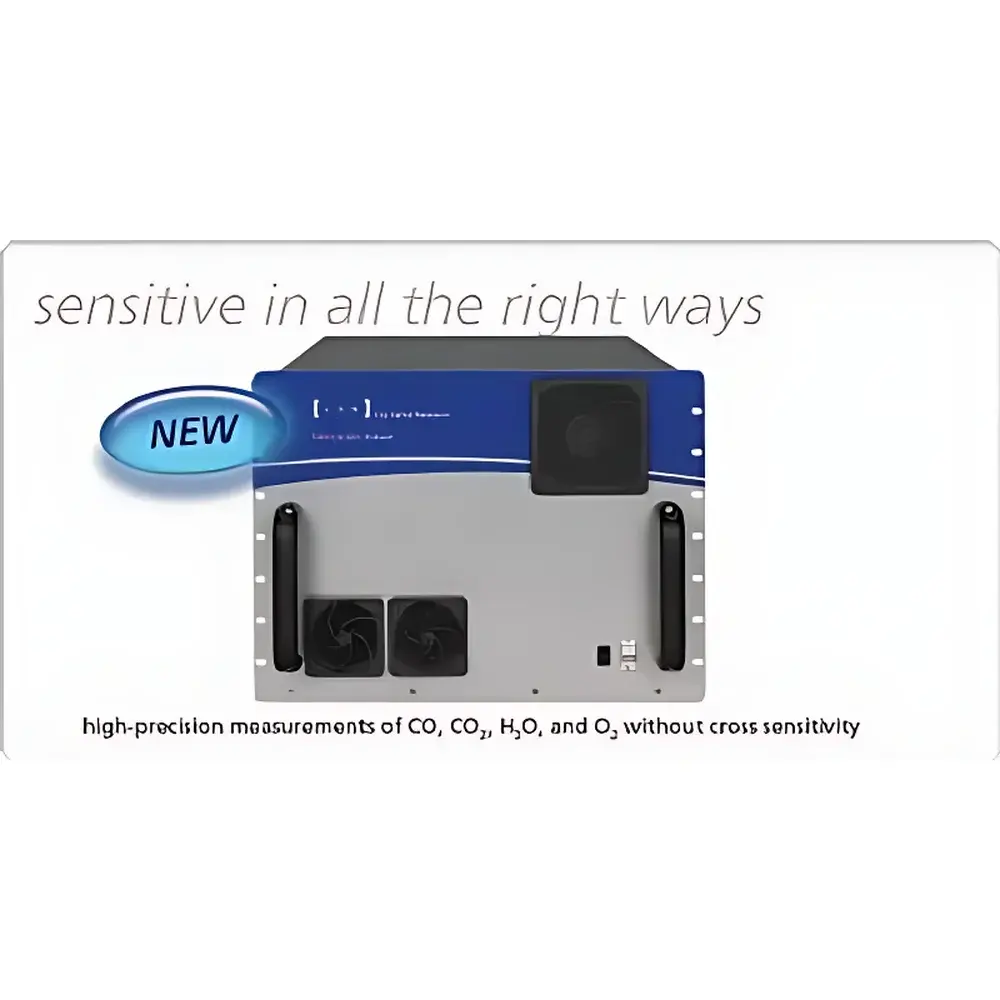
LGR 907-0036 / 911-0036 Industrial Emission Analyzer (IEA)
| Origin | USA |
|---|---|
| Manufacturer Type | Authorized Distributor |
| Origin Category | Imported |
| Model | 907-0036, 911-0036 |
| Price | Upon Request |
Overview
The LGR Industrial Emission Analyzer (IEA) is the world’s first laser-based, real-time gas analyzer engineered to simultaneously quantify CO, CO2, H2O, and O2 in hot, humid, and dynamically varying industrial exhaust streams. Built upon Los Gatos Research’s proprietary Off-Axis Integrated Cavity Output Spectroscopy (OA-ICOS) platform, the IEA delivers high-fidelity, interference-free measurements without reliance on sample drying, chemical scrubbing, or post-acquisition correction algorithms. Unlike conventional FTIR, NDIR, or CRDS systems, OA-ICOS provides exceptional immunity to laser alignment drift, sub-second measurement latency, low power consumption, and inherent spectral resolution sufficient to resolve overlapping ro-vibrational lines of target gases—even under high water vapor partial pressures. The instrument operates natively in harsh process environments up to 45 °C ambient (0 °C for EP variant), with full condensation-free operation across 0–100% RH. Its embedded Linux computing architecture enables autonomous data logging, onboard diagnostics, and secure remote access via Ethernet—making it suitable for unattended continuous emission monitoring (CEM) and closed-loop combustion optimization in regulated industrial settings.
Key Features
- Simultaneous, real-time quantification of CO, CO2, O2, and H2O at native wet-gas conditions
- Direct output of dry-mole-fraction concentrations—no external drying or computational dilution correction required
- High-resolution, real-time absorption spectra visualization for method transparency and validation
- Wide dynamic range: CO (5 ppm–10%), CO2 (500 ppm–100%), O2 (300 ppm–100%), H2O (7,000–70,000 ppm)
- Sub-6-second system response time (with optional external vacuum pump)
- Low-drift performance: ≤4 ppm CO, ≤400 ppm CO2, ≤300 ppm O2, ≤0.4% H2O (24-hr, 15-min averaging, STP)
- Uncertainty <0.03% (EP model) and <1% (standard model) under field-representative conditions, traceable to NIST standards
- Rack-mount form factor (22.2 cm H × 48.3 cm W × 61 cm D; 29 kg standard / 40 kg EP)
Sample Compatibility & Compliance
The IEA is validated for direct sampling of raw flue gas from metallurgical furnaces (steel, glass), municipal waste incinerators, petrochemical crackers, and refinery catalytic units—without conditioning hardware. It meets key regulatory design principles aligned with EPA Method 3A (O2/CO2), ASTM D6522 (CO), and ISO 14064-1 (GHG quantification). Its optical path is sealed and pressure-stabilized to minimize particulate ingress, while the heated sample interface (optional) prevents condensation-induced signal attenuation. Data integrity complies with 21 CFR Part 11 requirements when paired with LGR’s certified data acquisition software (Model 904-0002), supporting electronic signatures, audit trails, and ALCOA+ (Attributable, Legible, Contemporaneous, Original, Accurate) documentation practices for GLP/GMP environments.
Software & Data Management
Controlled via a web-based GUI accessible over Ethernet or local USB/RS-232, the IEA supports remote configuration, live spectral viewing, alarm thresholding, and firmware updates. The onboard Linux OS logs all raw spectra and derived concentrations at user-selectable intervals (0.01–1 Hz) to internal flash memory (≥16 GB). Optional LGR Data Acquisition Software (904-0002) enables synchronized timestamped ingestion from multiple IEAs and auxiliary sensors (e.g., thermocouples, anemometers, GPS), exporting to CSV, NetCDF, or SQL-compatible formats. All data files include embedded metadata (instrument ID, calibration history, environmental logs) to satisfy ISO/IEC 17025 traceability requirements.
Applications
- Continuous emission monitoring (CEM) for regulatory reporting under EPA 40 CFR Part 60/75 and EU IED Directive
- Combustion efficiency optimization via real-time O2/CO ratio feedback in cement kilns and glass melters
- Carbon capture readiness assessment through precise CO2 slip detection downstream of amine scrubbers
- Waste-to-energy plant emissions verification during transient load changes
- Process safety interlocks based on rapid CO excursion detection in syngas lines
- Research-grade greenhouse gas flux studies requiring simultaneous multi-species eddy covariance synchronization
FAQ
Does the IEA require gas drying or permeation-based moisture removal prior to analysis?
No. OA-ICOS spectroscopic modeling inherently corrects for H2O-induced pressure broadening and dilution effects, enabling direct dry-mole-fraction output without physical sample conditioning.
Can the IEA operate in high-dust environments typical of steel mill exhaust ducts?
Yes—when installed with a heated, sintered-metal probe and particulate filter (recommended accessory), the IEA maintains optical stability and calibration integrity under ISO 14644 Class 8 particulate loading.
Is factory calibration traceable to international standards?
All factory calibrations are performed using NIST-traceable gas standards (NIST SRM 1662a, 1663b) and documented per ISO/IEC 17025 Annex A.5.
What communication protocols does the IEA support for integration into SCADA or DCS systems?
Modbus TCP/IP, ASCII over RS-232/Ethernet, and analog 4–20 mA outputs (configurable per gas) are supported natively; OPC UA integration is available via third-party middleware.
How frequently must the IEA undergo field recalibration?
Under stable operating conditions, annual zero/span verification is recommended; EP models support extended calibration intervals (up to 18 months) when operated within specified temperature/humidity envelopes.
Related Products







