
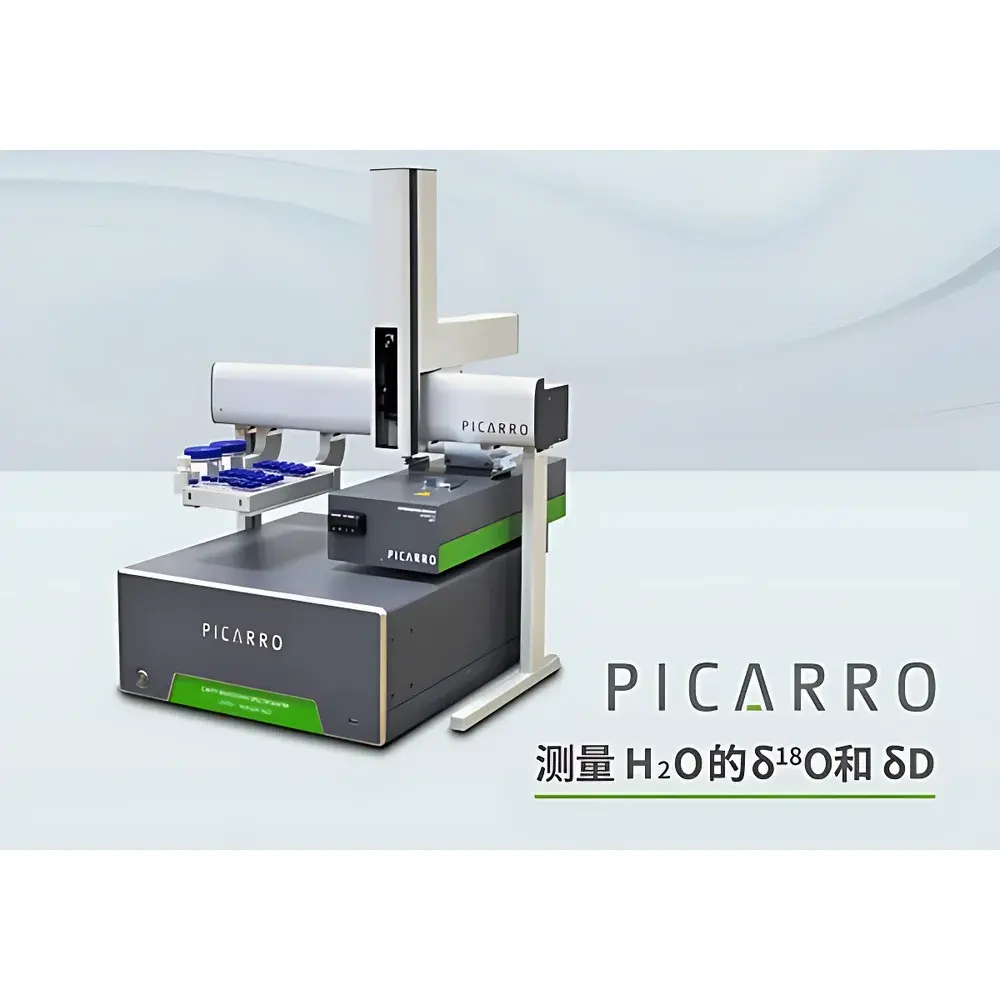
Picarro L2130-i Isotope Ratio Analyzer for High-Precision δ¹⁸O and δD Measurement in Water Vapor and Liquid Water
| Brand | Picarro |
|---|---|
| Origin | USA |
| Model | L2130-i |
| Instrument Type | Cavity Ring-Down Spectroscopy (CRDS) Isotope Ratio Analyzer |
| Measurement Targets | δ¹⁸O and δD in H₂O |
| Precision (1σ, liquid water) | δ¹⁸O ≤ 0.025‰, δD ≤ 0.100‰ |
| 24-h Drift (liquid) | δ¹⁸O ≤ 0.200‰, δD ≤ 0.800‰ |
| Water Vapor Range | 1,000–50,000 ppm |
| Detection Technique | Off-axis Integrated Cavity Output Spectroscopy (OA-ICOS) |
| Operating Temperature | 10–35°C (liquid analysis), –10 to 45°C (vapor analysis) |
| Dimensions | 43.2 × 19.1 × 43.2 cm (W × H × D) |
| Weight | 20.4 kg |
| Power | 90–240 VAC, 50/60 Hz, <150 W (analyzer), +80 W (external pump) |
| Software | Pre-installed Picarro Analysis Suite on Windows 10 Pro |
Overview
The Picarro L2130-i Isotope Ratio Analyzer is a high-performance, turnkey instrument engineered for precise, continuous, and automated measurement of stable hydrogen and oxygen isotope ratios (δD and δ¹⁸O) in both liquid water and water vapor samples. Unlike traditional isotope ratio mass spectrometry (IRMS), the L2130-i employs proprietary Off-Axis Integrated Cavity Output Spectroscopy (OA-ICOS)—a laser absorption technique that delivers laboratory-grade isotopic precision without vacuum systems, cryogens, or complex sample preparation. Its optical cavity design enables ultra-long effective pathlengths (>20 km), resulting in exceptional sensitivity and signal stability. The analyzer operates across two distinct measurement modes: direct liquid injection (via integrated A0211/A0325 liquid autosampler modules) and continuous water vapor analysis (with optional vaporizer or direct inlet). This dual-mode capability supports rigorous applications in paleoclimatology, ecohydrology, groundwater tracing, atmospheric moisture studies, and process monitoring where isotopic fidelity, long-term reproducibility, and minimal operator intervention are critical.
Key Features
- Sub-permil precision: Achieves ≤0.025‰ (1σ) for δ¹⁸O and ≤0.100‰ (1σ) for δD in liquid water—validated per IAEA reference materials and traceable to VSMOW-SLAP scale
- Low-drift architecture: Ensures ≤0.200‰ (δ¹⁸O) and ≤0.800‰ (δD) 24-hour drift under standard operating conditions, enabling daily calibration intervals without compromising data integrity
- Dual-phase compatibility: Simultaneously supports discrete liquid water analysis (0.1–10 µL injections) and continuous water vapor quantification (1,000–50,000 ppm H₂O)
- Robust optical design: Sealed, temperature-stabilized cavity with active wavelength locking ensures immunity to environmental vibration and thermal fluctuation
- Compact benchtop form factor: 43.2 cm wide × 19.1 cm high × 43.2 cm deep; weighs 20.4 kg—designed for integration into field laboratories, mobile platforms, or ISO-classified clean rooms
- Intuitive software interface: Pre-loaded Picarro Analysis Suite provides real-time spectral diagnostics, automated baseline correction, and configurable reporting templates compliant with GLP documentation requirements
Sample Compatibility & Compliance
The L2130-i accepts aqueous samples from diverse matrices—including precipitation, soil pore water, plant xylem sap, seawater, meltwater, and industrial process streams—without chemical derivatization. For solid-phase samples (e.g., ice cores, hydrated minerals), optional peripheral devices such as the A0312 CryoPrep™ or A0221 High-Temperature Converter enable quantitative water extraction prior to analysis. All liquid measurements comply with ASTM D7925–15 (Standard Test Method for Determination of Oxygen and Hydrogen Isotopic Composition of Water by Laser Absorption Spectroscopy) and support traceability to IAEA-certified reference waters (VSMOW2, SLAP2, GISP). The system meets key regulatory expectations for analytical validation: it records full audit trails (user actions, calibration events, spectral metadata), enforces electronic signatures, and supports 21 CFR Part 11–compliant data archiving when deployed with validated network storage protocols.
Software & Data Management
The embedded Picarro Analysis Suite (v4.x+) runs on a dedicated Windows 10 Pro platform and provides end-to-end workflow automation—from method selection and calibration scheduling to raw spectral fitting and delta-value calculation using dual-reference normalization (e.g., VSMOW–SLAP bracketing). Each measurement includes time-stamped spectral absorbance profiles, cavity ring-down time residuals, pressure/temperature logs, and uncertainty propagation metrics. Export formats include CSV, Excel (.xlsx), and netCDF for interoperability with MATLAB, Python (xarray/pandas), and commercial LIMS platforms. Remote access is enabled via secure SSH or TLS-encrypted HTTP, allowing centralized fleet monitoring and firmware updates without physical intervention. Data integrity safeguards include write-once storage options, automatic checksum verification, and configurable retention policies aligned with ISO/IEC 17025 clause 7.5.2.
Applications
- Paleoclimatology: High-resolution δ¹⁸O profiling in ice core sections to reconstruct past temperature gradients and atmospheric circulation patterns
- Hydrological partitioning: Quantifying evapotranspiration vs. infiltration contributions in catchment-scale water budgets using dual-isotope slopes
- Groundwater recharge studies: Discriminating meteoric vs. geothermal sources through δD–δ¹⁸O end-member mixing analysis
- Ocean-atmosphere exchange: Measuring isotopic fractionation during sea spray aerosol formation and marine boundary layer vapor cycling
- Food authenticity: Verifying geographic origin of bottled waters, wines, and dairy products via isotopic fingerprinting
- Biogeochemical process tracing: Monitoring microbial water utilization in soils and rhizosphere compartments using δD-labeled tracer experiments
FAQ
What measurement principle does the L2130-i use, and how does it differ from IRMS?
The L2130-i employs Off-Axis Integrated Cavity Output Spectroscopy (OA-ICOS), a laser absorption technique measuring isotopic ratios via high-resolution near-infrared absorption lines of H₂¹⁶O, H₂¹⁸O, and HD¹⁶O. Unlike IRMS—which requires ionization, magnetic sector separation, and vacuum maintenance—the L2130-i operates at ambient pressure, eliminates mass-dependent fractionation artifacts, and delivers faster throughput with lower operational overhead.
Can the L2130-i analyze water extracted from solids like soils or plant tissue?
Yes—when paired with Picarro’s A0312 CryoPrep™ or A0221 High-Temperature Converter, the system fully supports quantitative water extraction from frozen or dry solid matrices prior to isotopic analysis.
Is the instrument suitable for unattended long-term deployments?
Yes—the L2130-i features internal temperature stabilization, passive humidity control, and robust power management. It has been deployed in remote Antarctic field stations and high-altitude observatories with >95% uptime over 12-month intervals when coupled with uninterruptible power supplies and environmental enclosures.
How is data traceability ensured for regulatory submissions?
All raw spectra, calibration parameters, user log entries, and calculated δ-values are stored with cryptographic timestamps and immutable metadata. When configured with Picarro’s Enterprise Data Manager, the system generates audit-ready reports satisfying FDA 21 CFR Part 11, ISO/IEC 17025, and EU Annex 11 requirements.
What maintenance is required beyond daily calibration?
No consumables or routine optical alignment are needed. Recommended preventive maintenance includes quarterly inspection of inlet filters, annual verification of pressure transducers, and biannual cavity mirror reflectivity assessment—typically performed by Picarro Field Service Engineers during scheduled site visits.




