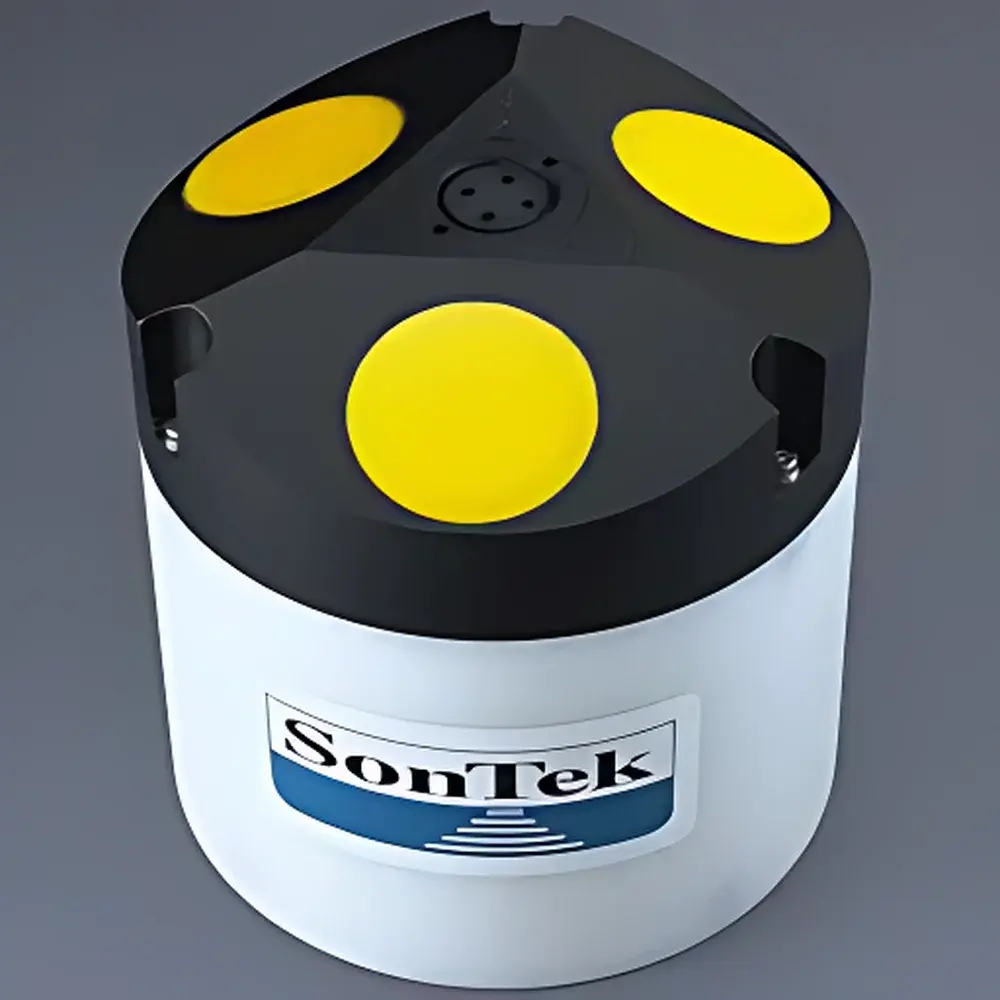
Argonaut-XR Upward-Looking Doppler Velocity Profiler
| Origin | USA |
|---|---|
| Manufacturer Type | Distributor |
| Origin Category | Imported |
| Model | Argonaut-XR |
| Price | Upon Request |
Overview
The Argonaut-XR Upward-Looking Doppler Velocity Profiler is an advanced, bottom-mounted acoustic Doppler current profiler (ADCP) engineered for high-accuracy, long-term velocity profiling in rivers, estuaries, tidal channels, and port environments. Operating on the principle of coherent pulsed Doppler signal processing at 1.5 MHz, the Argonaut-XR transmits three simultaneous acoustic beams upward from the seafloor or riverbed to resolve three orthogonal components (East, North, Up) of water velocity within a configurable vertical water column. Unlike fixed-range profilers, its adaptive sampling cell architecture enables dynamic adjustment of cell size and position—spanning a maximum profiling range of 22.0 m from the transducer face—while maintaining consistent spatial resolution across variable water depths. This capability is especially critical in tidally influenced or flood-prone settings where water level fluctuates significantly over time. The instrument integrates a strain-gauge pressure sensor for precise water level determination, a solid-state compass and dual-axis tilt sensor for Earth-referenced vector transformation, and a titanium-housed temperature sensor with rapid thermal response—ensuring robust, drift-resistant measurements under field conditions.
Key Features
- Three-beam, upward-looking acoustic Doppler configuration for true 3D velocity vector measurement in E/N/U coordinates
- Configurable sampling cell size and vertical positioning—user-defined range from 0.5 m to 22.0 m (1.5 MHz transducer); optional 3.0 MHz transducer extends near-bed resolution (0.2–8.0 m range)
- Auto-adaptive profiling mode: automatically adjusts cell size and gate position in real time as water level changes
- Integrated strain-gauge pressure sensor (±0.1% FS accuracy) and optional resonant pressure transducer (RPT, ±0.01% FS) for hydrostatic water level monitoring
- High-resolution temperature sensing (±0.1°C, 0.01°C resolution) via external titanium housing for minimal thermal lag
- Digital signal processor (DSP) optimized for low-SNR environments; 4 MB internal memory stores >200,000 velocity profiles
- Ultra-low power consumption: 0.1–0.2 W typical; compatible with 6–30 VDC input—suitable for solar-battery deployments
- No routine calibration required; measurement accuracy remains unaffected by biofouling due to acoustic beam geometry and signal processing algorithms
Sample Compatibility & Compliance
The Argonaut-XR is designed for continuous deployment in natural and engineered aquatic systems—including gravel-bed rivers, sediment-laden estuaries, brackish harbors, and irrigation canals. Its titanium transducer housing and corrosion-resistant mechanical design comply with ISO 9001-manufactured quality protocols and meet NEMA-4X environmental enclosure standards. Data integrity aligns with USGS Water Data Standards and supports compliance with EPA Method 1604 and ASTM D5941 for open-channel flow measurement. When integrated with certified CTD (e.g., Sea-Bird Electronics) or multiparameter probes (e.g., YSI EXO series), the system supports GLP-compliant environmental monitoring workflows. All firmware and data logging adhere to timestamped, non-volatile storage conventions required for regulatory reporting and long-term trend analysis.
Software & Data Management
Data acquisition and configuration are managed via the manufacturer’s cross-platform Argonaut Configuration Utility (Windows/macOS/Linux), supporting RS-232, RS-422, RS-485, SDI-12, and 4–20 mA output options. Raw velocity profiles, ensemble-averaged vectors, water level, temperature, and diagnostic metadata are stored in standardized binary format with embedded UTC timestamps and sensor health flags. Export formats include CSV, NetCDF, and compliant ASCII for direct ingestion into hydrological modeling platforms (e.g., HEC-RAS, MIKE SHE). Optional SonWave spectral package enables wave height, period, and directional spectrum derivation when paired with a calibrated pressure sensor—extending utility beyond current profiling into coastal process studies. Firmware updates maintain backward compatibility and include audit-trail logging per FDA 21 CFR Part 11 requirements for validated environments.
Applications
- River discharge monitoring and real-time flood forecasting systems
- Tidal current characterization for port infrastructure planning and ship maneuvering safety
- Irrigation canal flow optimization and water allocation verification
- Environmental flow assessment for ecological restoration and regulatory compliance (e.g., WFD, Clean Water Act)
- Long-term sediment transport studies using velocity shear profiling
- Integration into automated telemetry networks (SCADA, LoRaWAN, Iridium) for remote operations
- Calibration reference for stage-discharge rating curves and ADCP validation campaigns
FAQ
Does the Argonaut-XR require periodic factory calibration?
No. Its Doppler velocity measurement is based on time-of-flight and phase-shift principles referenced to internal quartz timing; no user-accessible calibration is needed. Biofouling does not degrade accuracy due to beam geometry and adaptive signal thresholding.
Can it operate reliably in highly turbid or sediment-laden water?
Yes. The 1.5 MHz frequency provides optimal balance between penetration depth and backscatter sensitivity in suspended sediment conditions typical of rivers and estuaries.
How is water level derived—and what is its uncertainty?
Water level is calculated from absolute pressure (via integrated strain gauge or optional RPT), compensated for local atmospheric pressure and water density. Total uncertainty is ≤±0.5 cm under stable thermal conditions.
Is it compatible with third-party dataloggers and telemetry systems?
Yes—via RS-232/422/485 serial protocols, SDI-12, or analog 4–20 mA outputs. Predefined Modbus RTU mapping is available upon request.
What is the minimum detectable velocity and its resolution?
Velocity resolution is 0.001 m/s (0.1 cm/s); minimum measurable magnitude is 0.01 m/s under typical SNR conditions.