
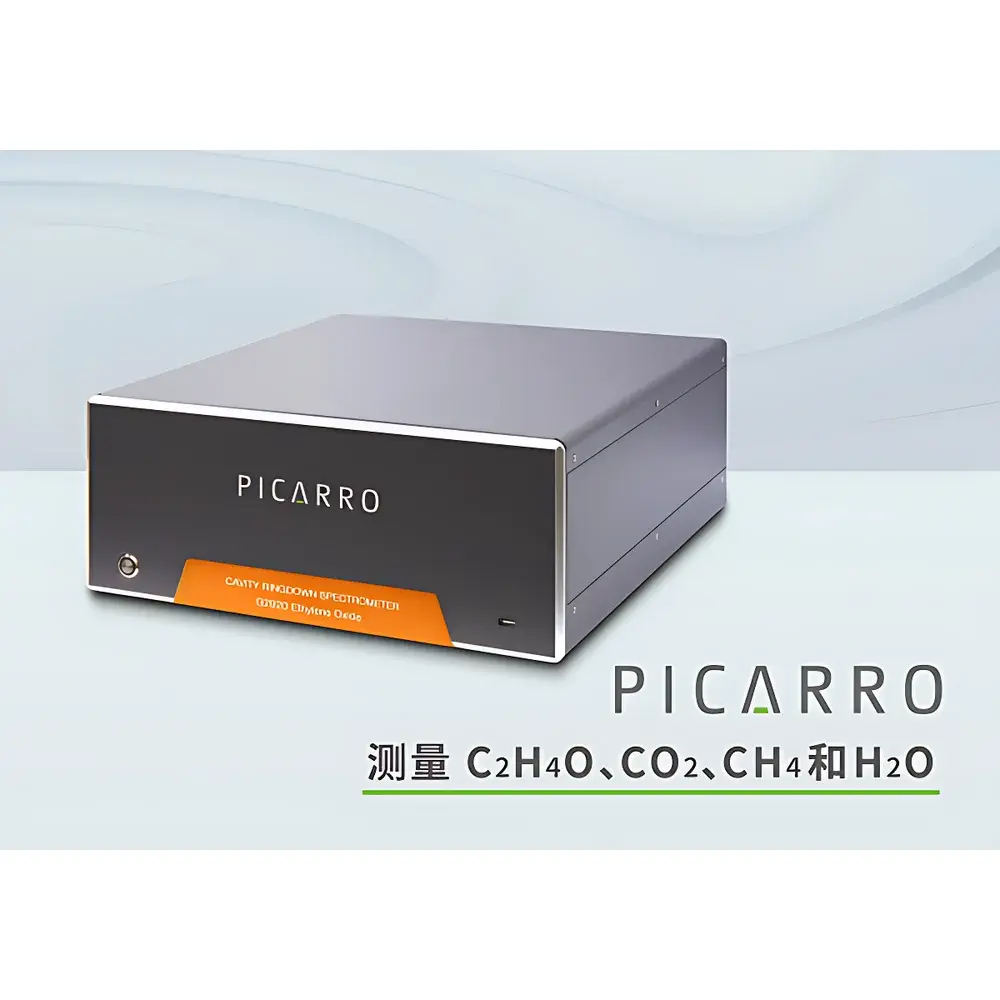
Picarro G2920 Ethylene Oxide (EtO) Multi-Gas Cavity Ring-Down Spectroscopy Analyzer
| Brand | Picarro |
|---|---|
| Origin | USA |
| Model | G2920 |
| Instrument Type | Portable |
| Detection Targets | C₂H₄O, CO₂, CH₄, H₂O |
| Detection Principle | Cavity Ring-Down Spectroscopy (CRDS) |
| Detection Limit (3σ, 300 s) | 100 ppt for C₂H₄O |
| Measurement Interval | < 2 s |
| Response Time (10–90%) | < 10 s |
| Operating Temperature Range | −10 °C to 80 °C (sample), 10 °C to 35 °C (ambient) |
| Pressure Control Accuracy | ±0.0002 atm |
| Temperature Control Accuracy | ±0.005 °C |
| Sample Flow Rate | ~250 sccm at 760 Torr |
| Humidity Tolerance | RH < 99% (non-condensing at 40 °C) |
| Dimensions (Analyzer) | 43.2 × 17.9 × 44.6 cm |
| Weight (Analyzer) | 21.3 kg |
Overview
The Picarro G2920 is a high-precision, portable cavity ring-down spectroscopy (CRDS) analyzer engineered for continuous, real-time quantification of ethylene oxide (C₂H₄O) alongside co-occurring gases—carbon dioxide (CO₂), methane (CH₄), and water vapor (H₂O)—in ambient air and industrial exhaust streams. Unlike conventional gas detection methods such as Fourier-transform infrared (FTIR) spectroscopy or gas chromatography (GC), the G2920 delivers part-per-trillion (ppt)-level sensitivity without pre-concentration, consumables, or zero-gas calibration. Its CRDS measurement architecture employs ultra-stable, temperature- and pressure-controlled optical cavities with high-finesse mirrors, enabling sub-second integration times and exceptional long-term stability. The system is specifically optimized for fence-line monitoring, community air quality assessment, and regulatory compliance applications where accurate, interference-free EtO measurement is mandated by agencies including the U.S. EPA, California Air Resources Board (CARB), and EU EEA. The G2920 operates across a dynamic range of 0–10 ppm for C₂H₄O while maintaining trace-level precision under variable matrix conditions—including elevated CO₂, CH₄, and humidity—making it suitable for both stack testing and ambient background characterization.
Key Features
- Ultra-low detection limit of 100 ppt (3σ, 300 s) for ethylene oxide—meeting stringent regulatory thresholds for fugitive emission monitoring.
- Simultaneous, independent quantification of C₂H₄O, CO₂ (0–2,000 ppm), CH₄ (0–10 ppm), and H₂O (0–30,000 ppm) with no cross-sensitivity or spectral interference.
- Patented stainless-steel gas path heated to 80 °C, minimizing surface adsorption/desorption hysteresis and ensuring rapid response (<10 s rise/fall time) and minimal memory effects.
- No zero-gas requirement: inherent baseline stability eliminates need for external zero-air sources or calibration cylinders during routine operation.
- High-precision environmental control: optical cavity maintained at ±0.005 °C and ±0.0002 atm, critical for reproducible CRDS decay-time measurements over extended deployments.
- Compact, rack-mountable form factor (17″ W × 7″ H × 17.5″ D) enables deployment in mobile labs, fixed monitoring stations, or integrated CEMS platforms with minimal footprint.
- Robust design certified for operation across −10 °C to 50 °C storage and 10 °C to 35 °C operational ambient ranges, with non-condensing RH tolerance up to 85%.
Sample Compatibility & Compliance
The G2920 is validated for direct analysis of humid, multi-component air matrices without sample drying or chemical scrubbing. It maintains accuracy in the presence of up to 2,000 ppm CO₂, 10 ppm CH₄, 30,000 ppm H₂O, and ambient NH₃ (0–2,000 ppm), eliminating common interferences that compromise FTIR or electrochemical sensors. Its measurement protocol aligns with ASTM D6348–21 (standard test method for determining gaseous compounds by CRDS), supports GLP/GMP data integrity requirements, and is compatible with FDA 21 CFR Part 11-compliant software configurations when paired with audit-trail-enabled data acquisition systems. The analyzer meets U.S. EPA Method TO-15 and EU EN 14662 criteria for VOC speciation support and is routinely deployed in EPA-approved fence-line monitoring networks under 40 CFR Part 63 Subpart HHHHH.
Software & Data Management
Controlled via embedded Windows 10 OS, the G2920 provides native support for time-synchronized data streaming over Ethernet, RS-232, and USB interfaces. Raw decay-time spectra, calibrated gas concentrations, and diagnostic metadata (cavity pressure, temperature, mirror reflectivity, laser power) are logged at user-selectable intervals (down to 1 Hz). The Picarro Analysis Software Suite enables real-time visualization, automated QA/QC flagging (e.g., pressure excursion alerts, signal-to-noise degradation), and export to CSV, NetCDF, or SQL-compatible formats. Optional analog output (0–10 V) allows integration with SCADA or DCS systems. All firmware updates and configuration changes are version-controlled and timestamped, satisfying traceability requirements for regulated environmental monitoring programs.
Applications
- Fence-line monitoring of sterilization facilities, pharmaceutical manufacturing plants, and medical device production sites for EtO compliance reporting.
- Mobile ambient air surveys to characterize spatial gradients and temporal trends in community exposure near industrial zones.
- Stack and duct testing for EPA Method 320/TO-15–compatible emissions verification, particularly where low-concentration, high-humidity streams challenge traditional GC/FID systems.
- Research-grade greenhouse gas flux studies leveraging concurrent CO₂, CH₄, and H₂O measurements for atmospheric correction and partitioning analysis.
- Integration into next-generation air quality sensor networks requiring metrologically traceable, maintenance-free operation over 12+ month field campaigns.
FAQ
Does the G2920 require zero-gas or span-gas calibration for routine operation?
No. The CRDS architecture provides intrinsic baseline stability; zero drift is characterized at <375 ppt peak-to-peak over 72 hours without zero-gas intervention.
Can the G2920 operate reliably in high-humidity environments?
Yes. It tolerates RH <99% at 40 °C without condensation and includes active thermal management of the optical path to prevent dew-point-related artifacts.
Is the G2920 suitable for unattended, long-term deployment?
Yes. With <120 W steady-state power draw and robust thermal design, it is rated for continuous operation in climate-controlled enclosures or outdoor shelters meeting IP54 specifications when equipped with optional environmental housing.
How is data integrity ensured for regulatory reporting?
All measurements include embedded timestamps, instrument health diagnostics, and configurable audit trails. When used with Picarro’s validated software modules, the system supports 21 CFR Part 11 electronic signature and change-control workflows.
What sample introduction options are available for multipoint monitoring?
The optional 16-channel autosampler (A0311-S) enables automated switching between up to 16 inlet locations, supporting spatially resolved monitoring networks without manual reconfiguration.







