
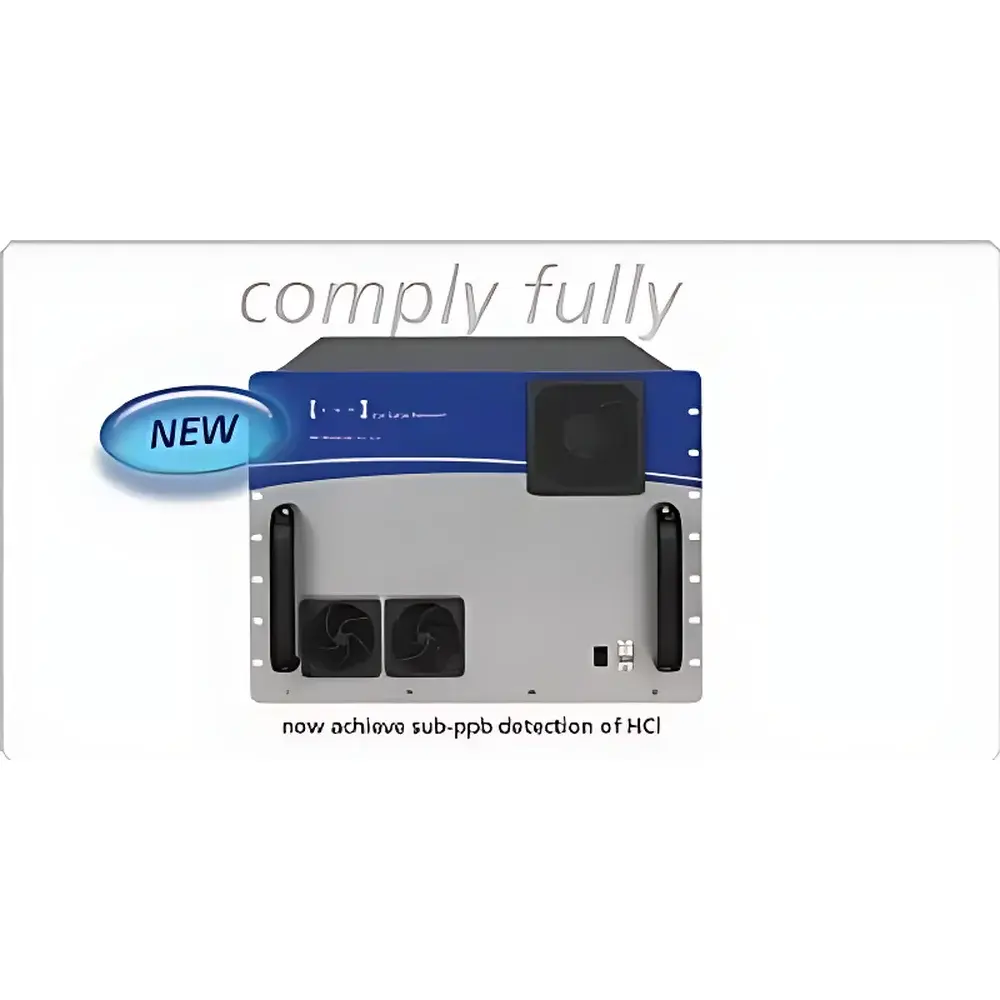
LGR Model 907-0037 / 911-0037 / 915-0037 HCl Analyzer
| Origin | USA |
|---|---|
| Manufacturer Type | Authorized Distributor |
| Origin Category | Imported |
| Models | 907-0037 (Standard Rackmount), 911-0037 (Enhanced Precision), 915-0037 (Ultra-Portable) |
| Repeatability (1σ) | 2 ppb (1 s), 0.2 ppb (100 s) |
| Max Drift (EP, 15-min avg, STP, 24 h) | 1 ppb |
| Measurement Range (full spec compliance) | 0.2–2000 ppb |
| Optional Range | 0–30 ppm |
| Measurement Rate | 0.01–1 Hz (flow response <10 s requires optional external pump) |
| Sample Temp | 0–50 °C |
| Operating Temp | 0–45 °C |
| Humidity | 0–100% RH (non-condensing) |
| Outputs | RS-232, Analog, Ethernet, USB |
| Power | 115/230 VAC, 50/60 Hz or 12 VDC |
| Power Consumption | 100 W (Standard), 150 W (EP), 70 W (Ultra-Portable) |
| Dimensions & Weight | Standard: 22.2 × 48.3 × 61 cm, 29 kg |
| EP | 35.6 × 48.3 × 61 cm, 40 kg |
| Ultra-Portable | 17.8 × 47 × 35.6 cm, 19 kg |
Overview
The LGR Model 907-0037, 911-0037, and 915-0037 HCl Analyzers are high-performance, field-deployable trace gas analyzers engineered for continuous, quantitative measurement of hydrogen chloride (HCl) and water vapor (H2O) in ambient air and industrial process streams. These instruments utilize Off-Axis Integrated Cavity Output Spectroscopy (OA-ICOS)—a patented optical absorption technique developed by Los Gatos Research—to deliver sub-part-per-trillion sensitivity and real-time spectral resolution without the operational constraints of conventional Cavity Ring-Down Spectroscopy (CRDS). Unlike CRDS systems requiring active laser-cavity mode matching, temperature stabilization, and wavelength dithering, OA-ICOS achieves robust signal-to-noise ratios through passive cavity filling and off-axis beam injection, eliminating alignment drift and reducing calibration frequency. The analyzers operate on a dual-wavelength, dual-beam principle optimized for simultaneous HCl and H2O quantification at atmospheric pressure, with inherent compensation for pressure and temperature fluctuations. All models feature an embedded Linux-based controller enabling autonomous data logging, onboard diagnostics, and full remote operability via Ethernet or USB.
Key Features
- Sub-second response time (T90 < 1 s) with selectable integration periods from 10 ms to 100 s
- Measurement precision of 2 ppb (1σ, 1 s) and 0.2 ppb (1σ, 100 s) under standard temperature and pressure (STP)
- Long-term stability: maximum drift ≤1 ppb over 24 hours (EP model, 15-minute averaging, STP)
- Real-time, high-resolution absorption spectra displayed locally and remotely via web interface
- Low power consumption—70 W for ultra-portable configuration—enabling extended battery or solar operation in remote field deployments
- Integrated thermal management system maintaining cavity and optics at constant temperature to minimize baseline drift
- Multi-output connectivity: RS-232 serial, 0–10 V analog, Gigabit Ethernet, and USB 2.0 for flexible integration into SCADA, DAQ, or IoT frameworks
- Rackmount (907/911) and compact benchtop (915) form factors compliant with IEC 60950-1 and UL 61010-1 safety standards
Sample Compatibility & Compliance
The analyzer is validated for direct sampling of unfiltered, non-corrosive ambient air and low-particulate industrial effluents. It exhibits negligible cross-sensitivity to CO2, CH4, NH3, SO2, NOx, and O3 within typical atmospheric concentration ranges, as verified per ASTM D6348–22 Annex A1 interference testing protocols. Water vapor co-measurement enables real-time dilution correction and humidity-dependent sensitivity normalization. All models meet EPA Method TO-15 and EU Directive 2008/50/EC requirements for ambient HCl monitoring when deployed with certified inlet conditioning (e.g., Nafion dryers, particulate filters). Data integrity complies with FDA 21 CFR Part 11 when used with LGR’s optional audit-trail-enabled data acquisition software (Model 904-0002), supporting GLP/GMP-aligned environmental monitoring programs.
Software & Data Management
Each unit ships with LGR’s proprietary AcqServer™ firmware (Linux OS v5.10), providing timestamped binary data storage on internal microSD (≥32 GB), configurable averaging intervals, and real-time spectral visualization via HTML5 web interface. Remote access is enabled through secure SSH, HTTP/S, and Modbus TCP protocols. The optional 904-0002 Data Acquisition Software synchronizes time-stamped HCl/H2O outputs with auxiliary sensors—including GPS position, meteorological stations, and flow meters—using NMEA 0183 and ASCII protocol support. Raw spectral files (.dat) and processed concentration logs (.csv) are exportable for third-party analysis in MATLAB, Python (Pandas/NumPy), or commercial chemometrics platforms. Firmware updates and diagnostic reports are delivered over-the-air with SHA-256 signature verification.
Applications
- Ambient air quality monitoring networks (EPA SLAMS, EEA AirBase)
- Volcanic gas plume characterization and early-warning systems
- Industrial stack emissions compliance (e.g., waste incineration, chlor-alkali plants)
- Indoor air quality assessment in semiconductor fabrication cleanrooms
- Atmospheric chemistry research (HCl/HOx radical cycling, stratospheric chlorine activation)
- Mobile monitoring platforms (vehicle-mounted, UAV-integrated, or balloon-borne configurations)
- Calibration transfer standards for reference-grade HCl permeation tubes and dynamic dilution systems
FAQ
What detection principle does the analyzer use, and how does it differ from CRDS?
It employs Off-Axis Integrated Cavity Output Spectroscopy (OA-ICOS), which eliminates the need for active laser-cavity resonance locking—reducing complexity, improving long-term stability, and enabling broader operating temperature ranges than CRDS.
Can the instrument measure HCl in high-humidity environments?
Yes. It simultaneously quantifies H2O and applies real-time spectroscopic correction, maintaining accuracy across 0–100% RH (non-condensing) without desiccant drying.
Is the system compatible with multi-point sampling?
Yes. Optional 8-channel (MIU-374-8) or 16-channel (MIU-377-16) multiplexers enable automated sequential analysis across multiple inlet locations.
Does the analyzer require routine calibration with gas standards?
Field calibration is recommended every 30–90 days depending on application severity; zero/span verification can be performed using certified N2 and HCl/N2 standards traceable to NIST SRM 2692.
What certifications apply to the electrical and mechanical design?
All models conform to CE marking (EMC Directive 2014/30/EU, Low Voltage Directive 2014/35/EU), RoHS 2011/65/EU, and IP20 ingress protection for indoor use.
Related Products







