
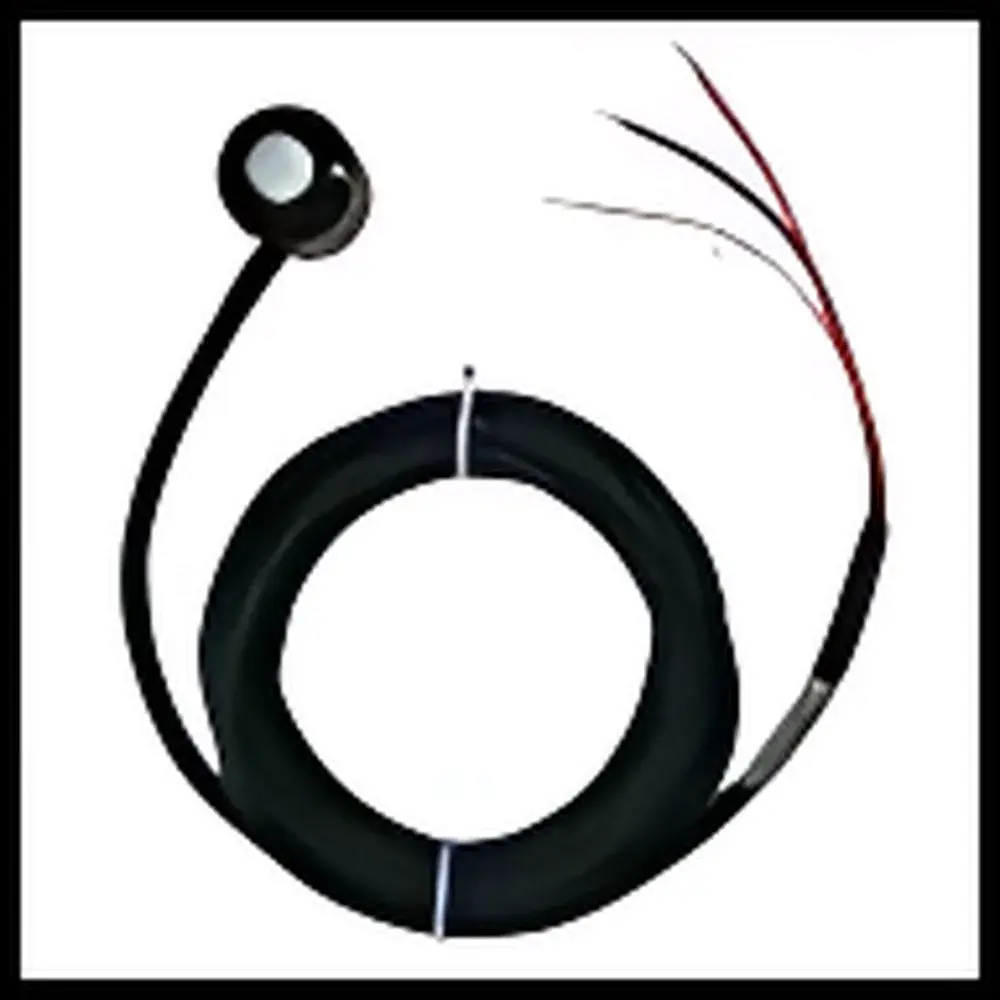
Apogee SQ-500 Series Quantum Sensor for Photosynthetically Active Radiation (PAR) Measurement
| Key | Origin: USA |
|---|---|
| Manufacturer Type | Authorized Distributor |
| Product Origin | Imported |
| Model | SQ-500 |
| Pricing | Available Upon Request |
| Spectral Range | 400–700 nm |
| Cosine Response Error | <2% (typical) |
| Temperature Drift | <0.1% per °C |
| Long-Term Drift | ≤1% per year |
| Sensitivity | 0.200 mV per µmol·m⁻²·s⁻¹ |
| Output Range | 0–1000 mV (0–5000 µmol·m⁻²·s⁻¹) |
| Operating Temperature | −40 to +55 °C |
| Relative Humidity | 0–100% RH (non-condensing) |
| Submersible | Yes (IP68-rated housing) |
| Housing Material | Anodized aluminum body with acrylic diffuser |
| Dimensions | Ø24 mm × H27.5 mm |
| Cable | 3 m shielded, bare-wire termination (custom lengths available on order) |
| Calibration Interval | Recommended every 24 months |
| Warranty | 1 year limited |
Overview
The Apogee SQ-500 Series Quantum Sensor is a high-accuracy, spectrally optimized photodiode-based instrument engineered for precise measurement of photosynthetically active radiation (PAR) in the 400–700 nm wavelength band. Unlike broadband pyranometers or unfiltered silicon detectors, the SQ-500 incorporates optical filtering and cosine-corrected geometry to replicate the quantum yield response of higher plants—enabling direct quantification of photon flux density (PPFD) in µmol·m⁻²·s⁻¹. Its measurement principle relies on a calibrated silicon photodiode with spectral responsivity matched to the CIE-defined PAR action spectrum, coupled with a precision acrylic diffuser that minimizes angular dependence. The sensor’s hemispherical arc-shaped top surface significantly reduces cosine response error—particularly at low solar elevation angles—achieving typical deviations of less than ±2% across 0–80° incidence, well within ISO 9060:2018 Class C specifications for quantum sensors.
Key Features
- Optimized spectral response aligned to the 400–700 nm PAR band, with <±5% deviation from the ideal quantum action curve
- Low-profile, ruggedized design: anodized aluminum housing and UV-stabilized acrylic diffuser ensure long-term outdoor stability and resistance to thermal shock
- Self-powered operation—no external excitation voltage required—enabling seamless integration with data loggers supporting mV input channels (e.g., Campbell Scientific CR series, Onset HOBO, Decagon EM50)
- IP68-rated construction permits continuous submersion up to 30 m depth, supporting aquatic PAR profiling, greenhouse hydroponic monitoring, and underwater canopy studies
- Minimal temperature-induced drift (<0.1% per °C) and low long-term drift (≤1% per year), attributable primarily to photodiode aging—mitigated by biennial recalibration traceable to NIST-standard reference lamps
- Compact form factor (Ø24 mm × 27.5 mm height) enables deployment in spatially constrained environments including leaf-canopy gaps, growth chambers, and UAV-mounted platforms
Sample Compatibility & Compliance
The SQ-500 is compatible with all standard environmental monitoring systems accepting millivolt-level analog inputs. It meets ASTM E2915-22 requirements for performance verification of quantum sensors used in agricultural and ecological research. While not certified to IEC 61724-1 for PV system monitoring, its spectral fidelity and angular response make it suitable for GLP-compliant plant physiology labs, USDA ARS field trials, and ISO 17025-accredited calibration laboratories performing secondary standard transfer. The sensor’s materials comply with RoHS Directive 2011/65/EU and are free of SVHC substances per REACH Annex XIV. No battery or internal electronics are present—eliminating electromagnetic interference concerns in sensitive EMF studies.
Software & Data Management
Data acquisition is performed via any analog-input-capable logger; raw mV output is converted to PPFD using the factory-determined sensitivity coefficient (0.200 mV per µmol·m⁻²·s⁻¹). Apogee provides open-format calibration reports—including individual spectral responsivity curves and cosine correction matrices—for integration into custom Python, MATLAB, or LabVIEW analysis pipelines. For users requiring audit-ready records, the sensor supports 21 CFR Part 11-compliant data workflows when paired with validated logging software (e.g., Campbell Scientific LoggerNet with security-enabled user roles and electronic signatures). Firmware-free architecture ensures zero firmware update dependencies or obsolescence risk over extended deployments (>10 years typical field service life).
Applications
- Canopy light interception modeling in agronomy and forestry research
- Controlled-environment agriculture (CEA) lighting validation and uniformity mapping
- Aquatic primary productivity assessment in limnology and marine ecology
- LED horticultural lamp spectral output characterization against PAR efficacy standards
- Long-term climate station networks measuring interannual PAR variability under changing cloud regimes
- Validation of satellite-derived PAR products (e.g., MODIS, Sentinel-3 OLCI) through ground-truthing campaigns
FAQ
Is the SQ-500 sensor suitable for underwater use?
Yes—the housing is rated IP68 and has been verified for continuous submersion at depths up to 30 meters. Saltwater exposure requires periodic rinsing with deionized water to prevent chloride residue buildup on the diffuser.
Does the sensor require periodic recalibration?
Apogee recommends recalibration every 24 months to maintain traceability to NIST standards. Annual field verification against a reference sensor is advised for mission-critical applications.
Can the cable be extended beyond 3 meters?
Yes—custom cable lengths up to 100 meters are available; specify required length at time of order. Shielded twisted-pair cabling is mandatory beyond 10 meters to preserve signal integrity.
What is the recommended mounting orientation?
For horizontal PPFD measurements, mount with the diffuser facing zenith. For directional or reflected PAR, orient the sensor normal to the plane of interest—avoid shading structures within the 180° field of view.
How does temperature affect measurement accuracy?
The integrated temperature compensation circuit maintains output stability within ±0.1% per °C across the full operating range (−40 to +55 °C); no post-processing correction is needed for most field applications.
Related Products







