
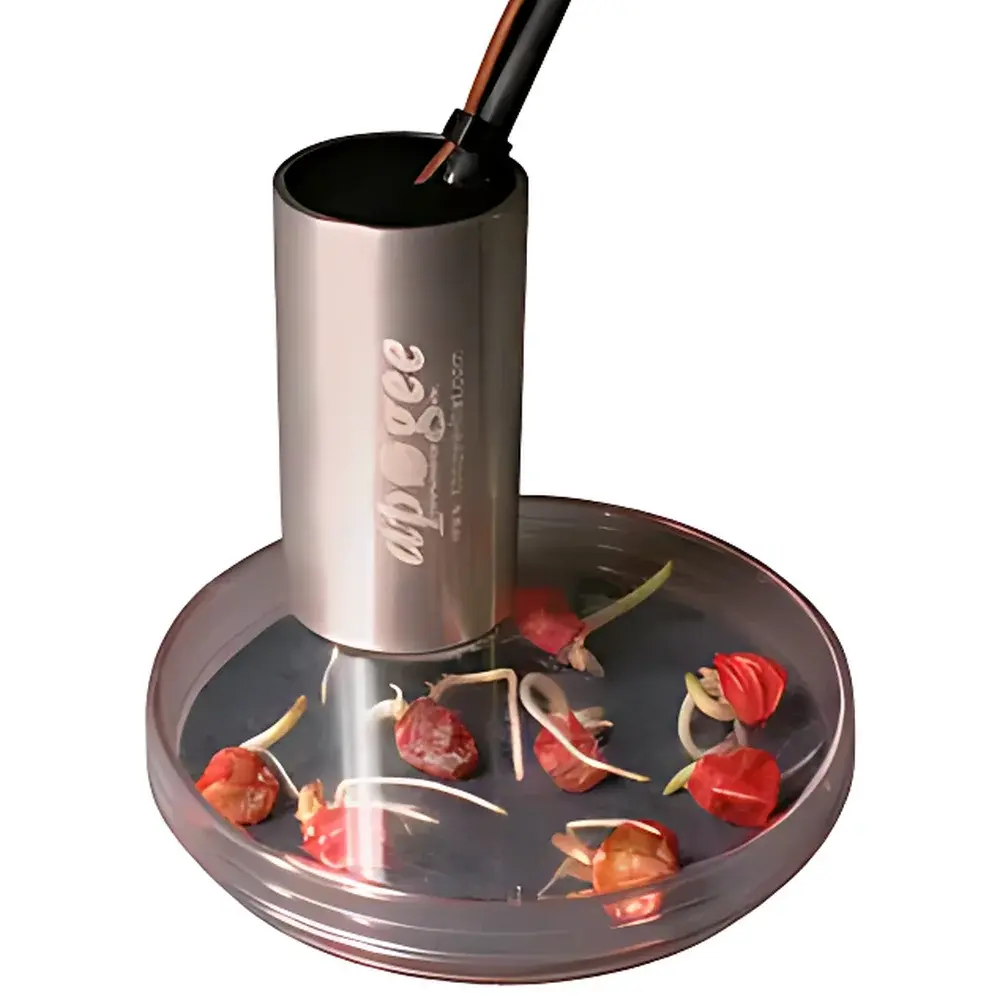
Apogee O2S-F and O2S-D Oxygen (O₂) Sensors
| Origin | USA |
|---|---|
| Manufacturer Type | Authorized Distributor |
| Origin Category | Imported |
| Model | O2S-F |
| Pricing | Available Upon Request |
| Diffusion-Type (D) | Height 1.375", Diameter 1.375", Mesh Size 125 |
| Flow-Through Type (F) | Length 3.5 cm, Diameter 3.5 cm, Tubing Port 1/8" NPT |
| Output (D/F) | ~50 mV at 20.95% O₂ (D), ~12 mV at 20.95% O₂ (F) |
| Lifetime | >10 years continuous (D), >5 years continuous (F) |
| Response Time (t₉₀) | 60 s (D), 12 s (F) |
| Measurement Range | 0–100% O₂ |
| Accuracy Drift | <0.01% O₂/day |
| Repeatability | ±0.001% O₂ (10 ppm) |
| Operating Temperature | 0–50 °C |
| Power Supply | 12 V for heater (TM variant), 5 V excitation for thermistor (TM) |
| Sensor Dimensions | Ø3.15 cm × 6.85 cm |
| Weight | 175 g |
| Standard Cable | 3 m (extendable) |
| Soil-Compatible Variant | O2S-S |
Overview
The Apogee O2S-F and O2S-D are electrochemical, current-mode oxygen sensors engineered for high-stability, long-term monitoring of molecular oxygen (O₂) partial pressure in soil gas, headspace, controlled atmospheres, and laboratory-scale respiration studies. Based on the galvanic cell principle, each sensor integrates a lead anode, gold–silver cathode, aqueous electrolyte, and hydrophobic polytetrafluoroethylene (PTFE) membrane—enabling selective O₂ diffusion while rejecting water vapor and CO₂. The resulting cathodic current is linearly proportional to the partial pressure of O₂ across the membrane, converted internally via a precision bridge resistor into a millivolt-level analog output. Unlike optical or zirconia-based sensors, these galvanic devices operate at ambient temperature without external power to the sensing element itself—only auxiliary circuits (e.g., thermistor or thermocouple compensation, heater control) require regulated voltage. Their design prioritizes metrological robustness: daily drift remains below 0.01% O₂, repeatability achieves ±10 ppm under stable thermal conditions, and operational lifetime exceeds five years (O2S-F) or ten years (O2S-D) under continuous deployment—validated through accelerated aging per ASTM D4169 and ISO 9001-compliant manufacturing protocols.
Key Features
- Galvanic current-mode transduction with built-in signal conditioning for direct mV output—no external amplifier required
- Two core configurations: flow-through (O2S-F) for dynamic gas streams and diffusion-limited (O2S-D) for static or low-permeability media such as saturated soils
- O2S-S variant optimized for direct insertion into mineral and organic soils, featuring corrosion-resistant stainless-steel housing and tapered tip geometry
- Integrated temperature compensation options: thermistor (TM) with dual-channel analog input (1 differential + 1 single-ended), or type-T thermocouple (TC) requiring two differential inputs and cold-junction reference
- Low O₂ consumption: ≤2.2 µmol O₂/day at 20.95% O₂ (23 °C, 101.3 kPa)—minimizing perturbation in closed-system respirometry
- Output calibrated to O₂ partial pressure (kPa), convertible to % O₂ or ppm using standard gas law relationships (ideal gas approximation)
- IP67-rated housing with PTFE membrane ensuring long-term stability in humid, particulate-rich environments
Sample Compatibility & Compliance
The O2S series supports direct measurement in heterogeneous, multiphase environments including unsaturated and waterlogged soils, compost matrices, sediment cores, and bioreactor headspaces. The O2S-D’s 125-mesh diffusion barrier enables equilibration in low-permeability substrates without mechanical disturbance, while the O2S-F’s 1/8″ NPT port interfaces seamlessly with standard gas chromatography manifolds and mass flow controllers. All variants comply with IEC 61000-6-2 (EMC immunity) and IEC 61000-6-4 (EMC emission) standards. Data integrity meets GLP and GMP documentation requirements when paired with compliant data loggers supporting audit-trail functionality (e.g., Campbell Scientific CR6, HOBO UX120). Sensor calibration certificates traceable to NIST SRM 2645a (O₂-in-N₂ gas mixtures) are available upon request.
Software & Data Management
Raw mV outputs are compatible with any analog-input data acquisition system supporting ±100 mV full-scale range and ≥16-bit resolution. Apogee provides open-format calibration equations (linear and polynomial) for conversion to % O₂, incorporating temperature-corrected solubility and barometric pressure compensation. When used with thermistor-compensated variants (O2S-TM), the integrated 10 kΩ NTC allows simultaneous temperature logging within the same sensor housing—critical for correcting O₂ solubility effects in soil gas analysis per ISO 11260. For regulatory applications, systems configured with 21 CFR Part 11–compliant loggers (e.g., Onset HOBO RX3000 with secure firmware) support electronic signatures, user access controls, and immutable audit trails—fully satisfying FDA and EPA method validation expectations for environmental monitoring programs.
Applications
- Soil respiration flux quantification in ecosystem carbon cycling studies (aligned with USDA NRCS Soil Health Initiative protocols)
- In situ O₂ profiling in landfill cover systems and phytoremediation trenches per ASTM D5267
- Root-zone aeration assessment in precision agriculture and controlled-environment horticulture
- Long-term stability testing of packaging headspace O₂ in pharmaceutical blister packs (USP <671>)
- Baseline O₂ monitoring in anaerobic digestion bioreactors and wastewater treatment lagoons
- Calibration transfer standards for portable O₂ analyzers in field-deployed environmental networks
FAQ
How does temperature affect O₂ readings—and how is it compensated?
Temperature influences both O₂ solubility in the electrolyte and diffusion kinetics across the PTFE membrane. The TM variant includes a matched NTC thermistor enabling real-time correction using the Apogee-provided temperature coefficient (–0.21%/°C nominal). TC variants require external cold-junction compensation in the data logger.
Can the sensor be used underwater or in saturated soils?
The O2S-S and O2S-D models are rated for immersion up to 10 m depth (IP67), but prolonged submersion may accelerate electrolyte depletion. For saturated soils, use only the diffusion-limited O2S-D or O2S-S configuration—never the flow-through O2S-F.
What is the recommended recalibration interval?
Under stable storage and routine field use, annual verification against certified 0% and 20.95% O₂ standards is sufficient. In high-accuracy respirometry applications, quarterly checks are advised per ISO 5725-2 precision guidelines.
Is the sensor compatible with Campbell Scientific, Onset, or Delta-T data loggers?
Yes—all standard analog input modules (e.g., CR6 AI channels, HOBO U12-012, Delta-T GP1) support the O2S’s ratiometric mV output. Sample wiring diagrams and scaling scripts are provided in Apogee’s Technical Note TN-O2-03.







