
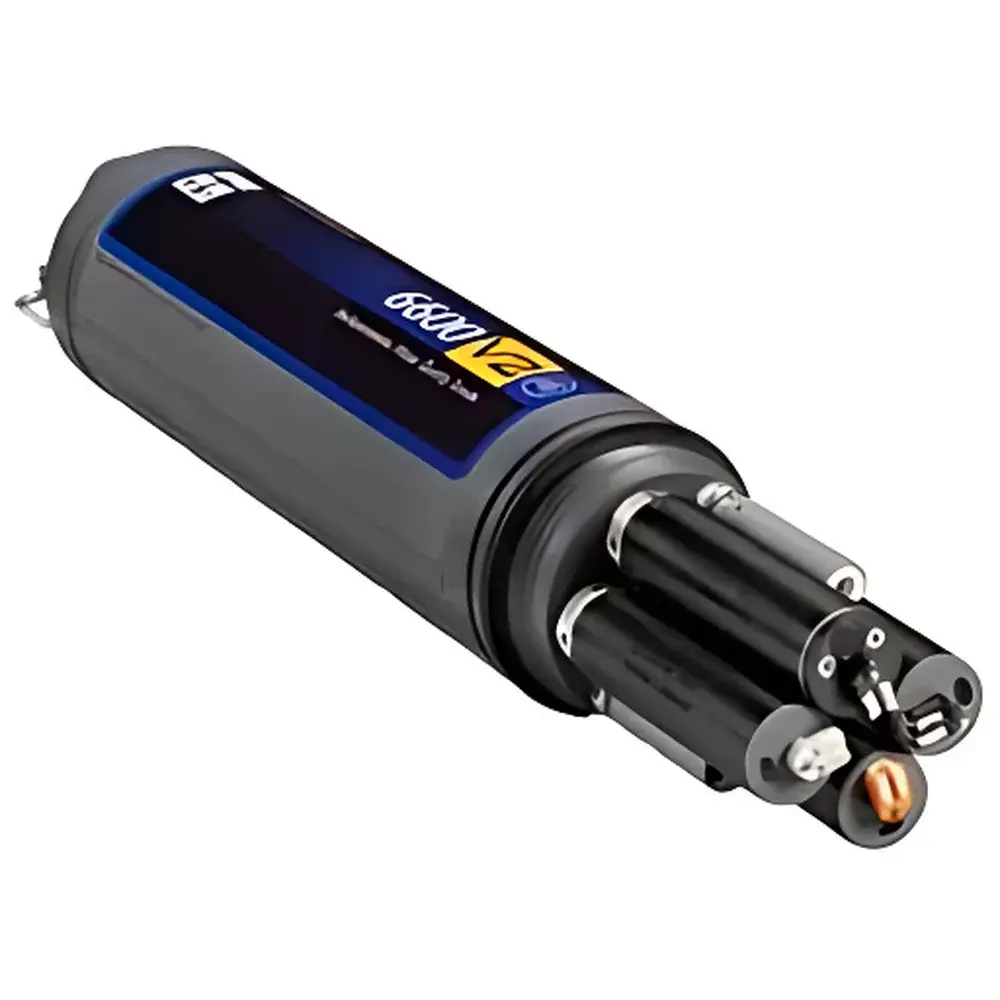
YSI 6600V2 Multi-Parameter Water Quality Sonde
| Brand | YSI |
|---|---|
| Origin | USA |
| Model | 6600V2 |
| Sensor Capacity | Up to 4 optical sensors (DO, phycocyanin/blue-green algae, turbidity, chlorophyll-a, rhodamine WT) |
| Measurement Principle | Fluorescence lifetime (ROX DO), optical absorption/scattering (turbidity, chlorophyll, BGA), fluorescence excitation/emission (rhodamine) |
| Operating Temperature | -5 to +50 °C |
| Storage Temperature | -10 to +60 °C |
| Housing Material | PVC |
| Communication Interfaces | RS-232, SDI-12 |
| Memory | 384 KB non-volatile memory (150,000 readings) |
| Power Supply | Internal: 8 × C-cell alkaline batteries (54 days @ 15-min interval, 20 °C) |
| External | 12 V DC |
| Dimensions | Ø 8.9 cm × 49.8 cm (without depth sensor), 54.9 cm (with depth sensor) |
| Weight | 3.18 kg (with batteries and depth sensor) |
| Water Compatibility | Freshwater, seawater, wastewater |
| Self-Cleaning | Integrated brush mechanism on all optical sensors |
| User-Replaceable Sensors | All except depth sensor |
Overview
The YSI 6600V2 Multi-Parameter Water Quality Sonde is an advanced, field-deployable environmental monitoring platform engineered for high-reliability, long-term in-situ water quality assessment. Designed around a modular optical sensor architecture, it supports up to four simultaneously active optical sensors—including ROX Optical Dissolved Oxygen, phycocyanin-based blue-green algae (cyanobacteria), turbidity, chlorophyll-a, and rhodamine WT—enabling comprehensive profiling of biogeochemical and ecological indicators. Its core measurement principles are rooted in fluorescence lifetime detection (for DO), calibrated optical scattering/absorption (for turbidity and algal pigments), and selective fluorometric excitation (for tracer dyes). Unlike electrochemical DO probes, the ROX sensor eliminates oxygen consumption during measurement, delivers stable performance under low-oxygen and sulfide-rich conditions (e.g., hypolimnetic zones or anaerobic sediments), and operates independently of flow velocity—critical for deployment in stagnant or tidal environments. The sonde’s robust PVC housing, wide thermal operating range (-5 to +50 °C), and compatibility with both freshwater and marine matrices make it suitable for regulatory-grade monitoring across diverse aquatic ecosystems.
Key Features
- Modular optical sensor design: Supports user-swappable sensors (excluding integrated depth sensor) for flexible configuration and rapid field maintenance.
- ROX Optical Dissolved Oxygen sensor: Utilizes temperature-compensated fluorescence lifetime technology; exhibits negligible drift, no membrane fouling, and immunity to H2S interference—validated per ASTM D888 and ISO 5814 standards.
- Integrated cleaning brush™: Mechanically sweeps optical windows before each measurement cycle to mitigate biofouling, sediment deposition, and air bubble adhesion—extending calibration intervals and sustaining data integrity over multi-week deployments.
- Self-contained operation: Built-in 384 KB non-volatile memory stores up to 150,000 timestamped readings; internal alkaline battery pack enables 54 days of continuous logging at 15-minute intervals (20 °C), eliminating dependency on external power or telemetry during initial setup.
- Dual communication protocol support: RS-232 for direct laptop connection and SDI-12 for seamless integration into existing datalogger networks (e.g., Campbell Scientific CR1000X, Onset HOBO UX120), facilitating compliance with USGS NWIS and EPA STORET data submission requirements.
- Depth-rated mechanical construction: Certified for submersion up to 100 m (optional pressure sensor), with IP68 ingress protection and corrosion-resistant fasteners suitable for coastal, estuarine, and wastewater infrastructure applications.
Sample Compatibility & Compliance
The YSI 6600V2 is validated for use across heterogeneous water matrices—including potable source waters, eutrophic lakes, brackish estuaries, coastal seawater, and municipal wastewater effluents. Its optical sensors maintain accuracy across salinity ranges from 0 to 70 ppt and suspended solids concentrations up to 1000 NTU (turbidity channel). All factory calibrations are traceable to NIST-certified reference standards. Data acquisition workflows align with GLP-compliant field protocols, and raw sensor outputs meet minimum reporting criteria outlined in EPA Method 180.1 (chlorophyll-a), ASTM D3921 (turbidity), and ISO 10260 (phycocyanin quantification). When paired with EcoWatch software, audit trails, electronic signatures, and metadata tagging support 21 CFR Part 11 readiness for regulated utilities and research institutions subject to FDA or state-level QA/QC oversight.
Software & Data Management
EcoWatch software (Windows-compatible, v5.0+) provides full instrument configuration, real-time telemetry visualization, automated QA/QC flagging (e.g., out-of-range values, sensor saturation, memory overflow warnings), and export to CSV, Excel, and EPA-compliant .dat formats. It supports batch processing of time-series datasets, spectral overlay comparisons between chlorophyll and phycocyanin channels to distinguish cyanobacterial dominance from diatom or green algal blooms, and georeferenced mapping via integrated GPS log import. All firmware updates, calibration coefficient uploads, and sensor diagnostics are performed through encrypted USB or serial interface—ensuring data continuity and version control across multi-sonde monitoring networks. Field data can be synchronized with cloud-based platforms (e.g., HydroSphere, Aquarius) using optional cellular or satellite modems.
Applications
- Drinking water source protection: Continuous tracking of cyanobacterial toxin precursors (phycocyanin), taste-and-odor compounds (via chlorophyll–BGA correlation), and hypoxia onset in reservoirs and intakes.
- Harmful algal bloom (HAB) early warning systems: High-temporal-resolution detection of phytoplankton community shifts using dual-pigment optical indices—supporting NOAA’s HAB Forecasting Program and EU Marine Strategy Framework Directive (MSFD) monitoring obligations.
- Nutrient cycling and primary productivity studies: Quantifying chlorophyll-a dynamics alongside dissolved oxygen diel curves to estimate gross primary production (GPP) and ecosystem respiration (ER) in wetlands and shallow lakes.
- Wastewater treatment plant (WWTP) outfall compliance: Real-time rhodamine WT tracer dilution analysis for mixing zone delineation and effluent dispersion modeling per NPDES permit requirements.
- Long-term ecological monitoring: Integration into fixed-station buoys, moorings, or riverbed observatories for multi-year trend analysis aligned with UN SDG Indicator 6.3.2 (ambient water quality).
FAQ
Can the YSI 6600V2 operate autonomously without telemetry?
Yes—the sonde functions as a self-contained logger with internal memory and battery power, requiring no external communication link for basic deployment.
Is the ROX DO sensor compatible with sulfide-rich sediments?
Yes—its solid-state fluorophore is chemically inert to H2S, enabling reliable operation in anoxic hypolimnia and wastewater collection systems where traditional Clark-type electrodes fail.
How often must optical sensors be cleaned or recalibrated?
With the integrated cleaning brush™, routine manual cleaning is typically required only every 2–4 weeks in moderately fouling environments; factory calibration is recommended annually or after sensor replacement.
Does the sonde meet regulatory reporting standards for drinking water utilities?
Yes—when deployed per EPA Guidance Document 815-R-12-001 and configured with certified sensors, its data output satisfies reporting requirements for Source Water Monitoring Rule (SWMR) and Unregulated Contaminant Monitoring Rule (UCMR) programs.
Can turbidity and chlorophyll-a measurements be used to estimate phytoplankton biomass?
Yes—empirical correlations between optical backscatter (turbidity), chlorophyll-specific absorption, and laboratory-measured cell counts are routinely applied in limnological studies; site-specific regression models improve accuracy.
Related Products







