
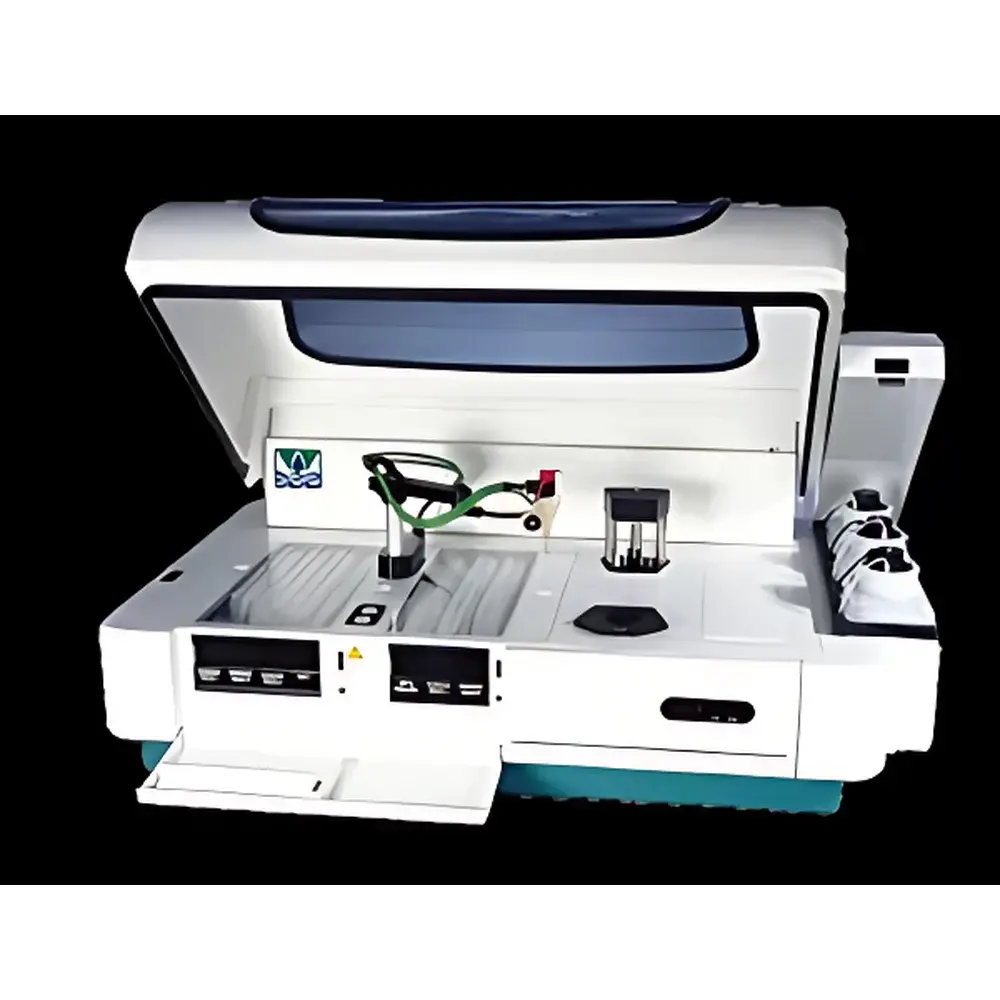
AMS SmartChem 200 Fully Automated Discrete Analyzer for Water Quality Analysis
| Origin | Italy |
|---|---|
| Manufacturer | AMS Group |
| Instrument Type | Laboratory-Based Discrete Chemistry Analyzer |
| Optical Range | 420–880 nm |
| Linear Absorbance Range | 0.001–2.500 AUFS |
| Resolution | 0.0001 Abs |
| Filter Wheel | 9 + 1 Blind Position |
| Sample Capacity | Up to 126 Positions (5 Racks) |
| Reagent Positions | 16 Total (10 Refrigerated, 6 Ambient) |
| Dispense Volume | 3–450 µL |
| Reaction Temperature Control | 37 °C ±0.1 °C |
| Dimensions (H×W×L) | 42 × 65 × 100 cm |
| Weight | 65 kg |
| Power | 90–250 VAC, 47/63 Hz, 300 W |
| Water Consumption | 2 mL per test |
| Compliance | ASTM, ISO, AOAC, US EPA Methods (incl. EPA 353.2), AFNOR, COFRAC, BATF |
Overview
The AMS SmartChem 200 is a fully automated discrete analyzer engineered for high-precision, multi-parameter wet-chemical analysis of water matrices—including drinking water, wastewater, surface water, groundwater, seawater, and industrial effluents. Unlike continuous-flow or segmented-flow systems, the SmartChem 200 employs discrete (batch-style) chemistry: each sample and reagent combination is processed in an individual cuvette under controlled reaction conditions. This architecture eliminates carryover and cross-contamination inherent in shared fluidic pathways. Measurement relies on standardized colorimetric principles—absorbance quantification via dual-beam digital photometry across a spectral range of 420–880 nm. The system integrates robotic liquid handling, thermally regulated reaction incubation (37 °C ±0.1 °C), real-time cuvette integrity verification, and adaptive dilution—all governed by deterministic software logic. Designed for compliance-driven laboratories, it supports method execution aligned with US EPA, ISO, ASTM, AOAC, and AFNOR regulatory frameworks without hardware reconfiguration.
Key Features
- Discrete analysis architecture ensures zero sample-to-sample interference—each reaction occurs in a dedicated, auto-cleaned cuvette.
- Dual-beam digital photometer with extended linear absorbance range (0.001–2.500 AUFS) minimizes repeat analysis due to over-range samples.
- 9-position optical filter wheel plus blind position enables rapid wavelength switching; no module swapping required for multi-analyte assays.
- High-precision robotic arm with integrated wash/dry cycle delivers volumetric accuracy from 3 to 450 µL; depth-sensing probes maintain consistent 2 mm aspiration depth.
- Onboard refrigerated reagent storage (10 positions at 4–8 °C) preserves reagent stability for extended unattended operation.
- Automated calibration curve generation: supports manual standard prep or single-stock auto-dilution series with QC traceability.
- Real-time cuvette quality monitoring: optical validation precedes each measurement; defective cuvettes are automatically bypassed.
- Five operational modes—graphical, batch, priority, emergency, and method-specific—optimize workflow flexibility in regulated environments.
Sample Compatibility & Compliance
The SmartChem 200 accepts liquid samples with minimal pretreatment: clarified aqueous extracts, filtered wastewater, acid-preserved groundwater, and digested soil leachates. It accommodates turbid or particulate-laden samples when paired with optional centrifugation or filtration modules upstream. All core methods—including ammonia, nitrate/nitrite (via US EPA Method 353.2 cadmium reduction), phosphate, silica, chloride, sulfate, COD (dichromate), cyanide, fluoride, and heavy metals (Al, Fe, Mn)—are validated against ISO 15586, ISO 7890, ASTM D1253, ASTM D3370, and US EPA 300–350 series protocols. Instrument firmware and data handling comply with GLP and GMP requirements, supporting full audit trails, electronic signatures, and 21 CFR Part 11–ready configurations when deployed with validated LIMS integration.
Software & Data Management
The SmartChem Control Suite runs natively on Windows OS and provides method-centric workflow management. Preloaded methods cover >120 standard water quality parameters; users may import or author custom protocols using intuitive scripting tools compliant with ICH Q2(R2) analytical procedure design principles. Software features include automatic dilution scheduling, dynamic range extension logic, QC charting (Levey-Jennings, Westgard rules), and raw absorbance export in CSV/Excel formats. All instrument actions—liquid transfers, temperature logs, photometer diagnostics, cuvette status—are timestamped and stored with immutable metadata. Optional network deployment enables centralized method distribution, remote diagnostics, and secure data backup aligned with ISO/IEC 27001 practices.
Applications
The SmartChem 200 serves as a primary analytical platform in environmental testing labs accredited to ISO/IEC 17025, municipal water utilities performing routine compliance monitoring, research institutions conducting nutrient cycling studies, and food/beverage facilities assessing process water quality. Its discrete architecture delivers superior reproducibility for low-concentration analytes (e.g., nitrite < 0.01 mg/L) and high-salinity matrices (e.g., seawater alkalinity). Field-deployable method packages support rapid response during contamination events, while its modularity allows seamless integration into existing QA/QC pipelines—replacing manual spectrophotometric workflows without sacrificing method fidelity.
FAQ
Does the SmartChem 200 require dedicated laboratory infrastructure beyond standard bench space and power?
No—its compact footprint (100 × 65 × 42 cm), low water consumption (2 mL/test), and universal AC input (90–250 VAC) enable installation in standard analytical labs without plumbing or HVAC modifications.
How does the system ensure long-term calibration stability across multiple reagent lots?
Through built-in reference standards, daily photometer self-checks, and adaptive calibration slope adjustment based on control sample performance—tracked in real time and reported in QC dashboards.
Can legacy wet-chemistry methods be migrated to the SmartChem 200 without revalidation?
Yes—provided the original method specifies reagent composition, reaction time, temperature, and detection wavelength; the platform executes identical chemistry with enhanced precision and documentation rigor.
Is the nitrate/nitrite module field-replaceable and EPA 353.2 certified?
Yes—the cadmium column assembly is user-swappable and pre-validated to meet all procedural requirements of US EPA Method 353.2, including flow dynamics, residence time, and reduction efficiency verification.
What level of IT security and data integrity assurance does the software provide?
The software supports role-based access control, encrypted audit logs, electronic signature capture, and configurable retention policies—fully compatible with FDA 21 CFR Part 11 and EU Annex 11 implementation requirements when configured with qualified IT infrastructure.
Related Products







