
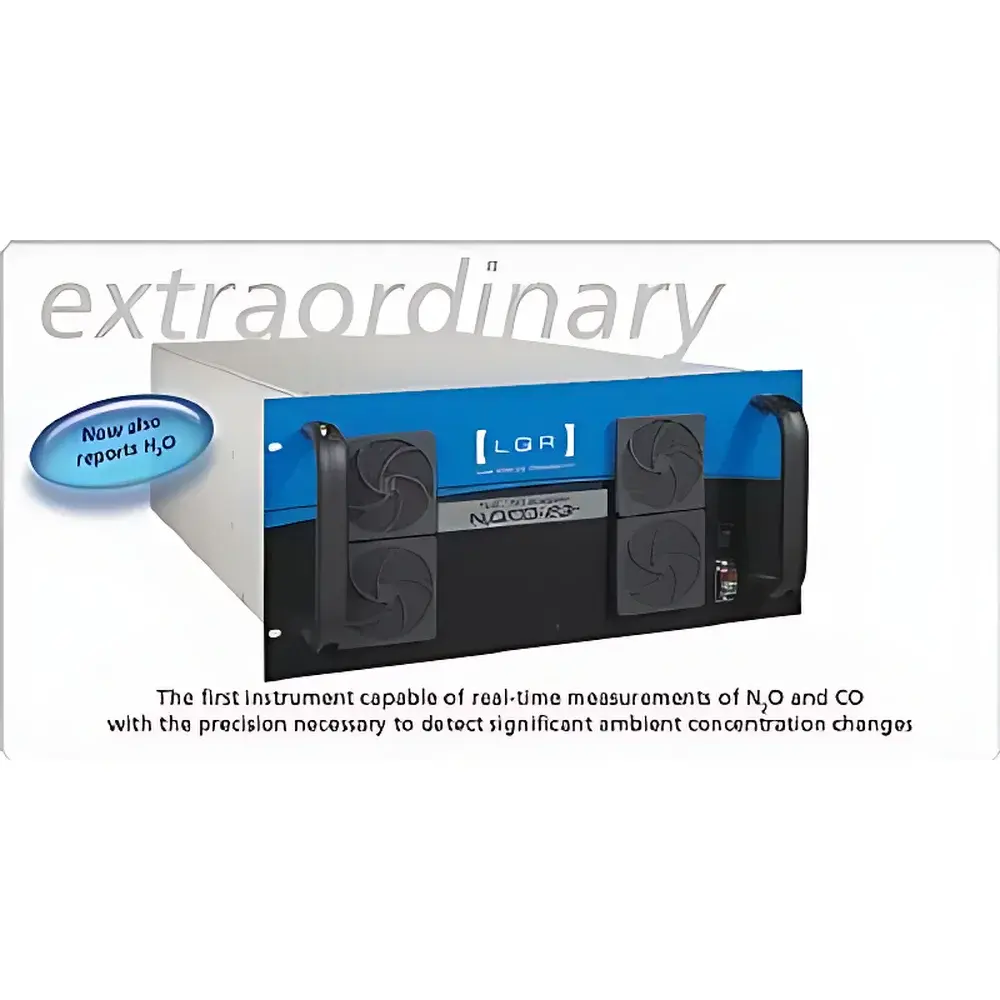
Los Gatos Research APOGEE N₂O/CO Analyzer
| Origin | USA |
|---|---|
| Manufacturer Type | Authorized Distributor |
| Origin Category | Imported |
| Model | APOGEE |
| Price | Upon Request |
Overview
The Los Gatos Research APOGEE N₂O/CO Analyzer is a high-precision, field-deployable trace gas analyzer engineered for simultaneous, real-time quantification of nitrous oxide (N₂O), carbon monoxide (CO), and water vapor (H₂O) in ambient air. Based on Off-Axis Integrated Cavity Output Spectroscopy (OA-ICOS)—a proprietary laser absorption technique—this instrument delivers exceptional sensitivity, stability, and robustness without requiring cryogenic cooling, external calibration gases, or sample drying. Unlike conventional Cavity Ring-Down Spectroscopy (CRDS) systems, OA-ICOS eliminates the need for active laser wavelength locking, cavity length stabilization, or complex thermal tuning, enabling reliable operation under variable environmental conditions. The analyzer measures both wet and dry mole fractions directly, with full spectral validation visible in real time via high-resolution absorption line profiles. Its design supports unattended long-term deployment in remote terrestrial sites, airborne platforms (including NASA’s DC-8 aircraft), and mobile laboratories—making it a cornerstone instrument for atmospheric composition research, eddy covariance flux networks, chamber-based emission studies, and regulatory air quality monitoring.
Key Features
- Simultaneous, synchronous measurement of N₂O, CO, and H₂O at up to 10 Hz sampling rate
- Sub-part-per-trillion (ppt) precision: ≤0.05 ppb (1σ, 1 Hz) for both N₂O and CO at ambient concentrations
- Ultra-low drift: ≤0.1 ppb (24-hour, 15-min average, STP) for N₂O and CO in EP configuration
- Full-scale linearity across extended ranges: N₂O (0–10 ppm), CO (0–10 ppm), H₂O (0–100% RH)
- Mid-infrared quantum cascade laser (QCL) source—immune to interferences from CO₂, CH₄, O₃, or pressure fluctuations
- Integrated Linux-based embedded computer for autonomous data logging, timestamping, and metadata tagging
- Remote operation and diagnostics via Ethernet (TCP/IP), with secure SSH access and real-time spectral visualization
- No liquid nitrogen or chiller required—operational from −30 °C to +50 °C sample inlet temperature
Sample Compatibility & Compliance
The APOGEE analyzer accepts untreated ambient air, including humid, particulate-laden, or thermally variable streams—eliminating pre-conditioning artifacts common in dried or filtered systems. It complies with key international observational standards, including NOAA’s Global Monitoring Laboratory (GML) specifications for background station instrumentation and the AmeriFlux/ICOS protocols for eddy covariance flux measurements. Data output formats adhere to CF Metadata Conventions and support integration into FAIR-compliant repositories. For regulated environments, the EP variant meets GLP-aligned traceability requirements through built-in audit trails, user-access logs, and configurable data integrity settings compatible with 21 CFR Part 11 readiness when paired with validated software workflows.
Software & Data Management
Data acquisition and system control are managed by LGR’s proprietary Data Acquisition Software (v5.x+), delivered with each unit. The software enables synchronized logging of N₂O/CO/H₂O alongside auxiliary inputs (e.g., GPS position, sonic anemometer signals, temperature/pressure sensors) at user-defined intervals. All raw spectra, calibrated concentrations, diagnostic flags, and environmental metadata are stored in HDF5 format with embedded timestamps and instrument configuration snapshots. Remote users can initiate firmware updates, adjust averaging windows, trigger zero/span checks, and export time-series datasets directly via web interface or command-line scripts. Export options include CSV, NetCDF, and MATLAB-compatible binaries for post-processing in Python (Pandas, Xarray), R, or MATLAB environments.
Applications
- Long-term atmospheric monitoring at global baseline stations (e.g., Mauna Loa, Barrow, South Pole)
- Eddy covariance flux measurements over agricultural soils, forests, and urban interfaces
- Chamber-based greenhouse gas emission quantification from soils, manure lagoons, and wastewater treatment units
- Airborne vertical profiling in tropospheric and stratospheric campaigns
- Stack and fugitive emission verification for industrial compliance reporting
- Calibration transfer and reference standard validation for secondary analyzers
- Climate model evaluation using high-temporal-resolution N₂O/CO ratio diagnostics
FAQ
Does the APOGEE require routine calibration with certified gas standards?
No—its EP-grade configuration achieves <0.03% absolute uncertainty without calibration; standard models maintain <1% uncertainty. Optional dynamic dilution systems enable traceable span verification if required for QA/QC.
Can the analyzer operate continuously in sub-zero field environments?
Yes—the EP variant operates from 0 °C to 45 °C ambient temperature and accepts sample gas down to −30 °C. Internal thermal management ensures cavity stability without condensation.
Is spectral data accessible for independent validation?
Yes—raw interferograms and fully resolved absorption spectra are streamed in real time and archived with every concentration record.
What communication protocols does the APOGEE support for integration into SCADA or IoT networks?
Ethernet (Modbus TCP, ASCII over TCP), RS-232 (ASCII), analog voltage outputs (0–5 V / 4–20 mA), and USB host interface for local storage or direct PC connection.
How is measurement traceability maintained across deployments?
Each unit ships with NIST-traceable factory characterization reports, including line strength validation, pressure-broadening coefficients, and temperature-dependent response curves—all embedded in firmware and applied during real-time spectral fitting.







