
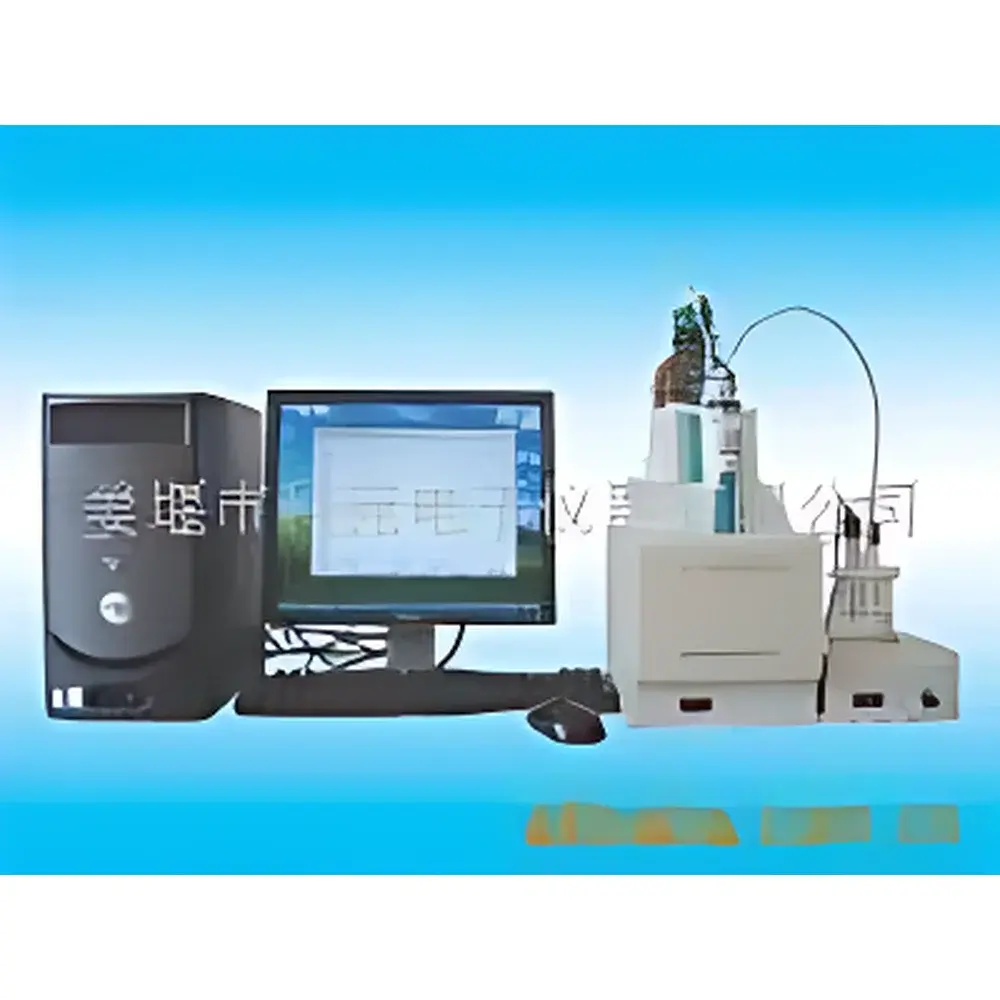
KY-4S Microcomputer-Controlled Mercaptan Sulfur Titrator
| Brand | Keyuan Instruments |
|---|---|
| Origin | Jiangsu, China |
| Manufacturer Type | Manufacturer |
| Country of Origin | China |
| Model | KY-4S |
| Price | Upon Request |
| Standard Compliance | GB/T 1792–1988 |
| Sample Form | Liquid |
| Measurement Range | ≥3 µg/g |
| Titration Method | Potentiometric Titration |
| Minimum Dispensed Volume | 0.01 mL |
| Potential Measurement Range | ±1999.5 mV |
| Burette Accuracy | ±0.1% F·S |
| Electronic Unit Basic Error | ±0.1% of full scale + 0.5 mV |
| Relative Error | ≤5% |
| Control Platform | Windows-based PC Interface |
| Electrode Input | Dual High-Impedance Input |
| Endpoint Detection | Automatic Potential Inflection Point Recognition |
| Fluid Handling | Automated Reagent Refill and Fixed-Volume Dispensing |
Overview
The KY-4S Microcomputer-Controlled Mercaptan Sulfur Titrator is a dedicated potentiometric titration system engineered for the precise quantification of mercaptan sulfur (R–SH) in liquid petroleum products—including gasoline, kerosene, diesel fuel, and jet fuels—according to the internationally referenced methodology outlined in GB/T 1792–1988. This standard specifies the silver nitrate (AgNO₃) potentiometric titration method, where mercaptan anions selectively react with silver ions to form insoluble silver mercaptides, generating a distinct inflection point in the potential–volume curve. The KY-4S implements this principle using a dual high-impedance potentiometric cell, coupled with a precision burette drive and real-time derivative-based endpoint detection algorithm. Unlike manual or semi-automated systems, the KY-4S continuously acquires electrode potential data at sub-second intervals, applies digital signal smoothing to suppress noise from unstable reference junctions or polarizable electrodes, and calculates the first derivative maximum to locate the stoichiometric endpoint with high reproducibility. Its architecture integrates electrochemical measurement rigor with deterministic fluid handling control, making it suitable for routine QC analysis in refinery laboratories, third-party testing facilities, and R&D departments requiring trace-level sulfur speciation data under controlled conditions.
Key Features
- Automated potentiometric titration platform compliant with GB/T 1792–1988, supporting standardized reporting for regulatory and contractual specifications.
- Imported high-precision titration unit with ±0.1% full-scale burette accuracy and 0.01 mL minimum dispensing resolution for low-volume reagent delivery.
- Dual high-impedance input circuitry (≥10¹² Ω) ensuring stable potential readings during slow-reacting titrations and minimizing polarization-induced drift.
- Real-time potential curve acquisition and digital smoothing algorithm to mitigate baseline instability caused by junction potential fluctuations or electrode fouling.
- Windows-based control software enabling automated sequence execution: sample aspiration, blank correction, AgNO₃ titrant addition, endpoint recognition via dE/dV maxima, and result calculation with uncertainty propagation.
- Integrated fluid management system performing automatic reagent replenishment, fixed-volume dosing for standard additions, and waste aspiration—all synchronized with titration events.
Sample Compatibility & Compliance
The KY-4S accepts homogeneous liquid hydrocarbon samples with minimal suspended solids or water content (≤0.1% v/v), including distillate fuels, naphthas, and light cycle oils. Samples must be dissolved in a specified solvent mixture—typically isopropanol/toluene (1:1 v/v) containing potassium iodide and ammonium acetate—to ensure complete mercaptan solubilization and prevent interference from elemental sulfur or disulfides. The instrument’s measurement range of ≥3 µg/g meets ASTM D3229 and IP 57 requirements for low-sulfur fuel certification. While GB/T 1792–1988 remains its primary validation standard, method equivalence studies support alignment with ISO 8217 Annex D and EN 590 Annex D for diesel sulfur speciation. Data integrity complies with GLP principles: all raw potential vs. volume datasets are archived with timestamps, operator ID, and instrument configuration metadata.
Software & Data Management
The KY-4S operates via a dedicated Windows application that records raw electrode potential (mV) and delivered titrant volume (mL) at configurable sampling intervals (default: 200 ms). Each analysis generates a timestamped .csv file containing unprocessed data, smoothed curve points, derivative traces, and final concentration output (µg/g as sulfur). The software supports batch processing, statistical summary (mean, SD, RSD), and customizable report templates exportable to PDF or Excel. Audit trails log user actions—including method edits, calibration updates, and result overrides—with immutable timestamps. Though not natively 21 CFR Part 11 compliant, the system supports external validation protocols for electronic record retention in regulated environments when deployed with networked file servers and access-controlled user accounts.
Applications
- Quality control of finished gasoline blends to verify compliance with Tier 3 sulfur limits (10 ppm) and odor control specifications.
- Monitoring mercaptan scavenger efficiency in sweetening units (e.g., Merox, caustic wash) by tracking feedstock vs. treated product sulfur profiles.
- Research into sulfur compound reactivity kinetics, particularly nucleophilic substitution rates of thiols with silver-based reagents under varying solvent polarity.
- Method development for alternative titrants or electrode configurations, leveraging the system’s open data export and programmable titration sequences.
- Training laboratories validating student understanding of potentiometric endpoint theory, including Gran plot interpretation and junction potential compensation.
FAQ
What electrode types are compatible with the KY-4S?
The system is optimized for use with a silver indicator electrode and a double-junction reference electrode (e.g., Ag/AgCl in saturated KCl with ceramic frit), configured for non-aqueous titration media.
Can the KY-4S analyze solid or viscous samples?
No—it requires homogenized liquid-phase samples pre-dissolved in the specified solvent matrix; undissolved particulates may clog the burette tip or interfere with potential stability.
How is calibration verified on this instrument?
Calibration is performed using certified reference materials (CRMs) of known mercaptan sulfur concentration (e.g., thiophenol in toluene), with periodic verification against NIST-traceable standards.
Is method validation documentation provided?
Yes—the manufacturer supplies a basic IQ/OQ protocol aligned with GB/T 1792–1988, including linearity assessment (3–100 µg/g), repeatability (n=6, RSD ≤3%), and intermediate precision across operators and days.
What maintenance is required for long-term reliability?
Daily rinsing of the burette and electrode with isopropanol, weekly cleaning of the silver electrode surface with dilute nitric acid, and quarterly verification of burette piston seal integrity and drive motor torque.




