
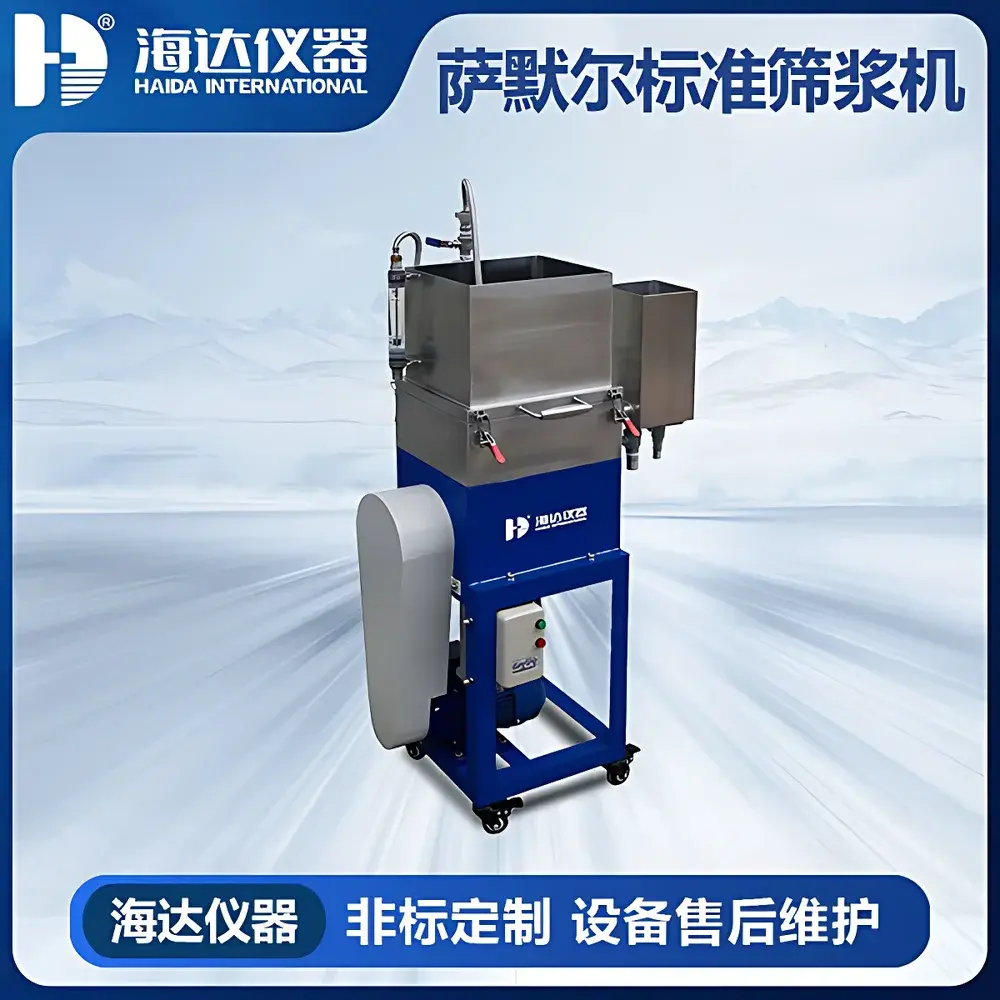
HAIDA HD-P001 Somerville-Type Pulp Screening Machine
| Brand | HAIDA INTERNATIONAL |
|---|---|
| Origin | Guangdong, China |
| Manufacturer Type | Direct Manufacturer |
| Product Category | Domestic (China-Made) |
| Model | HAIDA HD-P001 Somerville-Type Pulp Screening Machine |
| Pricing | Upon Request |
| Screen Plate Dimensions | 307 mm × 268 mm |
| Slot Length | 45 mm |
| Slot Width | 0.15 mm |
| Total Slots | 756 (126 × 6) |
| Standard Slot Size | 0.15 mm |
| Motor Power | 1.1 kW |
| Voltage | 380 V AC |
| Rubber Diaphragm Stroke Amplitude | 3.2 ± 0.1 mm |
| Camshaft Speed | 690–700 rpm |
| Water Flow Rate | 8.6 L/min |
| Water Pressure | 1.23 kg/cm² |
| Overall Dimensions | 720 × 410 × 1150 mm |
| Optional Slot Sizes | 0.15 mm, 0.2 mm, 0.3 mm, 0.35 mm, 0.4 mm |
Overview
The HAIDA HD-P001 Somerville-Type Pulp Screening Machine is a precision laboratory instrument engineered for standardized pulp contamination analysis in accordance with TAPPI T 275 om-18 (“Standard Test Method for Determining Stickies and Other Dispersed Contaminants in Pulp Using the Somerville Screen”). It operates on the principle of controlled vertical oscillation—driven by a camshaft mechanism—to induce rhythmic displacement of a resilient rubber diaphragm beneath a rigid perforated screen plate. This motion generates consistent mechanical agitation across the pulp slurry, enabling differential passage of fibers and fines through calibrated slots while retaining oversized contaminants—including stickies, plastic fragments, sand particles, metal shavings, and fiber bundles—on the screen surface. Unlike passive filtration or centrifugal separation, the Somerville method provides reproducible, operator-independent quantification of discrete contaminant classes under defined hydraulic and mechanical conditions. The HD-P001 is not a general-purpose sieve but a metrologically traceable tool for quality assurance in pulp production, recycled fiber processing, and papermaking R&D.
Key Features
- Compliance-driven design validated against TAPPI T 275, with documented adherence to ISO 5263-1 (Pulps — Laboratory screening — Part 1: Somerville method) and GB/T 24325–2009 (Chinese national standard for pulp screening).
- Calibrated mechanical excitation system: Eccentric camshaft rotating at 690–700 rpm delivers precise 3.2 ± 0.1 mm diaphragm stroke amplitude—critical for maintaining standardized kinetic energy transfer to the slurry.
- Modular screen plate assembly featuring interchangeable stainless-steel plates with slot widths ranging from 0.15 mm to 0.40 mm (in 0.05 mm increments), supporting multi-tier contaminant classification per ASTM D6460 or internal QC protocols.
- Integrated water flow control system maintaining constant 8.6 L/min delivery at 1.23 kg/cm² pressure—ensuring repeatable dilution ratio and hydraulic shear profile during screening cycles.
- Robust industrial architecture: 1.1 kW three-phase motor (380 V), heavy-duty cast frame, corrosion-resistant wetted components, and service-accessible drive train for long-term operational stability in high-humidity lab environments.
Sample Compatibility & Compliance
The HD-P001 accommodates refined and unrefined pulps (chemical, mechanical, deinked, and thermomechanical), with consistency range 0.1–1.5% (w/w) recommended for optimal slot retention dynamics. It supports batch screening of 100–500 g oven-dry pulp samples per test cycle. All structural materials comply with FDA 21 CFR 177.2600 (rubber components) and ISO 8502-9 (surface cleanliness verification). Device validation documentation includes factory calibration certificates for stroke amplitude, rotational speed, and volumetric flow rate—traceable to NIM (National Institute of Metrology, China) standards. Routine operation satisfies GLP audit requirements for raw material testing in certified pulp mills and ISO/IEC 17025-accredited laboratories.
Software & Data Management
While the base HD-P001 operates as a manually timed, analog-controlled instrument, optional PLC-integrated configurations support programmable cycle sequencing (screen time: 1–10 min adjustable), automatic vibration frequency logging, and digital water flow monitoring via pulse-output flow meters. Data output conforms to CSV export protocols compatible with LIMS platforms (e.g., LabWare, Thermo Fisher SampleManager). Audit trails include timestamped event logs for screen plate installation, maintenance intervals, and calibration status—meeting FDA 21 CFR Part 11 electronic record requirements when deployed with validated software modules. Firmware updates are delivered via secure USB interface with SHA-256 signature verification.
Applications
- Quantitative stickies assessment in recovered fiber streams prior to cleaning system optimization.
- Validation of dispersion efficiency in enzymatic or chemical stickies control trials.
- Comparative evaluation of contaminant load across pulp lots in supplier qualification programs.
- Method development for modified Somerville protocols targeting microplastics or hydrophobic agglomerates in packaging-grade pulp.
- Training platform for ISO 5263-1 competency assessment in pulp & paper technical education curricula.
FAQ
What standards does the HD-P001 comply with?
TAPPI T 275 om-18, ISO 5263-1, DIN 53147, and GB/T 24325–2009.
Can the machine be used for non-wood pulps such as bamboo or bagasse?
Yes—provided slurry consistency and fiber length distribution fall within validated operating envelopes; users must verify retention characteristics empirically for novel feedstocks.
Is screen plate calibration required before each test?
No—plate geometry is fixed and certified at manufacture; however, visual inspection for slot deformation or debris blockage is mandatory pre-use.
Does HAIDA provide IQ/OQ documentation for GMP environments?
Yes—customized qualification packages including Installation Qualification (IQ), Operational Qualification (OQ), and preventive maintenance SOPs are available upon request.
What maintenance intervals are recommended for continuous lab use?
Bi-weekly lubrication of camshaft bearings, quarterly verification of diaphragm elasticity, and annual torque calibration of motor coupling—per HAIDA Maintenance Manual Rev. 3.2.



