
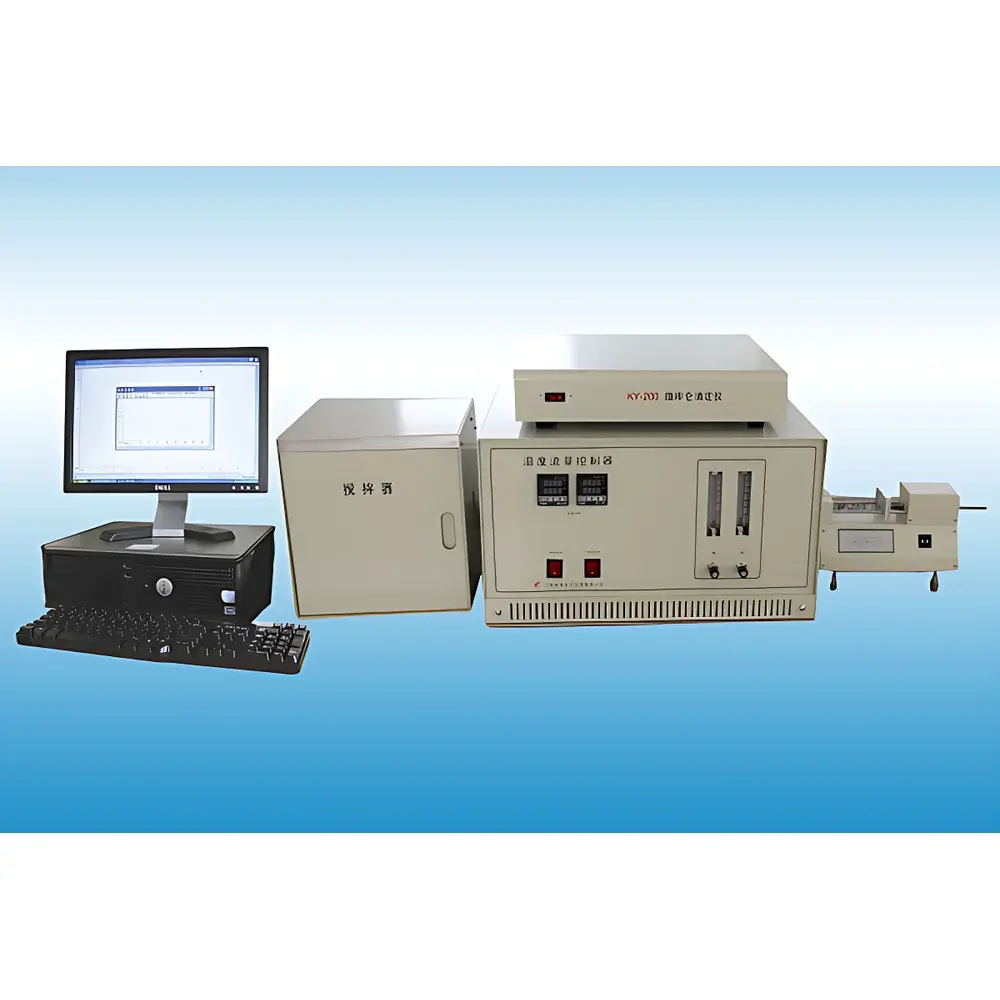
Kyuan KY-200 Microcoulometric Sulfur Analyzer
| Brand | Kyuan Instruments |
|---|---|
| Origin | Jiangsu, China |
| Manufacturer Type | OEM Manufacturer |
| Country of Origin | China |
| Model | KY-200 |
| Price | Upon Request |
| Principle | Microcoulometric Titration (Electrolytic Iodine Generation) |
| Sample Forms | Liquid, Solid, Gas (with optional injectors) |
| Analyte | Total Sulfur (S) |
| Detection Range | 0.1–10,000 mg/L |
| LOD | 0.1 mg/L (as S) |
| Repeatability | CV ≤3% (for x >10 mg/L), ±0.1 mg/L (0.5–1.0 mg/L), CV ≤8% (1.0–10 mg/L), <30% (x <0.5 mg/L) |
| Temperature Control | Ambient to 1100 °C, ±1 °C |
| Power Consumption | 1500 W |
| Carrier Gases | Industrial-grade N₂ and O₂ |
| Cooling | Air-cooled furnace with auto-start/stop fan |
| Compliance Standards | SH/T 0253, GB/T 11061.4, SH/T 0222, GB/T 3208, SH/T 1147 |
Overview
The Kyuan KY-200 Microcoulometric Sulfur Analyzer is a precision analytical instrument engineered for quantitative determination of total sulfur in hydrocarbon-based matrices using the fundamental principle of microcoulometric titration. In this method, sulfur-containing compounds—regardless of chemical form (e.g., mercaptans, sulfides, disulfides, thiophenes)—are quantitatively converted to sulfur dioxide (SO₂) via high-temperature oxidative pyrolysis (up to 1100 °C) under controlled N₂/O₂ carrier gas flow. The evolved SO₂ is swept into a dual-electrode titration cell, where it reacts stoichiometrically with electrogenerated iodine (I₂) according to the reaction: SO₂ + I₂ + 2H₂O → H₂SO₄ + 2HI. The coulometric current required to regenerate I₂ is continuously measured; based on Faraday’s law of electrolysis, the total charge consumed is directly proportional to the mass of sulfur in the sample. This first-principles electrochemical quantification ensures trace-level accuracy without reliance on calibration curves, delivering inherent linearity and long-term measurement stability.
Key Features
- Fully digital microcoulometric architecture with embedded real-time coulometric integrator and PID-controlled high-temperature furnace (ambient to 1100 °C, ±1 °C stability)
- Automated sample introduction via programmable liquid autosampler or optional solid/gas sampling modules, minimizing operator intervention and cross-contamination risk
- Self-regulating air-cooling system with intelligent fan control—activates only during cooling phases to extend component life and reduce thermal stress
- Integrated Windows-based acquisition and control software enabling full process supervision: real-time current/voltage monitoring, temperature ramp profiling, endpoint detection logic, and automatic result calculation
- Robust titration cell design featuring platinum working electrode, silver/silver chloride reference electrode, and optimized electrolyte circulation for consistent response and low carryover
- Compliance-ready architecture supporting audit trails, user access levels, and electronic signature functionality aligned with GLP and FDA 21 CFR Part 11 data integrity requirements
Sample Compatibility & Compliance
The KY-200 accommodates liquid (e.g., gasoline, diesel, naphtha, benzene), solid (e.g., catalysts, polymers, coal extracts), and gaseous (e.g., natural gas, LPG) samples—each requiring application-specific injection hardware validated per ISO 8573-1 (gas purity) and ASTM D6667 (gaseous sulfur analysis). Its measurement protocol conforms rigorously to multiple internationally recognized standards: SH/T 0253 (light distillates), GB/T 11061.4 (natural gas), SH/T 0222 (LPG), GB/T 3208 (aromatic hydrocarbons), and SH/T 1147 (industrial aromatics). All system validations—including LOD verification, linearity assessment (r² ≥0.999 over full range), and intermediate precision testing—are documented per ISO/IEC 17025 guidelines. Instrument qualification includes IQ/OQ documentation packages suitable for regulated laboratory environments operating under GMP or CNAS accreditation frameworks.
Software & Data Management
Kyuan’s proprietary KyControl™ software provides end-to-end data lifecycle management—from method setup and sequence definition to raw signal visualization, peak integration, uncertainty propagation, and report generation. Raw coulometric current-time profiles are archived with metadata (operator ID, timestamp, gas pressure logs, furnace thermocouple readings). Quantitative results include calculated sulfur mass, relative standard deviation (RSD), recovery rates (when spiked standards applied), and compliance flags against method-defined acceptance criteria. Export formats include CSV, PDF, and XML for LIMS integration. Audit trail records all critical events: parameter modifications, calibration executions, user logins/logouts, and result overrides—with immutable timestamps and operator attribution.
Applications
The KY-200 serves as a primary reference method for sulfur quantification across upstream, midstream, and downstream petroleum operations. It supports refinery QC for ultra-low-sulfur diesel (ULSD) certification (<10 mg/kg), catalyst poisoning studies in hydrotreating units, specification testing of petrochemical feedstocks (e.g., BTX streams), and environmental compliance monitoring of stack emissions precursors. In research laboratories, it enables kinetic sulfur speciation modeling when coupled with selective pre-treatment (e.g., selective oxidation or extraction). Regulatory agencies utilize it for verification testing under China’s GB 17930 and EU EN 590 mandates. Its adaptability to solid matrices also supports ASTM D7042-compliant analysis of sulfur in lubricant additives and polymer stabilizers.
FAQ
What types of sulfur species does the KY-200 detect?
It measures total recoverable sulfur—quantitatively converting all organic and inorganic sulfur forms (e.g., sulfides, sulfoxides, thiophenes, sulfate salts) to SO₂ under oxidative pyrolysis conditions.
Is carrier gas purity critical for accurate results?
Yes. Industrial-grade N₂ and O₂ must meet ISO 8573-1 Class 2 specifications (hydrocarbon content <0.1 ppmv, moisture <−40 °C dew point) to prevent baseline drift and false positives.
Can the instrument be validated for GMP use?
Yes. Full 3Q documentation (IQ/OQ/PQ), electronic signature support, and 21 CFR Part 11-compliant audit trails are available upon request.
How often does the titration cell require maintenance?
Under typical operation (≤20 samples/day), electrolyte replacement is recommended every 7–10 days; electrode polishing and membrane inspection every 3 months.
Does the system support remote diagnostics?
KyControl™ includes secure remote access capability (via TLS-encrypted VNC) for technical support teams to perform real-time troubleshooting and firmware updates.





