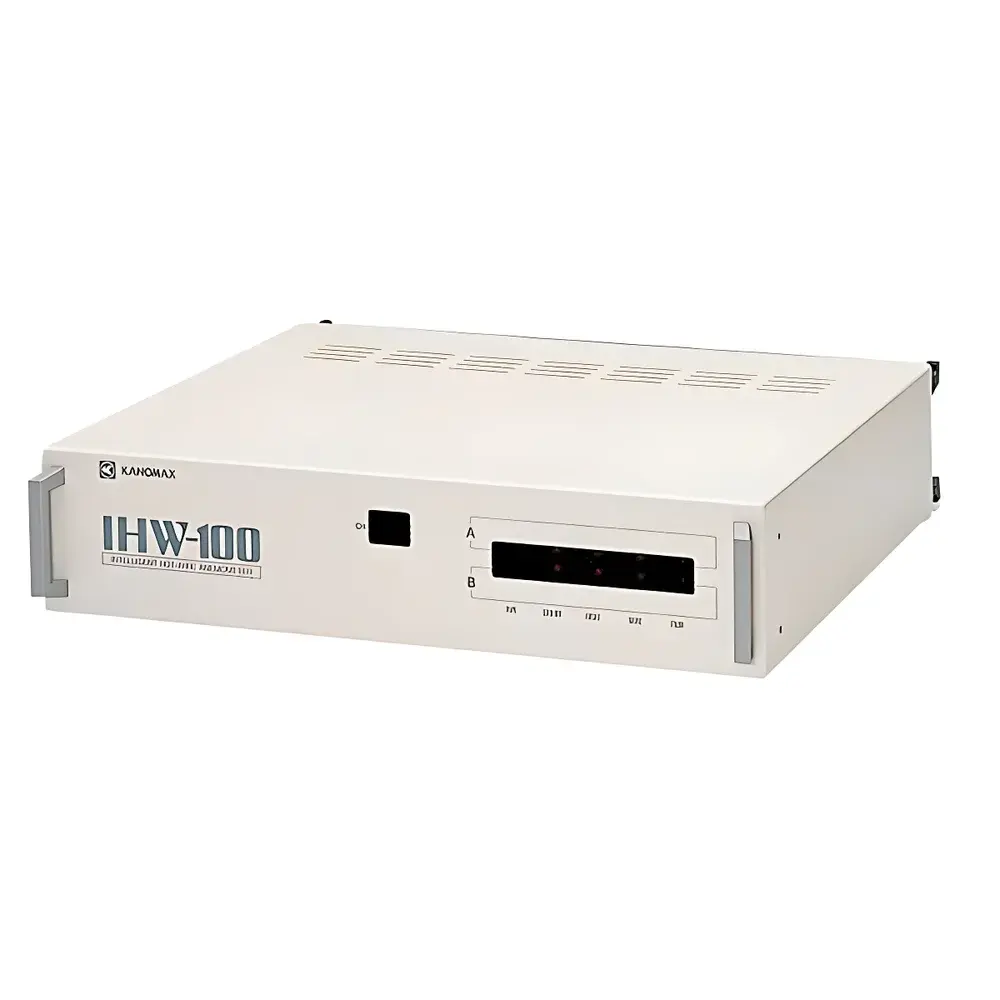
KANOMAX IHW-100 Constant-Temperature Anemometer (CTA) / Hot-Wire Anemometer (HWA)
| Brand | KANOMAX |
|---|---|
| Origin | Japan |
| Model | IHW-100 |
| Sensor Type | Thermal (Constant-Temperature Anemometry) |
| Measurement Principle | CTA (Constant-Temperature Anemometry) |
| Bridge Ratio | 10:1 |
| Maximum Probe Current | 500 mA |
| Frequency Response | 10 kHz (with 5 µm tungsten wire probe) |
| Power Supply | AC 100/115 V ±10%, 50/60 Hz |
| Dimensions (H×W×D) | 99 × 430 × 300 mm |
| Probe Compatibility | Interchangeable hot-wire and hot-film probes |
| Compliance | Designed for laboratory-grade fluid dynamics research per ISO 80000-4, ASTM D5096, and IEC 60068-2 environmental test standards |
Overview
The KANOMAX IHW-100 is a precision constant-temperature anemometer (CTA) engineered for high-fidelity, time-resolved velocity measurements in gaseous flows. It operates on the fundamental principle of thermal anemometry: a fine-wire sensor—typically a 5 µm diameter tungsten filament—is electrically heated and maintained at a constant temperature differential above ambient via a feedback-controlled Wheatstone bridge circuit. As airflow impinges upon the sensor, convective heat loss causes its resistance to decrease; the control electronics instantaneously compensates by increasing current to restore thermal equilibrium. The resulting power input is linearly correlated to local flow velocity under calibrated conditions. This closed-loop CTA architecture delivers superior temporal resolution (up to 10 kHz bandwidth), low noise floor, and exceptional sensitivity across a wide dynamic range—from sub-centimeter-per-second laminar boundary layers to supersonic flow regimes in wind tunnel testing. Unlike averaging-based instruments such as pitot tubes or ultrasonic anemometers, the IHW-100 provides true point-wise, instantaneous velocity data essential for turbulence characterization, vortex shedding analysis, and unsteady aerodynamic investigations.
Key Features
- Real-time CTA operation with 10 kHz frequency response—enabled by optimized bridge electronics and low-thermal-mass 5 µm tungsten wire probes.
- Automatic zero-point and gain calibration routines embedded in firmware, minimizing operator dependency and reducing setup time.
- Modular probe interface supporting interchangeable single-wire, X-wire, and cross-wire configurations for 1D, 2D, and 3D velocity vector reconstruction.
- Integrated temperature compensation circuitry ensures stable output across ambient variations from 5 °C to 40 °C, critical for long-duration experiments.
- Rugged 99 × 430 × 300 mm chassis with EMI-shielded enclosure meets IEC 61326-1 requirements for electromagnetic compatibility in industrial lab environments.
- Bridge ratio fixed at 10:1 for optimal signal-to-noise ratio and linearity over extended velocity ranges (0.02–200 m/s typical, dependent on probe geometry and gas properties).
Sample Compatibility & Compliance
The IHW-100 is validated for use with dry air and non-corrosive gases (e.g., N₂, CO₂, He) at atmospheric pressure and moderate humidity (<70% RH). It is not rated for explosive, particulate-laden, or chemically aggressive media without optional protective sheaths. Probe selection must account for gas thermal properties—calibration coefficients are supplied for standard air per ISO 10780 and ASTM D5096 Annex A. The system supports GLP-compliant data acquisition when paired with time-stamped, audit-trail-enabled DAQ hardware. Its electrical design conforms to IEC 61010-1 for measurement category II pollution degree 2, and mechanical construction aligns with ISO 14644-1 Class 8 cleanroom handling protocols where applicable.
Software & Data Management
The IHW-100 interfaces via analog voltage output (0–10 V DC proportional to velocity) and RS-232 serial port for configuration and status monitoring. While no proprietary PC software is bundled, it is fully compatible with industry-standard platforms including LabVIEW™ (NI DAQmx drivers), MATLAB® Data Acquisition Toolbox, and Python-based PyVISA frameworks. All calibration data—including probe-specific CTA constants, temperature compensation polynomials, and linearization tables—are stored in non-volatile memory and exportable in CSV format. Raw output supports post-processing for turbulence statistics (u′, v′, w′ RMS, Reynolds stress tensors) using FFT-based spectral analysis or wavelet decomposition tools.
Applications
- Aerodynamic development in low-speed and transonic wind tunnels (boundary layer profiling, wake survey, separation detection).
- Performance mapping of HVAC duct systems, fan inlets/outlets, and ventilation grilles under real-world operating conditions.
- Fundamental turbulence research—including Kolmogorov-scale resolution, intermittency analysis, and energy cascade studies.
- Combustion diagnostics: cold-flow simulation of intake/exhaust manifolds in internal combustion engines and gas turbines.
- Calibration traceability for secondary standards in national metrology institutes (NMI) adhering to ISO/IEC 17025 requirements.
- Educational laboratories for hands-on instruction in fluid mechanics, heat transfer, and instrumentation principles.
FAQ
What is the difference between CTA and CCA (Constant-Current Anemometry) modes?
The IHW-100 operates exclusively in constant-temperature mode (CTA), which prioritizes temporal fidelity and dynamic range. CCA is not supported due to inherent thermal lag and reduced sensitivity at low velocities.
Can the IHW-100 measure velocity in liquids?
No—it is designed strictly for gaseous media. Liquid immersion would cause immediate thermal shock and probe failure due to orders-of-magnitude higher convective heat transfer coefficients.
Is NIST-traceable calibration provided with the instrument?
Factory calibration is performed against KANOMAX’s primary wind tunnel standard, accredited to JCSS (Japan Calibration Service System). NIST-traceable certificates are available as an optional add-on service.
How often does the probe require recalibration?
Annual recalibration is recommended for ISO 17025-compliant operations; more frequent verification is advised after mechanical shock, exposure to condensation, or operation beyond specified temperature/humidity limits.
Does the system support synchronization with external triggers (e.g., PIV lasers or engine crank-angle encoders)?
Yes—via TTL-compatible external trigger input, enabling phase-locked sampling for cyclic flow phenomena such as blade-passing frequency analysis or pulsatile ventilation studies.