
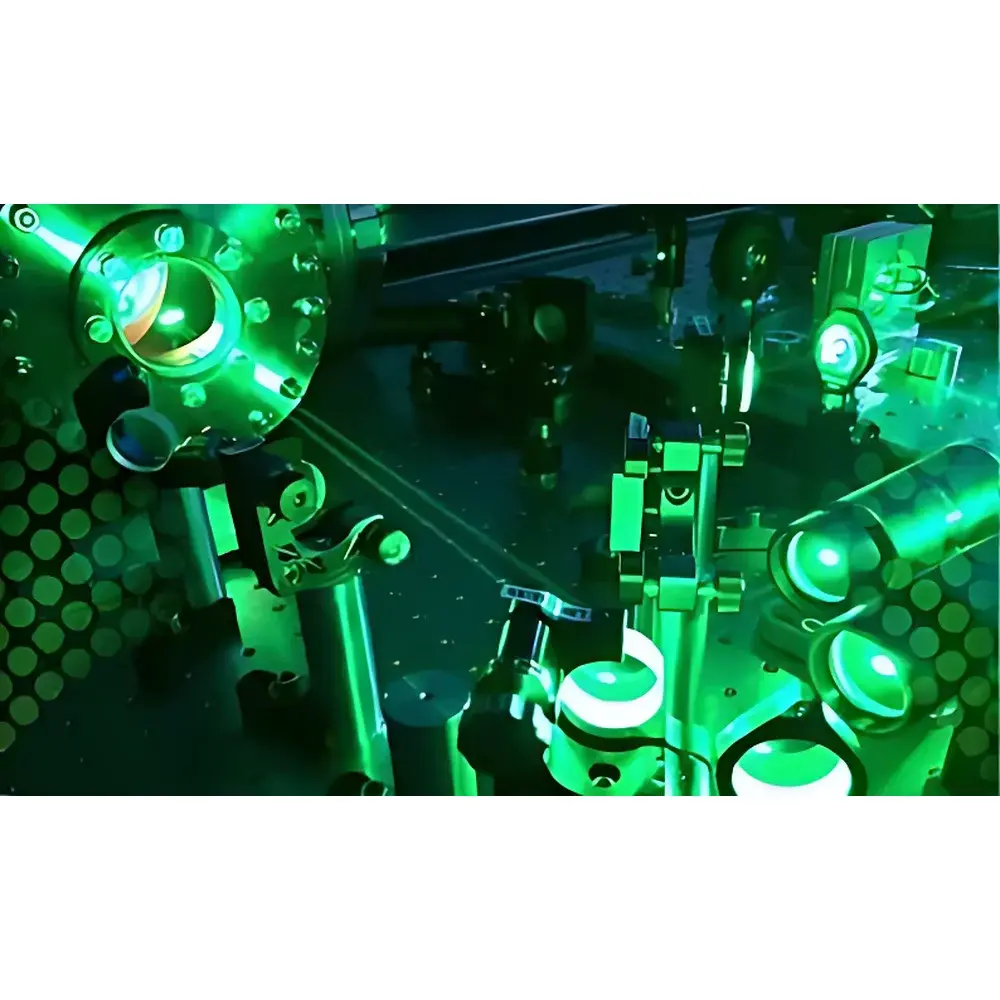
Proton VILSER High-Repetition-Rate Terawatt Laser System
| Origin | Spain |
|---|---|
| Manufacturer Type | Distributor |
| Origin Category | Imported |
| Model | VILSER |
| Price | Upon Request |
| Core Components | Solid-State Laser System and Associated Equipment |
Overview
The Proton VILSER High-Repetition-Rate Terawatt Laser System is a compact, turnkey diode-pumped solid-state (DPSS) chirped pulse amplification (CPA) laser platform engineered for ultrafast science laboratories requiring high peak power with industrial-grade stability. Operating on Ti:sapphire or Yb-doped gain media (configurable per application), the system delivers sub-50-fs pulses at terawatt peak power levels while maintaining repetition rates from 1 kHz up to 100 kHz—enabling statistically robust data acquisition in pump-probe spectroscopy, high-harmonic generation (HHG), and laser-driven particle acceleration experiments. Its architecture integrates active thermal management, vacuum-sealed beam paths for long-term pointing stability, and hermetically sealed amplifier stages to minimize environmental drift. Unlike single-shot TW systems, the VILSER series prioritizes shot-to-shot reproducibility and duty-cycle sustainability, making it suitable for time-resolved X-ray generation, attosecond metrology, and seeded plasma wakefield experiments where temporal jitter < 30 fs RMS and energy stability < 0.7% RMS over 8 hours are critical.
Key Features
- Diode-pumped solid-state CPA architecture with integrated stretcher-amplifier-compressor design
- Configurable repetition rate: 1 kHz, 10 kHz, 50 kHz, or continuous mode (CM) variants available
- Sub-50-fs pulse duration (FWHM), tunable via compressor grating alignment and dispersion compensation
- Peak power up to 1 TW at 1 kHz; scalable to >5 TW with external booster amplifiers (optional)
- Beam quality characterized by M² < 1.3 (measured at 800 nm); spatial profile near-diffraction-limited
- Active beam pointing stabilization (< 2 µrad RMS over 4 hours) using fast steering mirrors and quadrant photodiode feedback
- Integrated ASE suppression optics achieving >10⁸ contrast ratio at 5 ps, >10¹⁰ at 10 ps, and >10¹¹ at 20 ps pre-pulse windows
- Energy monitoring with calibrated photodiodes and real-time feedback loop for closed-loop pulse energy regulation
Sample Compatibility & Compliance
The VILSER system is compatible with standard ultrafast optical tables (optical path height 76 mm), vacuum-compatible end-stations (UHV flanges: CF100/CF160), and common pump-probe delay stages (e.g., Thorlabs DDS300, Newport UVPD). It meets CE marking requirements for Class 4 laser products (IEC 60825-1:2014) and incorporates interlock circuits compliant with EN 61511 for safety instrumented systems. All control electronics conform to EMC Directive 2014/30/EU. For regulated environments, optional audit-ready firmware supports GLP/GMP traceability: timestamped log files record every parameter change, user login events, and hardware status (temperature, humidity, pump diode current, cavity alignment diagnostics). While not FDA-cleared (as it is a research-grade instrument), its software architecture supports 21 CFR Part 11 compliance when deployed with validated third-party LIMS integration.
Software & Data Management
Control is managed via Proton’s proprietary VILSER Control Suite (v4.2+), a Windows-based application with Python API (PyVILSER) for automated experiment scripting. The suite provides real-time oscilloscope-style visualization of pulse energy, spectral phase (via SPIDER/FROG integration), and beam centroid position. All raw sensor data—including photodiode traces, temperature logs, and motor encoder positions—are stored in HDF5 format with embedded metadata (wavelength, pulse duration, compression setting, ambient pressure). Export options include ASCII, MATLAB .mat, and NI DIAdem-compatible formats. Remote operation is supported over TCP/IP with TLS 1.2 encryption; role-based access control (admin/operator/observer) ensures secure multi-user lab deployment.
Applications
- Pump-probe transient absorption and photoelectron spectroscopy (with electron time-of-flight spectrometers)
- High-order harmonic generation (HHG) in gas jets for coherent EUV/XUV sources
- Laser wakefield acceleration (LWFA) of electrons and protons in capillary or gas-cell targets
- Time-resolved X-ray diffraction using laser-driven plasma X-ray sources
- Strong-field ionization studies requiring precise intensity control and low CEP drift
- Nonlinear optical parametric amplification (NOPA) seeding for broadband IR/THz generation
FAQ
What is the typical pulse energy at 1 kHz repetition rate?
Standard VILSER1 configuration delivers ≥1.2 J per pulse at 1 kHz; higher-energy variants (VILSER10/VILSER50) scale linearly with rep rate while maintaining <1.5% RMS energy fluctuation.
Is carrier-envelope phase (CEP) stabilization available?
Yes—CEP stabilization is offered as an optional add-on module (VILSER-CEP), achieving <100 mrad RMS drift over 1 hour using f-to-2f interferometry and piezo-driven oscillator cavity control.
Can the system be upgraded to higher peak power post-purchase?
All VILSER platforms support field-upgradeable amplifier modules and compressor gratings; upgrades must be performed by Proton-certified engineers to maintain warranty and calibration integrity.
What maintenance intervals are recommended?
Optical alignment verification every 6 months; pump diode lifetime rated at ≥20,000 hours; compressor grating cleaning only under cleanroom conditions (ISO Class 5) every 12 months.
Does the system support synchronization with external RF sources or timing distribution networks?
Yes—integrated 10 MHz reference input/output, programmable trigger delays (0–10 s, 1 ps resolution), and White Rabbit timing interface (IEEE 1588-2019 compliant) for multi-lab synchronization.





