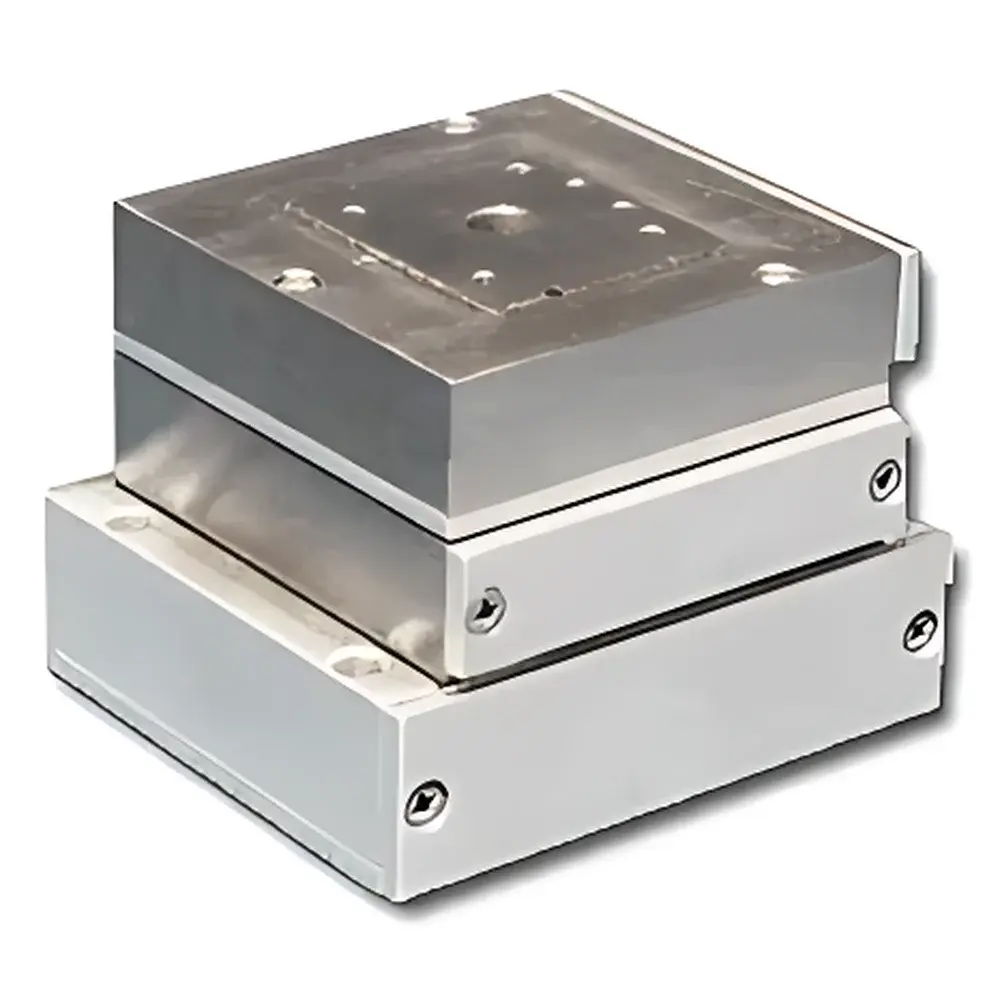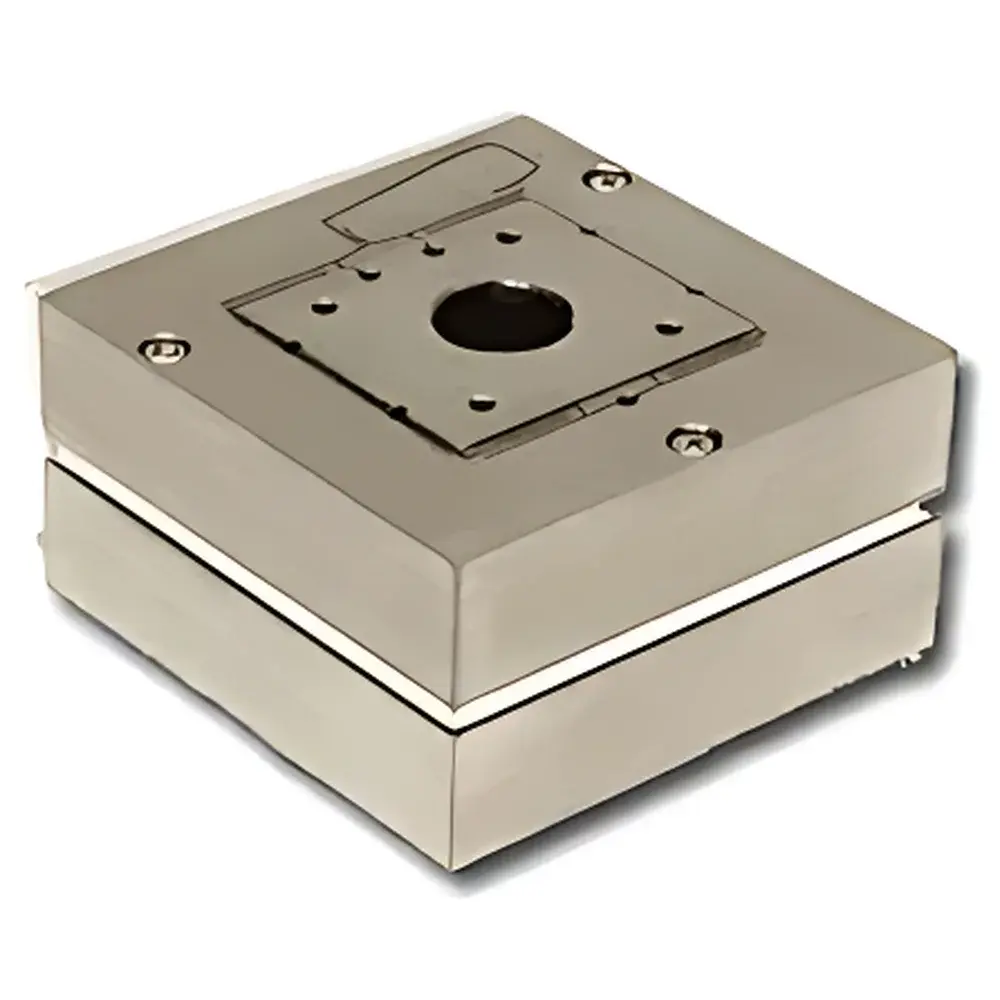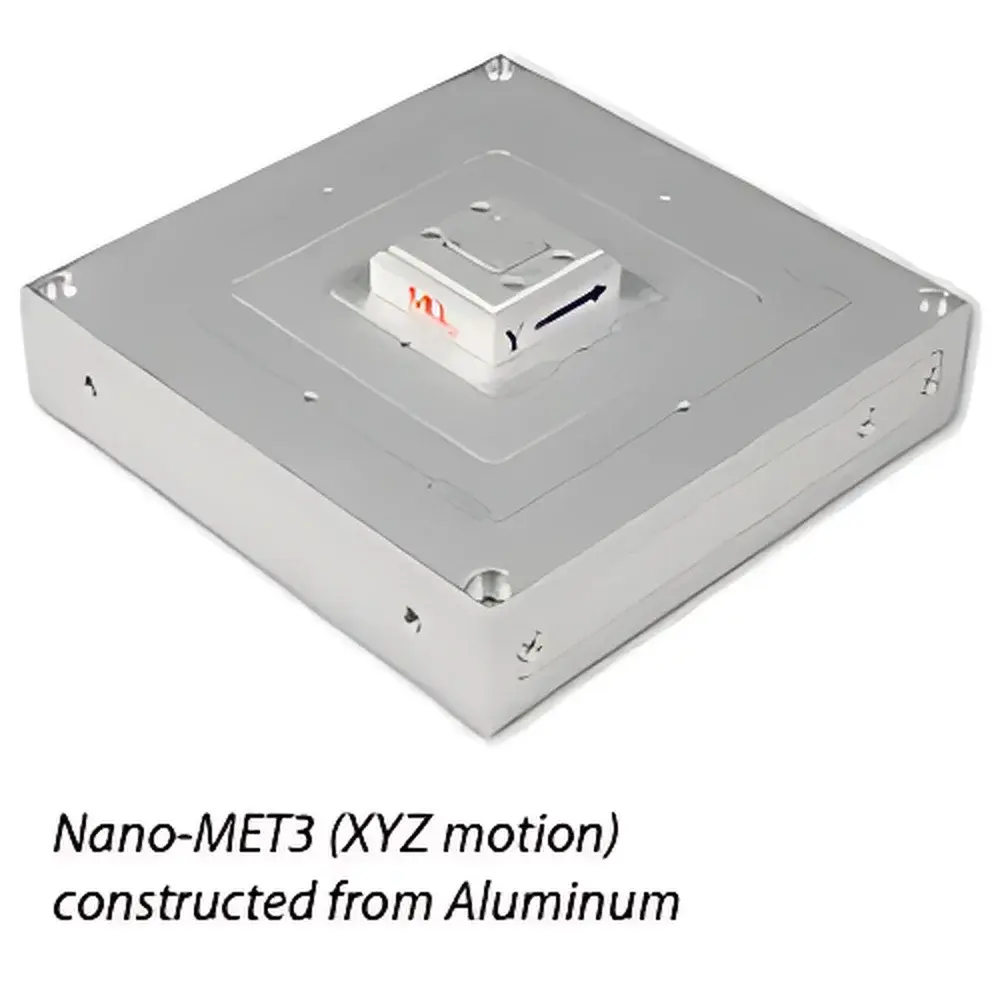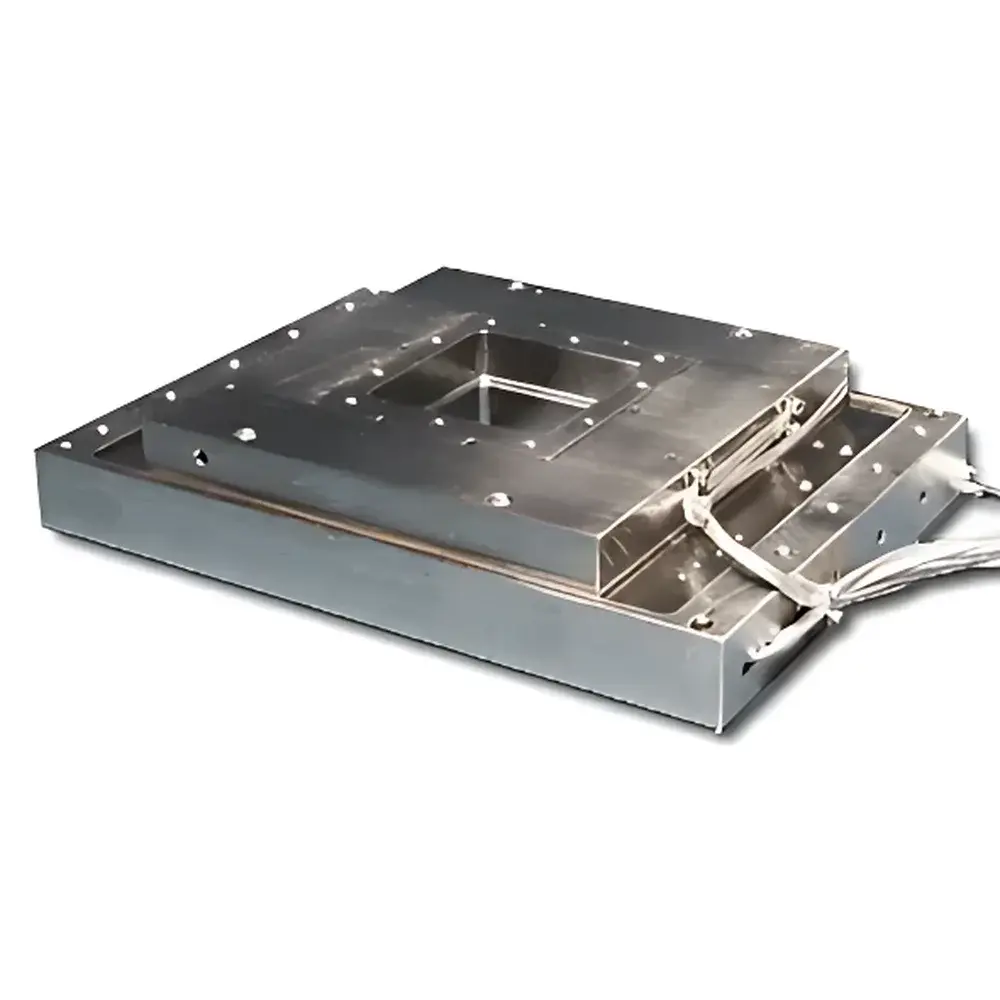
MCL Think Nano Nano-UHV200 Ultra-High Vacuum Compatible Three-Axis Piezoelectric Nanopositioning Stage

| Brand | MCL Think Nano |
|---|---|
| Origin | Canada |
| Model | Nano-UHV200 |
| Motion Range (X/Y/Z) | 200 µm × 200 µm × 200 µm |
| Resolution (XYZ) | 0.4 nm |
| Resonant Frequency (X) | 300 Hz ±20% |
| Resonant Frequency (Y) | 150 Hz ±20% |
| Resonant Frequency (Z) | 175 Hz ±20% |
| Stiffness | 2 N/µm |
| Angular Deviation (Roll/Pitch) | ≤1 µrad |
| Angular Deviation (Yaw) | ≤3 µrad |
| Max. Horizontal Load | 0.5 kg |
| Max. Vertical Load | 0.2 kg |
| Construction | Titanium & 316 Stainless Steel |
| UHV Compatibility | ≤1×10⁻¹⁰ Torr |
| Control | Closed-loop with PicoQ® absolute position sensing |
| Aperture | 2″ × 2″ center optical access |
Ask about pricing, availability and specifications.
Overview
The MCL Think Nano Nano-UHV200 is an ultra-high vacuum (UHV)-rated, three-axis (X-Y-Z) nanopositioning stage engineered for atomic-scale precision in demanding scientific environments. Built upon piezoelectric actuation and closed-loop feedback architecture, it operates on the principle of electrostrictive displacement amplification coupled with direct-measurement capacitive or strain-gauge-based position sensing—implemented here via MCL’s proprietary PicoQ® technology. This enables true absolute positioning without homing routines, eliminating cumulative drift and ensuring picometer-level repeatability over time. Designed explicitly for integration into UHV chambers operating down to 1×10⁻¹⁰ Torr, the Nano-UHV200 supports applications requiring long-duration stability under bakeout conditions up to 100 °C. Its monolithic titanium and 316 stainless steel construction ensures non-magnetic performance, low outgassing rates (<1×10⁻¹² Pa·m³/s per cm²), and compatibility with standard UHV surface preparation protocols including plasma cleaning and thermal cycling.
Key Features
- Full UHV compliance: Constructed entirely from certified low-outgassing materials—Grade 5 titanium (Ti-6Al-4V) and electropolished 316 stainless steel—with documented ASTM E595 total mass loss (TML) <0.5% and collected volatile condensable materials (CVCM) <0.05%.
- True three-axis independent motion: Each axis delivers 200 µm travel with sub-nanometer resolution (0.4 nm typical) and closed-loop linearity better than ±0.05% of full scale.
- PicoQ® integrated sensing: On-board absolute position transducers provide real-time, drift-free readout referenced to physical material properties—eliminating reliance on incremental encoders or external interferometers.
- Mechanical robustness: Stiffness of 2 N/µm across all axes ensures high resonant frequencies (X: 300 Hz; Y: 150 Hz; Z: 175 Hz) and minimal dynamic coupling during high-speed scanning sequences.
- Optical accessibility: A centered 2-inch × 2-inch aperture allows unobstructed beam paths for synchrotron X-ray, VUV spectroscopy, or multi-modal optical microscopy setups.
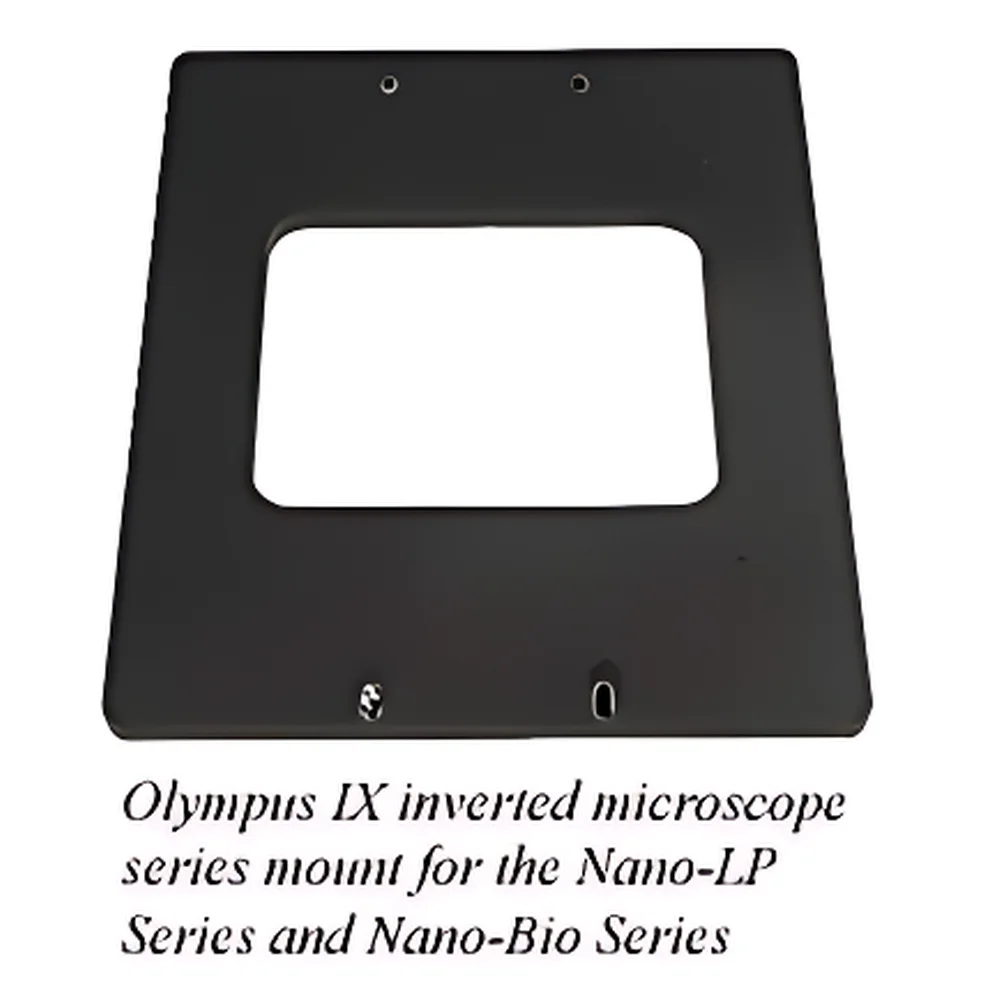
- Customizable feedthrough interface: Standard cable termination matches Accu-Glass Products’ CF100 and CF160 electrical feedthroughs; alternative flange interfaces (ISO-KF, ISO-F, ConFlat variants) available upon engineering review.
Sample Compatibility & Compliance
The Nano-UHV200 meets stringent international UHV material and design standards, including ISO 14644-1 Class 1 cleanroom assembly protocols and ESA SCC-ECSS-Q-ST-70-02C outgassing specifications. It is routinely deployed in facilities adhering to DOE, DESY, ESRF, and APS operational guidelines for beamline instrumentation. All internal fasteners are Helicoil-installed to prevent cold-welding; surface roughness (Ra) is maintained below 0.2 µm on critical sealing surfaces. The stage is fully compatible with GLP-compliant experimental workflows when paired with Nano-Drive® controller firmware v4.2+, which supports audit-trail logging, user-access levels, and timestamped parameter change records per FDA 21 CFR Part 11 requirements.
Software & Data Management
Control is delivered through the Nano-Drive® platform—a deterministic real-time motion controller supporting USB 2.0, Ethernet TCP/IP, and RS-422 interfaces. Firmware includes native support for LabVIEW™, MATLAB® Data Acquisition Toolbox, Python (PyVISA), and EPICS IOC integration. Position data streams at up to 10 kHz with 24-bit ADC resolution; synchronized trigger I/O enables precise coordination with detectors (e.g., CCD, MCP, photon counters). Data export formats include HDF5, CSV, and TDMS—structured to align with FAIR (Findable, Accessible, Interoperable, Reusable) data principles. Optional scripting engine permits automated multi-point acquisition sequences with conditional logic based on sensor feedback or external TTL signals.
Applications
- X-ray nanodiffraction and ptychography at third-generation synchrotron beamlines
- Scanning tunneling microscopy (STM) and non-contact atomic force microscopy (NC-AFM) sample positioning in cryogenic UHV systems
- Vacuum ultraviolet (VUV) reflectometry and ellipsometry metrology
- Quantum dot and 2D material transfer alignment under inert gas purged load-lock integration
- In situ surface science studies involving temperature-programmed desorption (TPD) and low-energy electron diffraction (LEED)
- Multi-axis alignment of fiber-coupled quantum emitters or superconducting nanowire single-photon detectors (SNSPDs)
FAQ
Is the Nano-UHV200 compatible with liquid nitrogen or cryogenic stages?
Yes—its titanium/316SS architecture and absence of polymer components allow operation from 4 K to 100 °C; however, thermal contraction mismatch must be accounted for in mechanical interface design.
Can I integrate this stage with my existing UHV chamber using a custom flange?
Absolutely—MCL provides mechanical drawings and bolt-hole templates for common ISO-KF, CF, and DN flanges; bespoke mounting solutions are developed in collaboration with your vacuum engineer.
Does closed-loop operation require recalibration after bakeout?
No—PicoQ® sensors are intrinsically stable across thermal cycles; factory calibration remains valid post-bakeout provided no mechanical shock or overload occurs.
What is the maximum scan speed achievable in continuous raster mode?
At full 200 µm range and 0.4 nm step size, bidirectional scanning up to 50 Hz is achievable with <1% trajectory error when using optimized trapezoidal velocity profiles.
Is remote firmware update supported over Ethernet?
Yes—Nano-Drive® controllers support secure OTA updates via HTTPS-authenticated connections with SHA-256 signature verification and rollback capability.