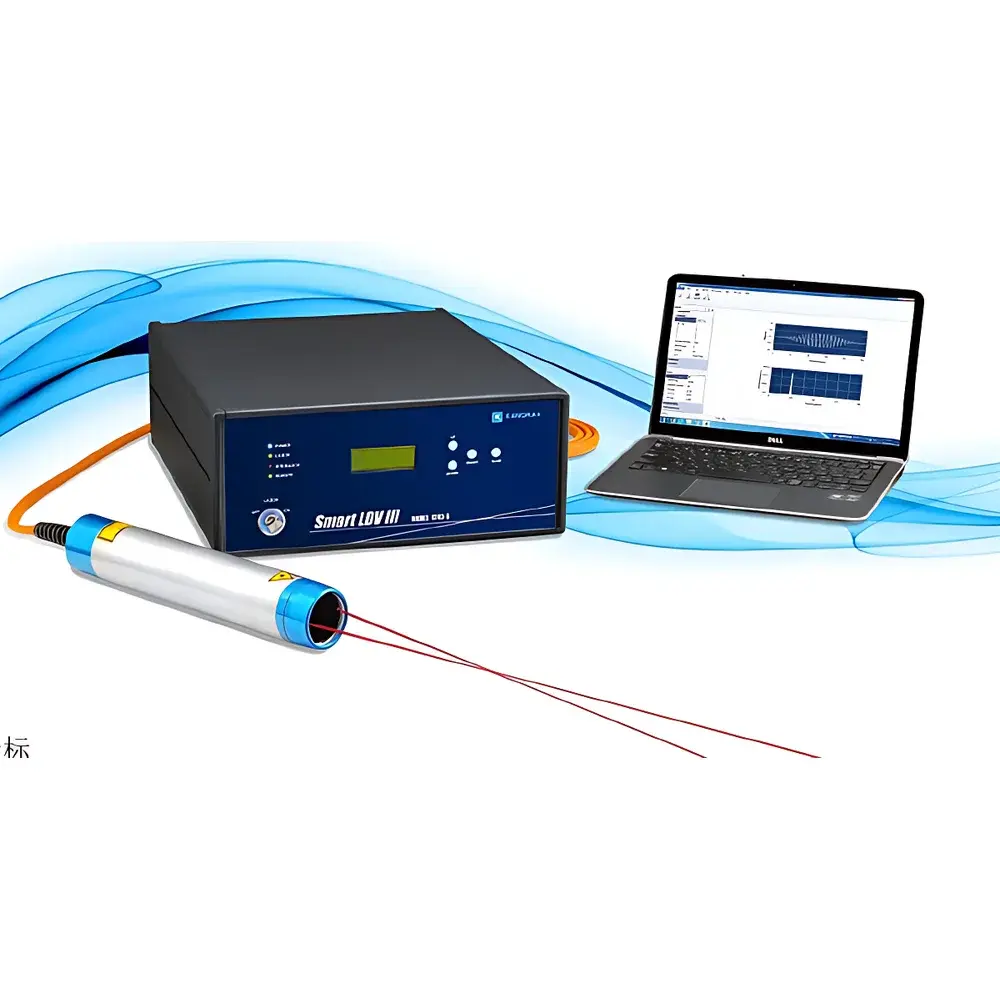
KANOMAX SmartLDV III Compact Laser Doppler Velocimetry System
| Brand | KANOMAX |
|---|---|
| Origin | Japan |
| Model | SmartLDV III |
| Laser Wavelength | 660 nm |
| Laser Power | 60 mW |
| Velocity Range | –40 to +264 m/s (at 400 mm focal distance, model 8743-S) |
| Focal Distances | 150, 200, 250, 300, 350, 400 mm |
| Spot Size | 0.13 mm × 1.3 mm (f = 200 mm) |
| Probe Dimensions | Ø61 mm × 345 mm |
| Probe Weight | 3.5 kg |
| Frequency Shift Range | 0.01–10 MHz |
| Signal Processor | KANOMAX Model 8008 |
| FFT Resolution | 8-bit |
| Frequency Bandwidth | 1 kHz – 40 MHz |
| Input Signal Range | 20 mV – 1 V (Doppler signal) |
| Data Acquisition Rate | 16,000 samples/sec |
| 3-Axis Traverse Stage | Max. vertical load 7 kg |
| Traverse Speed | 80 mm/sec |
| Positioning Accuracy | ±0.025 mm |
| Interface | RS232C |
| Compliance | CE-marked |
Overview
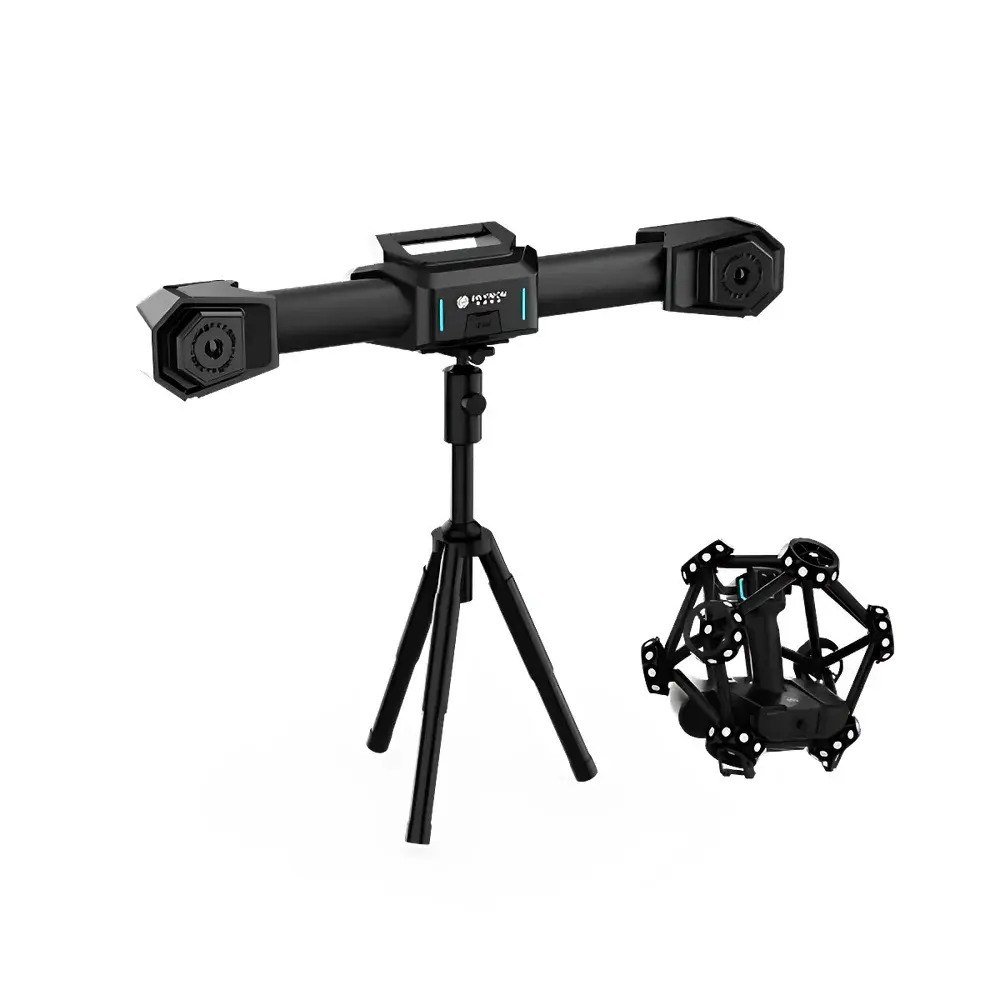
The KANOMAX SmartLDV III is a compact, fiber-optic-based Laser Doppler Velocimetry (LDV) system engineered for non-intrusive, high-fidelity point-velocity measurements in gaseous and low-scattering fluid flows. Operating on the principle of optical heterodyne detection, the system emits two coherent laser beams (λ = 660 nm, 60 mW) intersecting at a defined measurement volume. Particles or naturally occurring refractive index fluctuations within the flow scatter light, generating a Doppler-shifted signal whose frequency is linearly proportional to the local fluid velocity component along the bisector of the beam intersection angle. This fundamental interferometric approach ensures traceable, calibration-free velocity quantification with sub-millisecond temporal resolution—ideal for transient combustion dynamics, boundary layer analysis, and aerodynamic validation in wind tunnels and industrial burners.
Key Features
- Fiber-coupled dual-beam architecture enables flexible probe placement and vibration-isolated optical alignment, minimizing sensitivity to mechanical drift.
- Interchangeable probe optics support six standardized focal distances (150–400 mm), allowing optimization of measurement volume size (e.g., 0.13 mm × 1.3 mm at f = 200 mm) and depth-of-field for varying flow scales.
- Integrated frequency shifter (model 8743-S) extends bidirectional velocity range to ±264 m/s and eliminates directional ambiguity without requiring physical probe reorientation.
- Dedicated signal processor (Model 8008) performs real-time 8-bit Fast Fourier Transform (FFT) with programmable bandwidth (1 kHz–40 MHz), enabling robust spectral peak detection even under low-signal-to-noise conditions typical in lean combustion or low-dust gas streams.
- Motorized 3-axis traverse stage provides precise spatial mapping capability: ±0.025 mm positioning accuracy, 80 mm/sec translation speed, and 7 kg vertical load capacity—suitable for systematic profiling across shear layers or flame fronts.
- RS232C interface enables direct integration with LabVIEW, MATLAB, or custom Python-based acquisition environments; all hardware parameters—including gain, filter cutoff, and FFT bin count—are remotely configurable via ASCII command protocol.
Sample Compatibility & Compliance
The SmartLDV III is optimized for transparent or semi-transparent gaseous media containing naturally occurring scatterers (e.g., soot particles in flames, condensate droplets in humid air, or seeded tracer aerosols). It does not require electrical conductivity or magnetic susceptibility—making it uniquely suitable for electrically insulated or chemically aggressive environments where hot-wire anemometry or electromagnetic flowmeters are impractical. The system complies with CE directives for electromagnetic compatibility (EMC) and low-voltage safety. While LDV itself is a primary metrology method exempt from transducer calibration traceability, the SmartLDV III supports documented calibration verification per ISO 10816-3 and ASTM D7094 when used with NIST-traceable reference standards and certified traverse stages. Its architecture aligns with GLP/GMP data integrity expectations through timestamped binary data logging and audit-ready configuration metadata export.
Software & Data Management
No proprietary closed-software suite is bundled; instead, KANOMAX supplies comprehensive ASCII command documentation and Windows-compatible DLL libraries for seamless integration into existing laboratory data infrastructure. Raw Doppler burst signals are acquired at 16,000 samples/sec and stored in binary format (.bin) with header metadata (timestamp, probe ID, focal distance, gain setting). Post-processing tools—available as open-source Python packages—support spectral averaging, velocity distribution histogramming, turbulence intensity calculation (u′/U), and phase-locked ensemble averaging for periodic flows. All processed datasets retain full provenance: each velocity value carries embedded uncertainty estimates derived from FFT linewidth, signal amplitude, and particle transit time statistics—critical for ISO/IEC 17025-compliant reporting.
Applications
- Aerothermal characterization of gas turbine combustors and afterburners under realistic pressure/temperature conditions.
- Validation of CFD simulations in supersonic inlet ducts and shock-boundary layer interactions.
- Quantitative mapping of turbulent kinetic energy dissipation rates in atmospheric boundary layer wind tunnels.
- Time-resolved velocity profiling across premixed flame fronts and flashback zones in low-emission burner development.
- Non-contact velocity calibration of other flow sensors (e.g., Pitot tubes, thermal anemometers) in accredited metrology labs.
FAQ
Does the SmartLDV III require seeding for gas-phase measurements?
Yes—while natural scatterers (e.g., soot, dust, or condensate) may suffice in some combustion or humid environments, controlled seeding with mono-dispersed SiO₂ or TiO₂ particles (0.5–2 µm diameter) is recommended for quantitative repeatability in clean air or inert gas flows.
Can the system resolve reverse flow near walls or recirculation zones?
Yes—when equipped with the 8743-S probe (integrated acousto-optic frequency shifter), the system unambiguously distinguishes negative velocities down to –40 m/s with no phase-wrap limitation.
Is the signal processor capable of real-time turbulence statistics?
No—the Model 8008 outputs raw burst spectra only. Statistical post-processing (RMS, skewness, probability density functions) must be performed offline using validated numerical routines compliant with ISO 5167 Annex C guidelines.
What maintenance is required for long-term stability?
Annual verification of laser output power and beam collimation is advised; optical components are sealed and do not require user cleaning. No consumables or recalibration intervals are specified—system performance remains stable over >5 years with proper thermal management.
How is traceability established for accredited measurements?
Traceability is achieved by cross-referencing against a calibrated rotating disc standard (e.g., NIST SRM 2822) at identical focal geometry and signal processing settings—documented per ILAC-G8:2019 requirements for indirect measurement systems.