
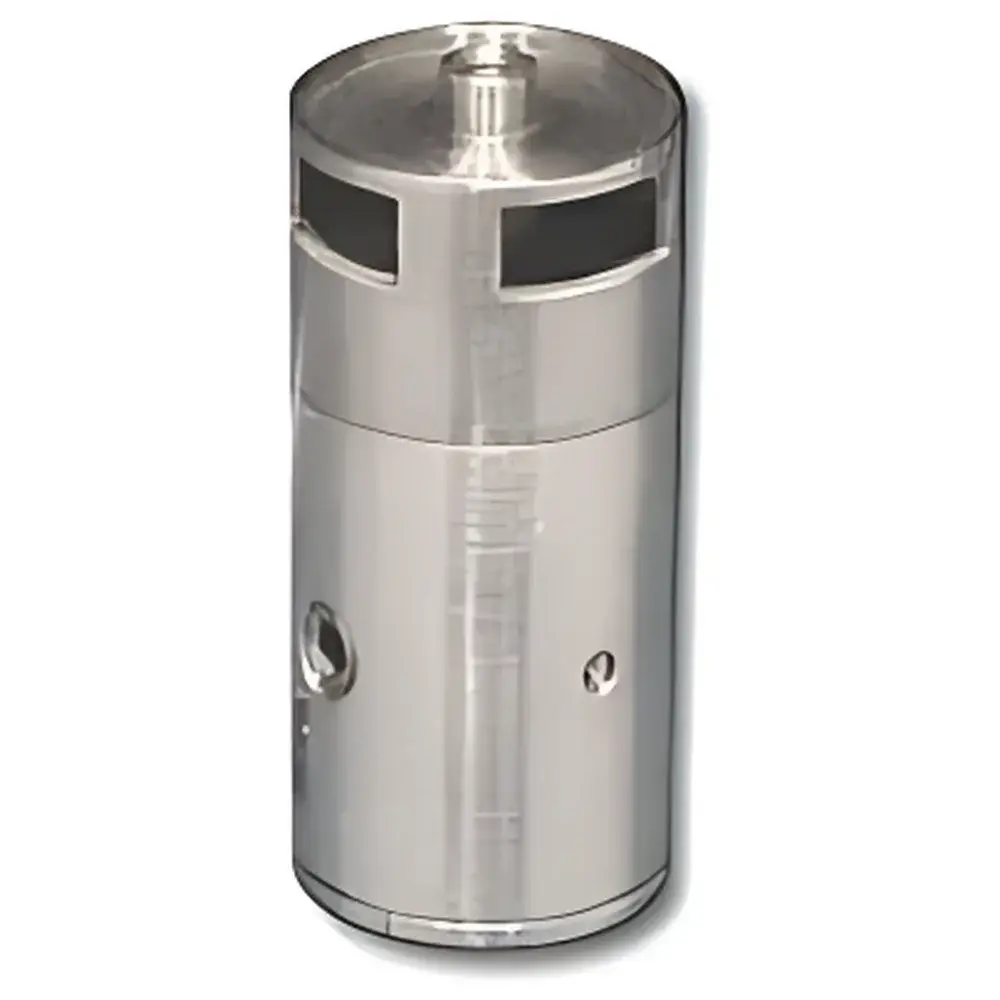
MCL Think Nano Nano-P Series Piezo-Actuated Closed-Loop Linear Translation Stage
| Brand | MCL Think Nano |
|---|---|
| Origin | USA |
| Model | Nano-P Series |
| Motion Range | 15/35/70 μm |
| Resolution | 0.03/0.07/0.14 nm |
| Resonant Frequency | 2.5 kHz ±20% |
| Max Load | 0.2 kg |
| Construction | Invar and Titanium |
| Control | Closed-loop with integrated PicoQ® position sensors |
| Actuation | Piezoelectric |
| Guiding Principle | Monolithic flexure hinge (no Belleville springs) |
| Compliance | Designed for ISO/IEC 17025-aligned metrology environments, compatible with GLP/GMP data integrity requirements via Nano-Drive® controller audit trail logging |
Overview
The MCL Think Nano Nano-P Series is a high-precision, piezo-actuated linear translation stage engineered for sub-nanometer positioning stability in demanding optical, metrological, and surface science applications. Unlike conventional motorized or spring-biased stages, the Nano-P Series employs a monolithic flexure hinge architecture—machined from a single block of aerospace-grade titanium using precision electrical discharge machining (EDM). This design eliminates mechanical play, backlash, and Coulombic stiction inherent in ball-screw, lead-screw, or Belleville-spring-based systems. The absence of discrete friction interfaces ensures true frictionless motion, enabling repeatable, hysteresis-free displacement under closed-loop control. Thermal stability is optimized through strategic use of Invar (low thermal expansion coefficient) for structural frames and titanium (high strength-to-density ratio, low thermal conductivity) for the flexure body—making the Nano-P Series suitable for long-duration interferometric measurements, scanning probe microscopy (SPM) sample scanning, and ultra-stable optical path length adjustment in vacuum or ambient laboratory environments.
Key Features
- Monolithic titanium flexure hinge—no assembled springs, no wear-prone joints, no lubrication required
- Closed-loop operation with integrated PicoQ® capacitive position sensors delivering absolute position feedback at picometer-level resolution (0.03 nm for Nano-P15, 0.07 nm for Nano-P35, 0.14 nm for Nano-P70)
- Three standard travel ranges: 15 μm, 35 μm, and 70 μm—each calibrated and certified for linearity error < ±0.05% of full scale
- Resonant frequency of 2.5 kHz ±20%, enabling fast step-and-settle response (< 5 ms for 10 nm steps) and compatibility with dynamic scanning protocols
- Maximum recommended static load of 0.2 kg; load capacity scalable upon engineering consultation for custom configurations
- Compact tubular form factor (diameter ≤ 38 mm) with standardized SM1 (1.035″-40) and kinematic mounting options for seamless integration into multi-axis optical breadboards and vacuum-compatible chambers
Sample Compatibility & Compliance
The Nano-P Series is designed for use with non-magnetic, non-corrosive samples up to 0.2 kg mass and ≤ 50 mm footprint. Its all-metal construction (Invar frame + Ti flexure) ensures compatibility with UHV environments (<1×10⁻⁹ mbar) when specified with bakeable variants. All units are manufactured and tested in accordance with ISO 9001:2015 quality management standards. Positional accuracy and repeatability data are traceable to NIST-calibrated interferometric reference systems. The Nano-Drive® controller supports FDA 21 CFR Part 11-compliant electronic signatures and audit trail logging—enabling use in regulated pharmaceutical, semiconductor, and medical device QA/QC laboratories operating under GLP or GMP frameworks.
Software & Data Management
Control is delivered via the Nano-Drive® digital controller, featuring USB 2.0 and analog (±10 V) interfaces. Firmware supports real-time streaming of position data at up to 10 kHz sampling rate, with onboard buffer storage for transient event capture. The accompanying NanoControl™ software suite (Windows/Linux/macOS) provides scripting support (Python API), waveform generation (sine, triangle, sawtooth, arbitrary), and automated calibration routines including hysteresis compensation and thermal drift correction. Raw sensor output is timestamped with microsecond resolution and exportable in CSV or HDF5 format for post-processing in MATLAB, Python (NumPy/Pandas), or LabVIEW. Audit logs record every command execution, parameter change, and firmware update—meeting ALCOA+ (Attributable, Legible, Contemporaneous, Original, Accurate, Complete, Consistent, Enduring, Available) data integrity criteria.
Applications
- Active stabilization of interferometer arms in gravitational wave detector prototypes and heterodyne laser Doppler vibrometry
- Sub-angstrom sample Z-scanning in atomic force microscopy (AFM) and scanning tunneling microscopy (STM) systems
- Precision alignment of fiber-optic couplers, photonic integrated circuits (PICs), and quantum dot emitters
- Dynamic focus correction in adaptive optics systems for astronomical imaging and ophthalmic retinal scanning
- Calibration artifact positioning in national metrology institute (NMI) primary standards labs performing nanoscale dimensional metrology per ISO 16014-3
- In-situ strain mapping in synchrotron X-ray diffraction experiments requiring <100 pm positional noise floor over 1-hour acquisitions
FAQ
What distinguishes the Nano-P Series flexure design from conventional piezo stages?
The Nano-P uses a monolithic EDM-machined titanium flexure—eliminating all mechanical bearings, screws, and Belleville washers. This yields zero static friction, no hysteresis, and intrinsic long-term stability unattainable with hybrid spring-piezo architectures.
Is vacuum compatibility available as standard?
Standard units operate in ambient air; UHV-rated versions (with ceramic feedthroughs and vacuum-compatible adhesives) are available as custom configurations—contact engineering for outgassing rate certification (per ASTM E595).
Can multiple Nano-P stages be synchronized?
Yes—the Nano-Drive® controller supports daisy-chained USB or master-slave analog triggering for coordinated multi-axis motion with sub-microsecond timing alignment.
How is calibration traceability documented?
Each unit ships with a Certificate of Calibration referencing NIST-traceable laser interferometry; raw calibration data files (including linearity, repeatability, and thermal drift curves) are provided digitally upon request.
What maintenance is required over the product lifetime?
None—there are no consumables, lubricants, or moving parts subject to wear. Lifetime is governed by piezoelectric actuator endurance (>10¹² cycles at rated voltage), verified per IEC 62047-19.



