
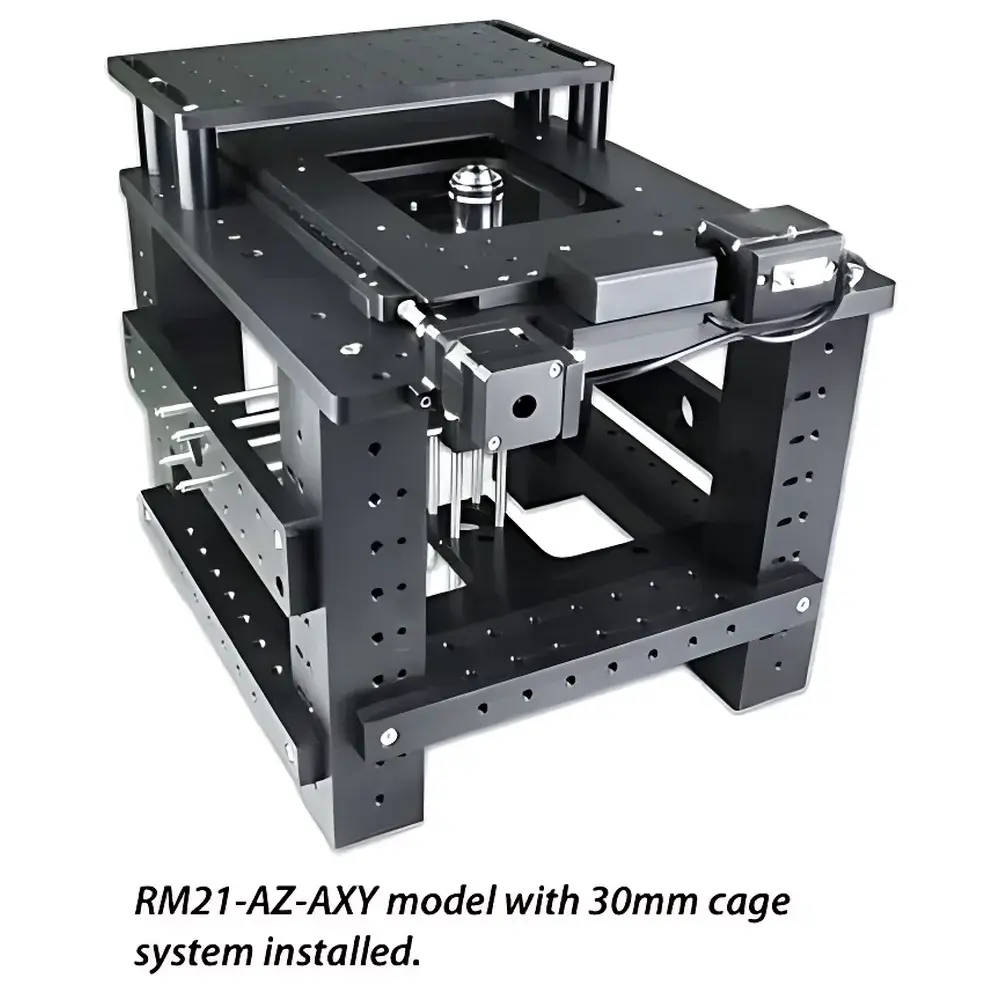
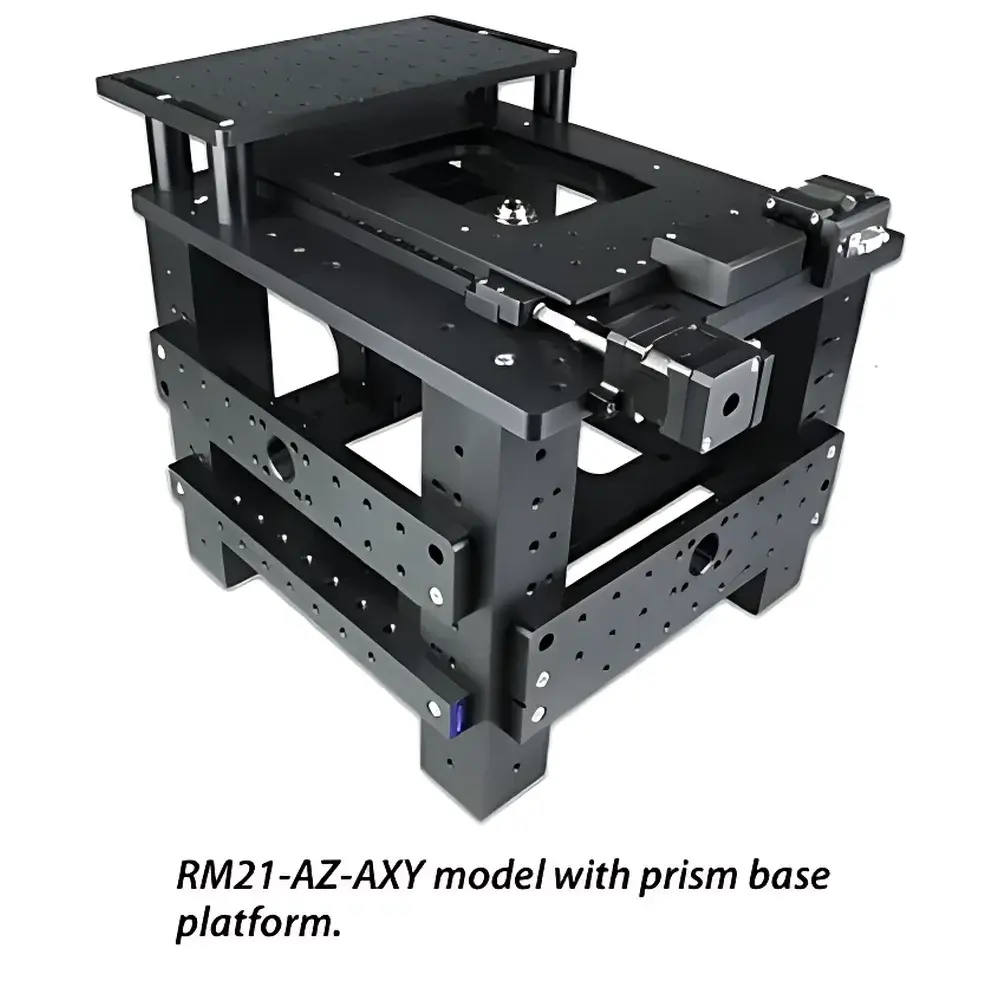
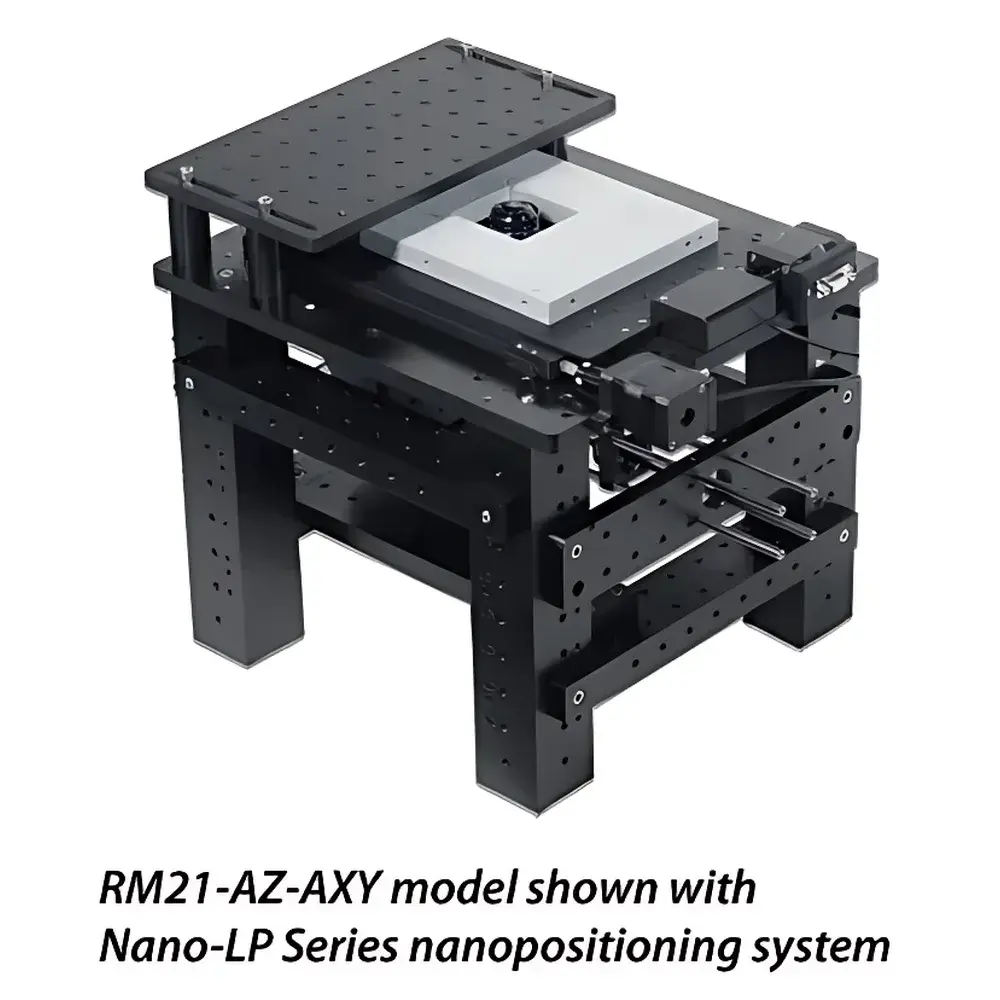
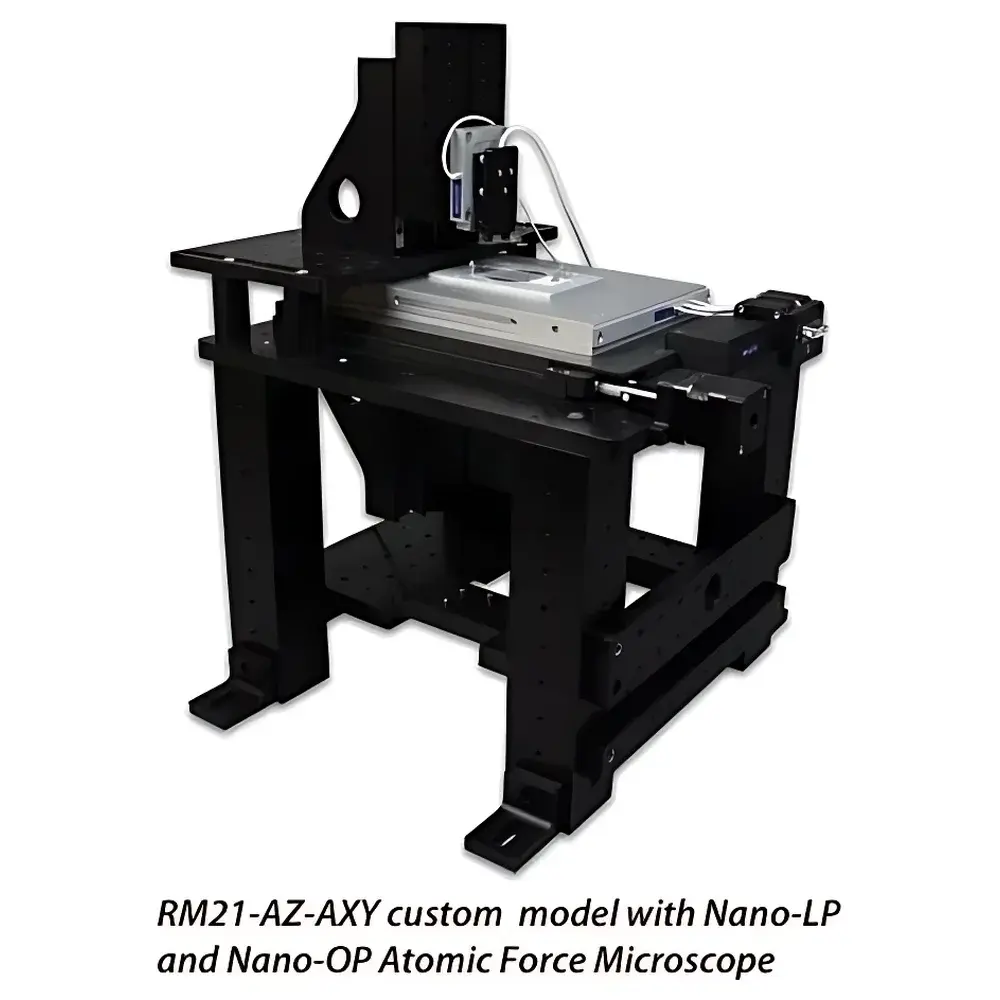
MCL Think Nano RM21™ Epifluorescence Microscope Platform
| Brand | MCL Think Nano |
|---|---|
| Origin | USA |
| Manufacturer Type | Authorized Distributor |
| Product Category | Imported Instrument |
| Model | RM21™ Microscope Platform |
| Instrument Type | Inverted Fluorescence Microscope |
| Excitation Source | Metal Halide Lamp |
| Eyepiece Compatibility | Standard 23.2 mm or 30 mm Mounts |
| Objective Compatibility | Standard RMS or M25 Thread Mounts |
| Fluorescence Configuration | Epi-illumination (Reflected Light) |
| Illumination Flexibility | Compatible with Broadband, LED, and Laser Sources |
| Observation Geometry | Inverted Optical Layout |
| Z-Axis Travel | 50 mm (2 in) with 95 nm Step Resolution |
| XY Positioning | Manual or Motorized Micropositioner (Optional) |
| Encoder Option | Closed-Loop Encoders Available for X, Y, and Z Axes |
| Integration Ready | Fully Compatible with Nano-Cyte® 3D Stability System, Nano-LPS/Nano-LPQ Linear Positioners, Nano-OP/Nano-F Objective Positioners, and LCC-Focus™ Autofocus Modules |
Overview
The MCL Think Nano RM21™ Epifluorescence Microscope Platform is a modular, precision-engineered foundation designed specifically for high-stability, alignment-critical fluorescence microscopy applications. Unlike conventional commercial microscopes, the RM21™ functions as an open-platform architecture—engineered not as a fixed instrument, but as a metrologically traceable mechanical backbone that supports custom optical integration and iterative experimental reconfiguration. Its core design principle centers on three-dimensional spatial repeatability: all mounting posts, kinematic interfaces, and adjustment points are referenced to a single, stable datum plane machined to ≤±0.5 µm flatness across its 300 × 300 mm baseplate. This enables deterministic alignment of excitation paths, emission filters, dichroics, objective collimation optics, and sample-stage coordinate systems—critical for quantitative single-molecule localization microscopy (SMLM), total internal reflection fluorescence (TIRF), and structured illumination microscopy (SIM).
Key Features
- Precision-machined aluminum alloy platform with black anodized, non-reflective surface finish to minimize stray light and thermal drift.
- Motorized axial Z-axis with 50 mm travel range and 95 nm minimum step resolution; integrated stepper motor with optional closed-loop encoder feedback for sub-micron positional verification.
- Modular XY positioning support: accepts either manual micrometer-driven stages (e.g., MicroStage-LT Series) or high-precision motorized linear positioners (Nano-LPS Series, Nano-LPQ Series) with <100 nm bidirectional repeatability.
- Standardized mounting interfaces compliant with ISO 8578 (optomechanical components) and ANSI/BHMA A156.19 (precision stage kinematics), enabling interoperability with third-party optics holders, filter cubes, and laser launch modules.
- Native compatibility with Mad City Labs’ Nano-Cyte® 3D active vibration cancellation system—providing real-time compensation for floor-borne vibrations down to 0.1 Hz, essential for >100 s exposure times in single-molecule tracking.
- Objective focusing architecture supports both lens-based (Nano-OP Series) and objective-screw-based (Nano-F Series) sub-nanometer focus control, enabling simultaneous multi-plane acquisition and adaptive optics integration.
Sample Compatibility & Compliance
The RM21™ accommodates standard inverted microscope sample formats including 35 mm glass-bottom dishes, 6–96-well plates, and custom microfluidic chambers mounted via vacuum or magnetic retention. Its open-top design permits unobstructed access for patch-clamp rigs, microinjection systems, and environmental control enclosures (temperature, CO₂, humidity). All structural components comply with RoHS 2011/65/EU directives. Mechanical tolerances adhere to ISO 2768-mK general tolerancing standards. When integrated with LCC-Focus™ closed-loop autofocus and Nano-View®/M Series imaging controllers, the platform supports GLP-compliant audit trails per FDA 21 CFR Part 11 requirements—including timestamped position logs, hardware configuration snapshots, and user-authenticated session records.
Software & Data Management
The RM21™ operates natively under Mad City Labs’ Nano-Control™ SDK (v4.2+), a C++/Python-accessible API supporting deterministic command sequencing, hardware synchronization (TTL/USB/NI-DAQ), and real-time trajectory buffering. It integrates seamlessly with industry-standard acquisition platforms including Micro-Manager 2.0, NIS-Elements AR (Nikon), ZEN Blue (Zeiss), and μManager-compatible plugins. Encoder-enabled axes generate calibrated displacement data streams compatible with HDF5 and OME-TIFF metadata schemas. All position and timing data can be exported with SI-traceable units (m, s, nm, ms) and synchronized to external triggers (e.g., laser pulses, camera exposure signals) with <100 ns jitter.
Applications
- Single-molecule fluorescence resonance energy transfer (smFRET) requiring precise donor–acceptor distance calibration and long-term photostability.
- Live-cell TIRF imaging of membrane protein dynamics with sub-100 nm axial sectioning and minimal background.
- Multi-color super-resolution reconstruction (STORM/PALM) where chromatic aberration correction demands rigid, reproducible optical path alignment.
- Correlative light-electron microscopy (CLEM) workflows leveraging the platform’s mechanical stability and fiducial marker registration capability.
- High-throughput screening of optogenetic constructs using automated multi-position acquisition with hardware-triggered z-stacking.
FAQ
Is the RM21™ compatible with laser-based illumination systems?
Yes—the platform features standardized SM1 (1.035″-40) and SM2 (2.035″-40) threaded ports, kinematic mirror mounts, and beam-height-adjustable rails to accommodate DPSS, diode, and fiber-coupled lasers up to 200 mW average power.
Can I retrofit my existing inverted microscope with the RM21™ platform?
The RM21™ is intended as a standalone foundation—not a retrofit kit—but its modular footprint allows direct mechanical coupling to OEM microscope bases via custom interface plates (available upon request with dimensional specifications).
Does the system support automated multi-point time-lapse experiments?
Yes—when paired with Nano-LPS motorized stages and Nano-Control™ scripting, the platform executes coordinated XYZT acquisitions with hardware-synchronized camera triggering and focus drift correction via LCC-Focus™.
What level of thermal stability does the platform achieve over 8-hour imaging sessions?
Under ambient lab conditions (22 ± 1°C), the baseplate exhibits <±0.8 µm thermal expansion over 8 hours, verified by interferometric monitoring; active stabilization via Nano-Cyte® reduces this to <±0.15 µm RMS positional drift.
Are service and calibration documentation provided with delivery?
Each unit ships with NIST-traceable dimensional certification, alignment verification report, and ISO 17025-accredited calibration certificate for encoder-equipped axes (optional add-on).



