
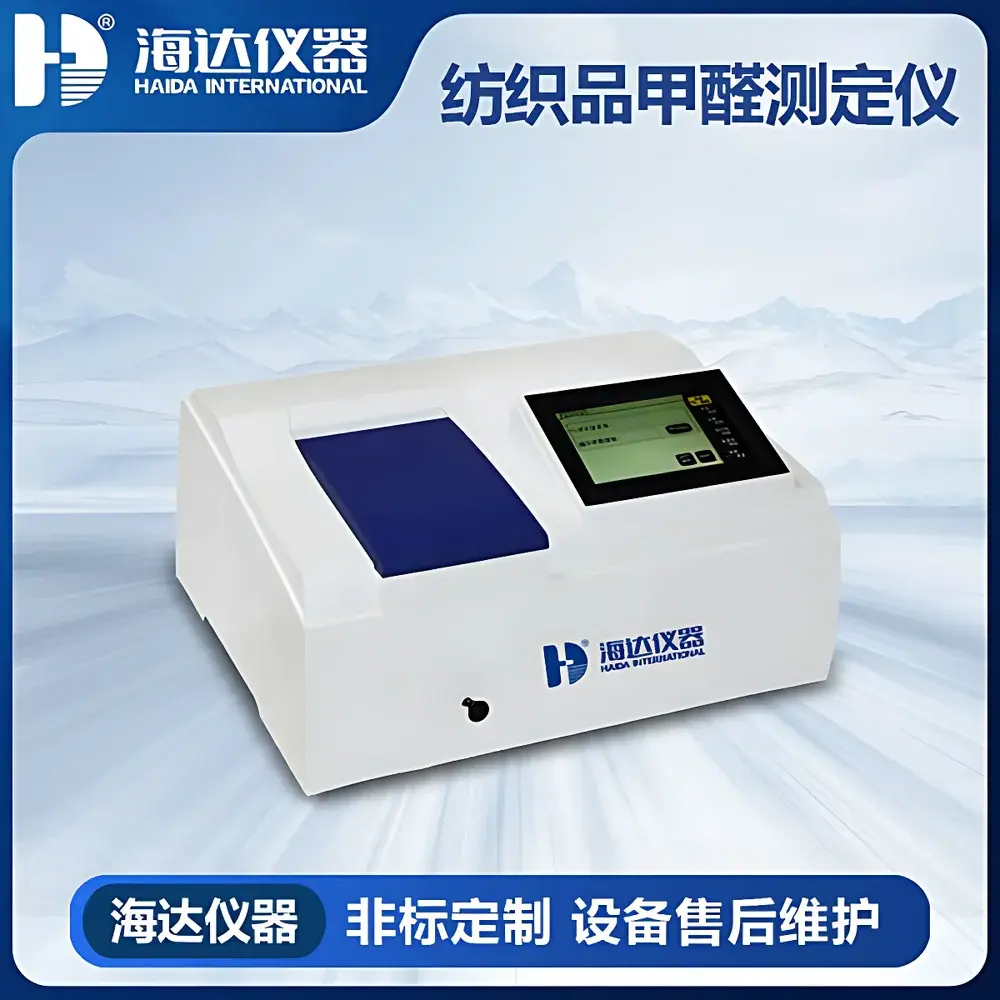
HAIDA HD-D008 Textile Formaldehyde Analyzer
| Brand | HAIDA INTERNATIONAL |
|---|---|
| Origin | Guangdong, China |
| Manufacturer Type | OEM/ODM Manufacturer |
| Country of Origin | China |
| Model | HAIDA HD-D008 Textile Formaldehyde Analyzer |
| Pricing | Upon Request |
Overview
The HAIDA HD-D008 Textile Formaldehyde Analyzer is a dedicated spectrophotometric instrument engineered for the quantitative determination of free and hydrolyzable formaldehyde in textile materials. It operates on the principle of acetylacetone colorimetry (chromotropic acid method per ISO 14184-1), where formaldehyde reacts with acetylacetone under acidic conditions to form a yellow chromophore measurable at 412 nm. This method is fully aligned with internationally recognized regulatory testing protocols for consumer textile safety, including GB/T 2912.1–2009 (China), ISO 14184-1:2014 and ISO 14184-2:2014 (Textiles — Determination of formaldehyde — Part 1: Free and hydrolyzable formaldehyde (water extraction method); Part 2: Release of formaldehyde (vapor phase method)), AATCC Test Method 112–2022 (Formaldehyde Release from Fabric), and GB/T 18401–2010 (National Basic Safety Technical Specifications for Textile Products). The analyzer delivers trace-level detection sensitivity suitable for Class A (infant wear), Class B (direct skin contact), and Class C (non-direct contact) compliance verification in quality control laboratories.
Key Features
- 5-inch high-contrast LCD graphical display with intuitive icon-based navigation and real-time status feedback during assay execution.
- Integrated thermal printer enabling immediate hard-copy output of test results, calibration records, and operator metadata—supporting audit-ready documentation per GLP and internal QA procedures.
- Five operational modes: Photometric (fixed-wavelength absorbance), Wavelength Scan (190–1100 nm range), Quantitative Analysis (with coefficient entry, single-point calibration, and multi-point calibration options), Kinetic Measurement (time-resolved absorbance tracking), and Multi-Wavelength Analysis (up to 10 user-defined wavelengths).
- Optical path optimization via cuvette pairing function—automatically compensates for inter-cuvette transmittance variation in photometric and quantitative modes, reducing systematic error by up to 0.8% absorbance units.
- Auto-zero and auto-full-scale calibration routines performed prior to each measurement cycle, ensuring baseline stability and minimizing drift across extended operation sessions.
- Triple-sample measurement chamber design allows simultaneous analysis of three textile extracts—enabling rapid batch evaluation without manual repositioning or sequential readouts.
Sample Compatibility & Compliance
The HD-D008 accepts aqueous extracts prepared according to standardized extraction protocols: GB/T 2912.1 specifies 65°C water extraction for 60 minutes; ISO 14184-1 mandates identical conditions for free formaldehyde, while ISO 14184-2 requires vapor-phase collection using sealed jars and desiccator-based trapping. Sample volumes range from 1.0 to 5.0 mL, compatible with standard 10-mm optical path quartz or high-quality optical glass cuvettes. All measurement workflows comply with ISO/IEC 17025:2017 requirements for analytical competence, and data integrity supports alignment with FDA 21 CFR Part 11 when paired with validated LIMS integration (via RS-232 or USB virtual COM port).
Software & Data Management
The instrument firmware includes embedded data logging with timestamped storage of up to 1,000 test records—including absorbance values, calculated concentrations (mg/kg), calibration coefficients, operator ID, and environmental temperature/humidity tags (when external sensor connected). Export is supported via USB flash drive in CSV format for traceability and statistical process control (SPC) analysis. While the base unit does not include PC software, HAIDA provides optional Windows-compatible application (HD-DataLink v3.2) supporting automated report generation compliant with ISO 17025 Annex A.2 and enabling electronic signature capture for GMP-aligned release testing.
Applications
- Pre-shipment QC screening of woven/knitted fabrics, garments, and home textiles for formaldehyde compliance against regional regulatory thresholds (e.g., ≤20 mg/kg for infant products under GB/T 18401).
- Supplier qualification and incoming raw material verification in vertically integrated apparel manufacturing facilities.
- Method validation and routine monitoring in third-party testing laboratories accredited to CNAS (China National Accreditation Service) or ILAC-MRA signatory schemes.
- Research applications involving formaldehyde scavenger efficacy evaluation and finishing chemistry optimization.
- Supporting sustainability audits requiring formaldehyde-free claims verification per OEKO-TEX® Standard 100 or ZDHC MRSL Level 3.
FAQ
What extraction method is required prior to analysis on the HD-D008?
Aqueous extraction per GB/T 2912.1 or ISO 14184-1 is mandatory; vapor-phase extraction per ISO 14184-2 requires separate sample preparation using sealed jars and subsequent liquid trapping.
Does the HD-D008 support calibration traceability to NIST standards?
Yes—calibration verification can be performed using certified formaldehyde reference standards traceable to NIST SRM 1960 or equivalent national metrology institutes.
Can the instrument store calibration curves for multiple textile types?
Up to five independent calibration sets (including slope, intercept, and correlation coefficient) may be saved and recalled by user-defined label.
Is the thermal printer compatible with continuous label stock?
No—it accepts only standard 57 mm wide thermal paper rolls with automatic paper-end detection and low-paper alert.
What maintenance intervals are recommended for long-term optical stability?
Lamp intensity verification every 200 hours of use; full optical alignment and wavelength accuracy check annually or after instrument relocation.
Related Products



